If you work full-time, studying for the CPA Exam can feel like having a second job. You finish work, eat dinner, handle a few chores, and suddenly it’s bedtime.
Spending 300 hours per section studying resulted in an increase in the likelihood of passing the CPA exam.
But when are you supposed to fit that time in to study?
The answer isn’t to squeeze hours of studying into every spare minute. Instead, you need a CPA study schedule that works with your real life.
A good plan helps you use your limited time well. It also gives you room for work, rest, and the occasional evening when you just don’t feel like looking at another accounting question.
Key Takeaways
- Plan Around Work: Build your study time around your actual work schedule.
- Use Small Blocks: Short, regular study sessions can make busy weeks easier to manage.
- Set One Exam Goal: Focus on one CPA section at a time.
- Practice Often: Mix learning with multiple-choice questions and task-based simulations.
- Stay Flexible: Adjust your plan when work or life gets in the way.
Understand the CPA Exam Before You Plan
Before you build a CPA study schedule, you need to know what you’re preparing for. The Certified Public Accountant (CPA) Exam has four sections, each of which is 4 hours long.
You must take the three Core sections—AUD (Auditing and Attestation), FAR (Financial Accounting and Reporting), and REG (Taxation and Regulation)—and choose one Discipline section: BAR (Business Analysis and Reporting), ISC (Information Systems and Control), or TCP (Tax Compliance and Planning).
You must pass all with a minimum score of 75. The exam also uses multiple-choice questions (MCQs) and task-based simulations (TBSs).
The AICPA’s 2026 Blueprints show how content is organized and how items are weighted for each section. That’s useful when planning your study time. Don’t just divide your time evenly across every topic. Use the CPA Exam Blueprints to see what each section covers and where you need more work.
Consider Taking a CPA Prep Course
If you’re working full time, a CPA prep course can make studying more manageable. Instead of building your entire study plan from scratch, you can use a course to guide you through the material and help you stay on track.
A good CPA prep course can give you structured lessons, practice questions, and progress tools in one place. That can save you time when your work schedule is already packed.
Look for a course that fits your learning style, budget, and available study time. The right course won’t do the studying for you, but it can give your CPA study schedule some much-needed structure.
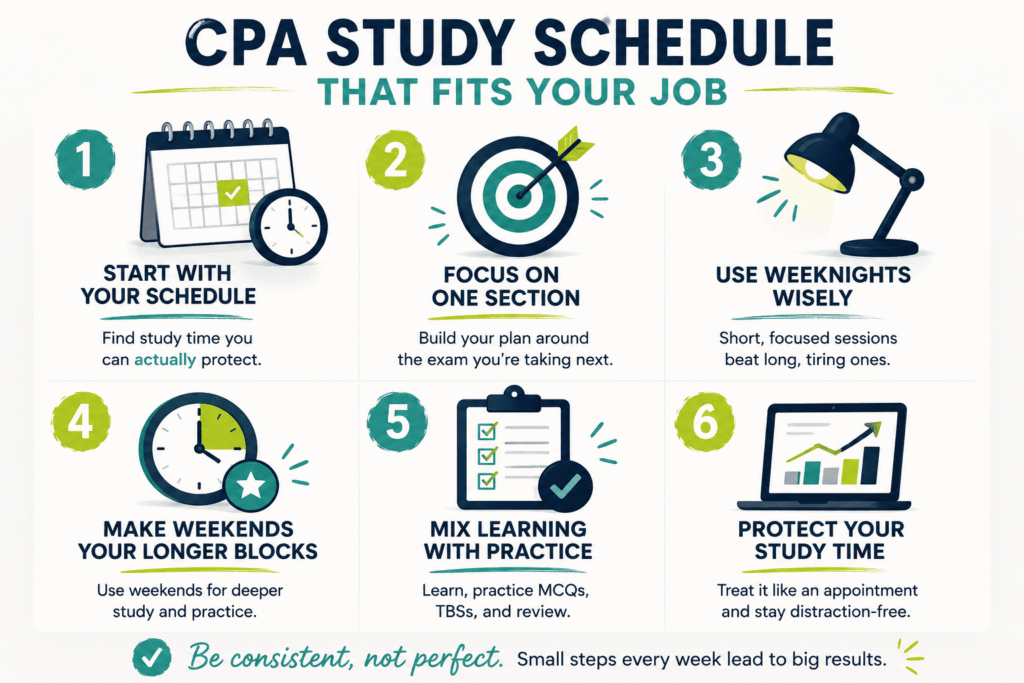
Start With Your Work Schedule
The first step is simple: look at your calendar.
Don’t start by deciding that you’ll study three hours every night. That might sound great on Sunday afternoon. By Wednesday, though, you may be staring at your textbook like it’s written in another language.
Instead, find the study times you can actually protect.
For example, your week might look like this:
- Monday: 60 minutes after work
- Tuesday: 60 minutes before work
- Wednesday: Rest or light review
- Thursday: 60 minutes after work
- Friday: Rest
- Saturday: Two to three hours
- Sunday: Two hours
This gives you regular study time without taking over your entire week.
Your schedule doesn’t have to look exactly like this. The goal is to find a pattern you can repeat.
Build Your CPA Study Schedule Around One Section
Trying to study for all four CPA sections at once can make your plan messy. A simpler approach is to focus your schedule on the section you’re preparing to take next.
Start by choosing your target exam date. Then work backward. For example, if you have 10 weeks before your exam, split that period into smaller stages:
Weeks 1–6: Learn the main topics and complete practice questions.
Weeks 7–8: Review weaker areas and increase practice.
Weeks 9–10: Take practice exams, review mistakes, and focus on areas that still need work.
The exact timeline will depend on your section, background, available time, and progress. There isn’t one perfect study schedule for every candidate.
Use Your Weeknights Wisely
After a full workday, your brain may not be ready for a four-hour study marathon. That’s OK. Use weeknights for focused tasks that don’t require huge blocks of time.
You might spend one evening learning a new topic. On another night, you could answer MCQs. A third session could focus on TBS practice or reviewing mistakes.
This approach can also make studying feel less repetitive.
I find that giving each session a clear purpose makes it easier to sit down and get started. “Study for the CPA” feels huge. “Complete 20 practice questions” feels much more manageable.
Make Weekends Your Longer Study Blocks
Weekends can give you more breathing room. If your work schedule is Monday through Friday, you may have more time for longer sessions on Saturday or Sunday.
But don’t automatically fill the whole weekend with studying. Instead, choose one or two longer blocks and protect your other time.
For example:
- Saturday morning: Learn and practice a major topic
- Saturday afternoon: Free time
- Sunday morning: Practice questions and review
- Sunday afternoon: Free time
Rest matters because you still need to work the next week. The CPA Exam isn’t going anywhere just because you take a few hours off.
Mix Learning With Practice
Reading study material for hours can feel productive. But your study plan should include practice, too. The AICPA’s CPA Exam Blueprints explain that the exam includes both multiple-choice questions (MCQs) and task-based simulations (TBSs).
That means your schedule should give you time to work with both types of questions.
A simple weekly mix could include:
- Learning new material
- Answering MCQs
- Working through TBSs
- Reviewing incorrect answers
- Revisiting weak topics
- Taking timed practice sets
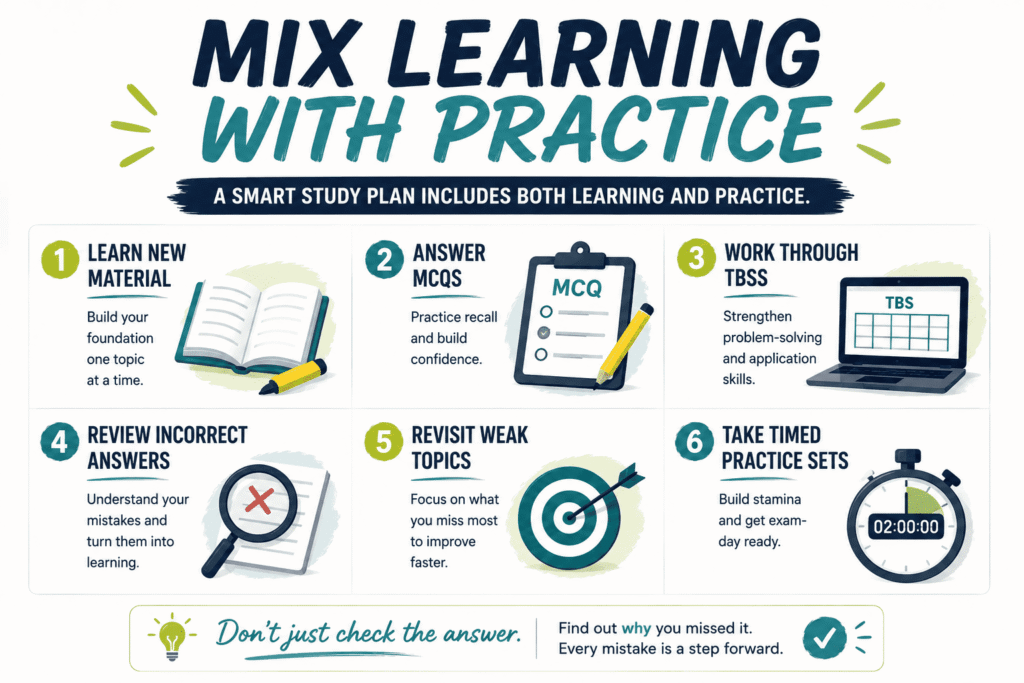
Don’t just look at the answer when you get a question wrong. Figure out why you missed it. That extra step can turn a mistake into a useful study session.
Protect Your Study Time
A study schedule only works if you actually follow it. Treat your study blocks like appointments. Put them on your calendar. Let your family or friends know when you’re studying. Keep your phone away if it keeps pulling your attention.
You don’t need a perfect study environment. You just need one where you can focus.
And if your workday runs late? Move the session instead of giving up on the entire week. Flexibility is part of a good plan.
Leave Room for Busy Workweeks
Full-time jobs don’t always follow the calendar. You may have a major project, a deadline, overtime, or a week where everything seems to happen at once.
That’s why your CPA study schedule shouldn’t depend on perfect attendance. Build in a lighter day each week. You can use it as a catch-up day or take it off if everything is on track.
You can also set a weekly study target instead of obsessing over daily numbers. For example, you might aim to complete a certain amount of practice or cover specific topics during the week. If Tuesday goes badly, Wednesday doesn’t have to become a three-hour punishment.
Track What You’re Actually Learning
Your schedule should change as you improve. At the end of each week, take a few minutes to review your progress.
Ask yourself:
- What topics did I finish?
- Which questions did I keep missing?
- Did I complete my planned study sessions?
- What should I change next week?
- Am I spending too much time on areas I already know?
The goal isn’t to make your calendar look impressive. It’s to make your study time useful.
The AICPA recommends using the Exam Blueprints to understand tested content, including content areas, skill levels, and item information. Use that information to guide your review instead of guessing what you should study next.
Schedule the Exam With Your Work in Mind
Your work calendar should also influence your exam date. Look ahead for busy periods at work. If your company has a major annual deadline, for example, you may not want your final study weeks to overlap with it.
Also remember that CPA Exam appointments are offered year-round through continuous testing, although appointment availability depends on individual testing centers. That gives you some flexibility when planning around a full-time job.
Before scheduling, also be sure to check the rules that apply to your jurisdiction.
Don’t Try to Make the Schedule Perfect
The best CPA study schedule isn’t the one with the most hours. It’s the one you can follow.
If you have a demanding job, you may need to study early in the morning. Someone else may do better after dinner. Another person may rely heavily on weekend sessions. There isn’t a magic number of hours that guarantees success.
Your goal is to create a routine that fits your job and gives you enough time to prepare properly. If you miss one session, don’t scrap the entire plan. Move on, adjust the next few days, and keep going.
Final Thoughts
When you study for the CPA while working full time, your schedule needs to fit your life—not fight against it.
Start by looking at your work calendar. Choose realistic study blocks, focus on one section at a time, and mix learning with practice. Leave space for rest and unexpectedly busy days.
Most importantly, give yourself a plan you can repeat. If you can build a CPA study schedule that keeps you moving forward without burning you out, you’re already making the process much more manageable.
For a realistic timeline while working, see our guide on how long to study for the CPA exam before you lock in weekly study blocks.
FAQs
How many hours should I study for the CPA Exam while working full time?
There isn’t one study-hour target that works for everyone. Your study time depends on the section, your background, your exam date, and how quickly you learn the material. However, it’s recommended that you dedicate around 300 hours per section, including doing practice questions and exams every week. Studying this much was correlated with better pass rates.
When is the best time to study for the CPA Exam if I work full time?
Choose the time when you can focus best and stay consistent. That could be before work, after work, or during longer weekend sessions.
Should I study for more than one CPA Exam section at once?
Focusing on one section at a time can make your schedule easier to manage. You can plan your next section after you have a clearer idea of your progress.
What should I include in a CPA study schedule?
Include time for learning material, multiple-choice questions (MCQs), task-based simulations (TBSs), reviewing mistakes, and revisiting weak areas. The AICPA CPA Exam Blueprints can help you understand what each section tests.
Can I work full time and still pass the CPA Exam?
Yes, working full time doesn’t prevent you from preparing for the CPA Exam. A realistic schedule, steady practice, and regular review can help you make progress while keeping your job. As a part-time student, it will just take you longer to prepare for the exams.



![Surgent EA CE Promo Code [Verified 2026 Discounts]](https://www.miamiherald.com/careers-education/wp-content/uploads/sites/2/2026/07/surgent-ea-ce-promo-code-1-1024x768.jpg)