Earning an accounting credential takes time, money, and hundreds of hours of study. Naturally, you want to know whether the investment will show up in your paycheck.
An Institute of Management Accountants survey found that accountants under 30 earned a median pay of $65,500 without either credential. Median pay increased to $80,000 for CMAs and $79,925 for CPAs.
Those numbers are almost identical, but they do not tell the whole story.
In my view, the better question is not simply which credential pays more. It is which credential has the most value in the type of accounting career you want.
Key Takeaways
- Career Direction Matters: CPA and CMA credentials lead to different types of opportunities.
- CPAs Often Have an Edge: The CPA can carry more weight in public accounting, audit, tax, and client-facing work.
- CMAs Can Earn Strong Salaries: The CMA aligns well with corporate finance, management accounting, and strategy roles.
- Experience Still Counts: Industry, location, job level, and management responsibilities can affect pay more than the credential alone.
- Holding Both Can Pay Off: Accountants with both credentials reported the highest median compensation in the IMA survey.
The Higher-Paying Credential Depends on Your Career Path
There is no universal salary attached to either credential. A CPA working for a small local firm may earn less than a CMA serving as a finance director at a large company. A CPA partner, however, may earn considerably more than either one.
Job responsibilities matter more than the letters alone.
The CPA often creates more opportunities in public accounting, audit, tax, compliance, and financial reporting. The CMA is typically more connected to corporate budgeting, forecasting, cost management, financial analysis, and internal decision-making.
That means your likely salary depends partly on which professional track you enter after earning the credential. For a full breakdown of requirements and exam differences, see our CPA vs. CMA comparison.
Where CPAs Tend to Have the Edge
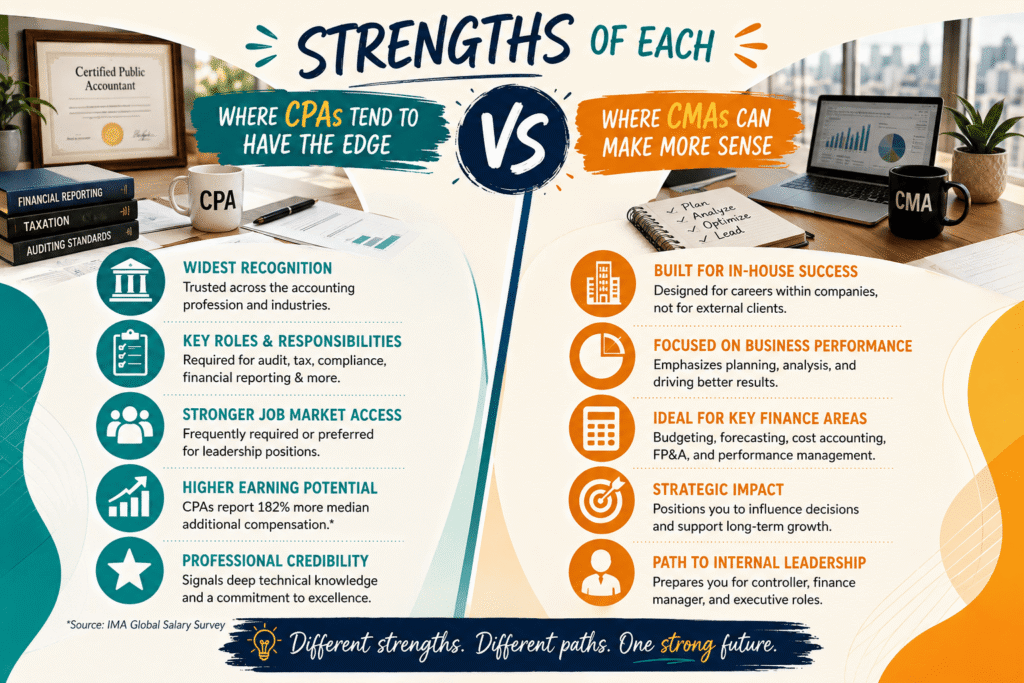
The CPA generally offers the widest recognition across the accounting profession. It can be especially valuable if you want to work in:
If the CPA path fits your goals, compare our best CPA review courses before you commit to the exam.
- Public accounting
- External audit
- Tax preparation or planning
- Regulatory compliance
- Financial reporting
- Accounting firm leadership
- Controller or chief financial officer positions
Certain accounting responsibilities can only be performed by properly licensed CPAs. That distinction gives the credential additional weight with accounting firms, government agencies, clients, and employers.
The CPA may also provide access to a larger overall job market because employers frequently list it as required or preferred for senior accounting positions. Even when the role does not legally require a CPA, companies may use the credential as evidence of technical accounting knowledge and professional commitment.
The potential downside is that CPA earnings can vary considerably. Entry-level public accountants may work long hours without immediately receiving a large salary premium. The strongest financial benefits may appear later, after the credential helps someone move into management, partnership, consulting, or executive leadership.
Where CMAs Can Make More Sense
The CMA may offer stronger career alignment if you plan to work inside a company instead of serving external accounting clients.
For the management accounting route, start with our guide to the best CMA review courses.
It is particularly relevant for positions involving:
- Corporate finance
- Management accounting
- Budgeting and forecasting
- Cost accounting
- Financial planning and analysis
- Performance management
- Operational strategy
- Internal financial leadership
Companies need professionals who can interpret financial information and use it to support business decisions. The CMA can signal that you understand how accounting connects with strategy, performance, and operations.
The IMA survey found that accountants under 30 with a CMA earned median pay of $80,000. That was slightly higher than the $79,925 reported by professionals in the same age group who held only a CPA.
The difference was just $75, so it would be a mistake to conclude that the CMA automatically pays more. Instead, the figures show that the CMA can compete closely with the CPA when it is applied to the right career track.
I would give the CMA serious consideration if your next step involves financial analysis, corporate management, or internal strategy rather than public accounting.
The Pay Gap Is Not Only About the Letters
A credential may help you qualify for better opportunities, but it does not control your salary by itself.
Your earnings can also depend on:
- Years of experience
- Geographic location
- Employer size
- Industry
- Management responsibilities
- Technical specialization
- Bonuses and profit sharing
- Ability to change employers or negotiate
The IMA data illustrates the importance of experience. Mid-career accountants without either credential reported median pay of $101,500. Those holding both the CPA and CMA reported median pay of $156,250.
That is a $54,750 difference, but the credentials may not be the only reason for it. Professionals who earn both designations may also be more likely to pursue leadership roles, manage teams, or work in organizations with higher compensation.
Salary data can show an association between certification and earnings. It cannot guarantee that earning a credential will immediately increase your pay by the same amount.
The credential becomes more valuable when it helps you move into a better-paying position.
Which Credential Has Better Long-Term Upside?
The CPA may have the advantage in overall flexibility. It is widely recognized, supports several established accounting career paths, and may be required for particular professional responsibilities. It can also remain valuable if your career direction changes. Someone may begin in public accounting, move into corporate reporting, and later pursue a controller or CFO role.
Still weighing credentials? Read our CPA vs MBA guide to compare long-term career upside.
The CMA has strong long-term potential for professionals committed to corporate finance and management. Its value may increase as you move from preparing financial information to using it for planning and decision-making.

The IMA survey found that professionals with both credentials reported median pay of $97,250 before age 30. That was substantially higher than the median reported for those holding only the CPA, only the CMA, or neither credential.
Earning both could make sense for someone pursuing senior financial leadership. However, it requires more time, money, and continuing professional education. I would not recommend collecting credentials without a clear career reason.
One credential that directly supports your next promotion may be more valuable than two credentials you never use.
How to Choose Based on Your Next Job
Start by reviewing actual job postings for the role you want next. Do not search only for general accountant positions. Look at the qualifications for jobs such as auditor, tax manager, financial analyst, accounting manager, controller, finance director, or CFO.
Then notice which credential employers request.
Choose the CPA if your target jobs frequently involve public accounting, tax, audit, compliance, or external reporting. Choose the CMA if your target roles focus on budgeting, forecasting, cost management, financial analysis, or internal business strategy.
You should also consider the professional network surrounding each credential. If the firms and leaders in your area strongly prioritize the CPA, that recognition may improve its local value. If you work for a company that promotes CMAs into management roles, the CMA may deliver a faster return.
The best credential is the one connected to a specific job, promotion, or career transition, not simply the one with the most familiar name.
Final Thoughts
CPA and CMA salary figures are close enough that I would not choose between them based on one median pay statistic.
The CPA tends to provide broader recognition and more options in public accounting, audit, tax, and financial reporting. The CMA can be highly valuable in corporate finance, management accounting, and strategic decision-making.
Both credentials can increase your earning potential. The larger payoff usually comes from using the credential to enter a higher-paying specialty, earn a promotion, or move into leadership. Before enrolling, identify the job you want next. Then choose the credential employers already value for that position.
FAQs
Does a CPA usually earn more than a CMA?
Not necessarily. CPA and CMA salaries vary by job, industry, location, and experience. The CPA may provide access to a broader range of accounting roles, while the CMA can lead to strong earnings in corporate finance and management.
Is a CMA worth it if I already work in corporate accounting?
It may be. The CMA aligns with budgeting, forecasting, cost management, financial analysis, and internal strategy. Its value will be strongest if your employer prefers it for promotions or leadership roles.
Is a CPA better for becoming a CFO?
A CPA can be valuable for CFO roles involving reporting, compliance, audit, and investor responsibilities. A CMA can also support a CFO path focused on planning, operations, and business strategy. Some professionals earn both.
Do accountants with both credentials earn more?
In the IMA survey, professionals holding both credentials reported higher median compensation than those holding only one or neither. However, experience, seniority, and job responsibilities may also contribute to that difference.
Should I earn both the CPA and CMA?
Earning both may be useful for senior finance or accounting leadership, but it is not necessary for every career. Start with the credential that best supports your next job, then decide whether a second one would add meaningful value.




![Surgent EA CE Promo Code [Verified 2026 Discounts]](https://www.miamiherald.com/careers-education/wp-content/uploads/sites/2/2026/07/surgent-ea-ce-promo-code-1-1024x768.jpg)