
Are Miami-Dade Schools sharing the wealth from $1.2 billion school improvement project?
The Miami-Dade school district is nearly halfway through a massive $1.2 billion school improvement project and a new report shows gains from past efforts at giving minority-owned firms a fairer share of the work.
Of the nearly $400 million awarded to primary contractors over the past four years for school construction and remodeling projects, the bulk of it has gone to businesses the district classifies as minority-owned — around 55 percent to Hispanic businesses and 9 percent to African-American businesses, according to a recent memo sent to the School Board.

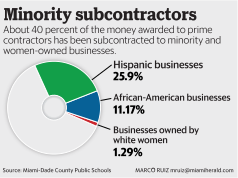
Roughly a quarter of the money awarded to lead contractors has been subcontracted to Hispanic-owned businesses and 11 percent to African-American owned businesses, according to the memo. Between 1 and 3 percent of spending in each category has been awarded to businesses owned by white women.
“It’s definitely encouraging,” said Lisa Martinez, the district’s chief strategy officer, noting that companies owned by African Americans and other underrepresented groups had historically won a much smaller chunk of the contracts. A disparity study conducted before the start of the school improvement project found that between 2006 and 2012 no school district prime construction contracts had been awarded to African-American or women-owned businesses.
But some critics — including the chairman of the committee tasked with advising the School Board on issues involving small and minority-owned businesses — continue to question the district’s oversight of the contracts and the validity of the ownership claims of at least a few companies. There are also concerns that goals to hire local workers, particularly black ones, aren’t being met.
Voters approved a $1.2 billion bond referendum in 2012 to rebuild and repair aging school facilities. The school improvement project was promoted as a boon for local businesses and the School Board created policies to ensure that small and minority-owned businesses got a piece of the pie. School improvement projects include mandatory goals requiring contractors to hire small businesses, many of which are owned by minorities, for a certain percentage of each project.
Ronald Frazier, the chairman of the Small Business Enterprise Advisory Committee, said that right now there’s no way to be sure contractors are complying.
In a letter to the county’s Office of the Inspector General, Frazier said the school district has failed to produce a public disclosure report detailing project expenditures and has yet to fully implement procedures to verify how much money is being awarded to small and minority-owned businesses. An online system acquired in 2015 that would enable the district to verify whether contractors are meeting their mandatory goals is not yet fully in place.
In addition, some firms certified as minority- or women-owned small businesses don’t actually meet the criteria for that certification, Frazier said. He told School Board members in a letter that they should request an independent audit to determine whether fraud has occurred.
“You have a fiduciary responsibility as board members and it’s imperative that you exercise this responsibility to protect the integrity of the School Board, the school system and the [Small Business Enterprise] program,” Frazier said at the board’s July meeting. “I’m asking you to look at this very seriously.”
Several School Board members have also voiced concerns about oversight of the bond spending.
The recent school district memo came in response to a request from board member Dorothy Bendross-Mindingall, who in May asked for a report detailing the participation of small and minority businesses and local workers.
Bendross-Mindingall said that while the results reported in the memo are “encouraging,” they still need to be verified and audited. She said it’s also important to look at which minority groups are getting contracts, rather than considering minority participation as a whole.
The issue at hand is which minority groups are being represented in these business opportunities and which are not.
Miami-Dade School Board member Dorothy Bendross-Mindingall
“When we contextualize minority and small business participation in a majority minority county — it is not difficult to attain that goal,” she said in an email. “The issue at hand is which minority groups are being represented in these business opportunities and which are not.”
Board member Steve Gallon shares these concerns. He told the Miami Herald that he is “not prepared to fully accept” the figures in the recent memo because they “have not been independently validated or audited.”
“It is reasonable to expect that a system to fully track [bond] expenditures would have been contemplated and fully operational at the onset of a $1.2 billion bond program,” he said in an email. “It would also be a reasonable expectation that an annual audit of bond expenditures be conducted and submitted to the Board as we do with our district, schools and various district departments. The Board and public deserve and should expect nothing less.”
In its memo to the board, the district said the online Diversity Compliance System will be fully implemented by the fall and that an independent lawyer has been hired to review policies and procedures “to dispel questions” regarding the certification programs.
Board members aren’t the only ones asking questions. Miami-Dade’s Office of the Inspector General recently looked into small business participation figures after the school district reported that some primary contractors had used small businesses for 80 percent or more of their projects. After reviewing four projects, the Inspector General found that the percentages reported were accurate and that the companies had been able to exceed the established goals.
As for the public disclosure of bond expenditures, Deputy Chief Facilities Officer Ana Rijo-Conde noted that the district has an online portal with information about expenditures and provides periodic updates at meetings. “There are a number of ways in which expenditures are published and available to the public widely and easily,” she said.
The one thing everyone seems to agree on is that the school district is making an effort to spread the wealth.
One of the district’s goals has been to help small businesses grow. African-American small business owner Curtis Morrow has been able to expand his painting business, Curtis Painting and Waterproofing, from four employees to about 25 employees as a result of the school improvement projects. “It’s been phenomenal for my business,” he said.
Other minority-owned small businesses have grown enough to graduate from one category to the next and are now able to compete for larger projects.
But efforts to meet other goals — like ensuring contractors hire local workers — have hit some road bumps.
Contractors are supposed to hire workers from the neighborhood around the project site when possible, but when Gallon visited a work site at Miami Gardens’ Norland Elementary in March, he noticed that there were no African-American workers present. This finding underscored concerns that contractors may not be complying with project requirements.
“We have a big responsibility to ensure that there’s compliance in a very positive way,” said School Board member Lubby Navarro. “We’re accountable to the people. We want to make sure that there’s a lot of transparency and accountability, like with everything we do.”
Kyra Gurney: 305-376-3205, @KyraGurney
This story was originally published July 21, 2017 at 7:30 AM with the headline "Are Miami-Dade Schools sharing the wealth from $$1.2 billion school improvement project?."