Stephen Ross built a towering success in NYC. He’s trying to build another with Dolphins
Stephen Ross’s yacht-length SUV with the blacked-out tinted windows pulls up to the Equinox Hotel in midtown Manhattan and the driver rushes to open the passenger door while a doormen unfurls an umbrella to cover the arrival from the morning’s soft drizzle.
There’s a rush of activity now. Tall men with earpieces that were nowhere to be seen a moment ago are suddenly in the vicinity. There’s a lot of glad handing. It’s as if royalty has arrived at this new metropolis on New York’s west side called Hudson Yards.
Ross built this place — all 18 million square feet. It’s his vision.
He audaciously covered acres of the unsightly Long Island Railroad yard with a $1 billion platform — as the trains were running — and then constructed a sprawling, towering neighborhood atop that platform. And now these towers dwarf the downtown area of most U.S. cities by comparison.
“The business district here,” Ross notes, “would probably be the equivalent to the fifth largest city in the United States.”
Ross is treated like a celebrity here. Within five minutes of his arrival, a hotel guest asks to get a photo with him. But the Ross name is nowhere to be found on the project. It’s not on any building. Not on any literature.
“Why?” Ross says, repeating a visitor’s question, “because it’s about a team. It’s not about one person. People like to work together as a team, not for someone.”
Stephen Ross has learned a lot about teams the past decade. He started the $15 billion first phase of this project about a decade ago when he won the rights to build. That’s about the same time he took over as the third owner in the Miami Dolphins’ storied history.
And while Hudson Yards already enjoys success and acclaim, the Dolphins have mostly languished.
Ross knows this. And as he spends the day at his burgeoning project-come-to-life — on a walking tour, inspecting the site, in meetings — he also has his sights set on raising the Dolphins to equal acclaim and stature in their respective domain.
“Long-term thinking,” Ross says. “That’s what you need to win in anything in life. If you think short-term, you might have immediate gratification, but it’s not going to last. I’m a developer. I have long-term vision. You have to have long-term vision on a project such as this.
“I’m looking to do something that’s going to last with the Dolphins so that we win year in and year out. And I have patience, which you guys questioned — because most people don’t. They can’t take the pressure. Everything is for immediate gratification.”
Lose today, win tomorrow
The Dolphins’ 2019 season — painful as it has been with a 3-10 record — is about resisting the desire to win today for a promise of winning tomorrow and for a long time to come.
“I finally was fed up with the common NFL jargon of, ‘Hey, with a good draft and a few free agents we can turn things around.’ That ain’t gonna happen,” Ross says. “You got to build it from the base and create the culture. I think our team has a different culture now. It’s on the way to developing.
“It doesn’t happen overnight. When you see the team fight the way they are, with the no-names, you got something special potentially. You still have to hit on the right draft picks but something is going right.”
Ross believes the Dolphins must address one of the major problems they’ve been unable to overcome for two decades: Finding a great quarterback.
The other issue that’s held the Dolphins back, Ross believes, is having a great coach. But the club’s owner believes that problem is already solved.
“There’s two things,” Ross says, “Coach and quarterback. We’ve got one. We’ll find out who the other is.”
Ross believes first-year coach Brian Flores is a keeper.
“He’s very impressive,” Ross says, “His is a great story. It tells you who he is. I think I have the coach.”
The Dolphins don’t have the quarterback and Ross mentions the need for a great one multiple times. So the team is a project far from completion.
This phase of Hudson Yards, meanwhile, is much further along, save for the $4 billion edifice Ross and Related president Bruce Beal Jr. are still constructing across the street from the Equinox hotel, and the second phase of the project that will cost another $10 billion and raise the total cost of Hudson Yards to $25 billion.
Beal, who began working for Ross in 1995 at age 25, is running the day-to-day work at Hudson Yards. And in his spare time he’s proudly a Dolphins fan, which is a good thing because in 2016 the NFL approved a succession plan that would give Beal the right of first option to purchase the Dolphins if Ross passes away or decides to sell.
Beal has worked side-by-side with Ross on the Hudson Yards construction, he’s with him on this tour, and he shares Ross’s passion for seeing the Dolphins rise to heights that rival the Related Company’s buildings.
“We had an incredible team on this project,” Beal says. “He [Ross] doesn’t like to talk about it too much but Related really is one family — which makes senses because it’s called Related. We have created the best team. Or he did. And when you’re thinking about team creation, this is what we need on the professional sports level, too.
“Look, one person didn’t build this. We had four to five thousand people a day working construction — just construction. Not to mention the architects and planners, consultants, lawyers and financial folks.
“And the only way you can bring it together is coordinating and having a good team. So he knows how to get that done. That’s why I believe, as his partner, we can translate that into a professional football team that will consistently win and be a successful franchise over and over again.”
A business sense
Ross started Related when he was 49. “I started the company from scratch by myself and bootstrapped it,” he says.
And as it was getting off the ground, Ross found aggressive, passionate people who had expertise in different areas. Once on board, he let them do their thing. And that’s exactly how he’s handling the Dolphins.
He’s hired two young head coaches in his time. He’s hired and promoted a young general manager in Chris Grier, who oversees the football operation and has made moves this year to bring five first-round picks to the team the next two offseasons. Club president and CEO Tom Garfinkel was experienced and accomplished in Major League Baseball, NASCAR, IndyCar and Grand-Am racing before he joined the Dolphins and remade what is now Hard Rock Stadium.
But that faith in young, sometimes unproven men comes with responsibility.
“He gives his employees a long leash,” one associate says, “then tells them not to use it to hang themselves.”
“You try to hire the best people,” Ross says. “Football is a lot more sophisticated than most people think it is and you’re only as good as the people you hire. That’s true everywhere, right? It’s like I’m not going to be the architect or engineer for a building. Because I’m not trained in that. So I hire an architect or engineer. The same thing with football, it’s who you hire and then you have to rely upon them. That doesn’t mean you don’t have input. But you have to focus responsibility.”
Beal was one such addition in 1995. And having succeeded to the point he is the Dolphins’ owner-in-waiting, he’s in agreement with Ross’s views on team building. And one of those is free agency is not the way to build.
“I started with him when I was 25,” Beal says. “Our other partner Jeff [Blau] started right out of college. We had so many young people come in and you home grow them. You can translate that onto a football team. Because what’s better than home grown talent?
“Yes, you need free agents sometimes but that’s more challenging because you don’t know what you’re getting. We had some big free agents we hired or signed over the years, but did that turn into a championship?”
Ross has learned a lesson about free agency. And although the Dolphins will have between $110 million and $120 million in salary cap space next offseason, more than any other team, the owner’s philosophy for free agency sounds different than it has been in the past.
“In sports you bring somebody in, a superstar, you hope it elevates everyone else,” Ross says. “But then you got to find people who really want to do it as a team and it’s not about themselves ... and that’s what the coach and the scouting department have to look for.
“It’s about a team. We want people that will want to work together. It’s not about them. We need them to sacrifice for what it takes to win. A guy can have all the ability in the world, but he puts in that extra because it’s more about winning than about himself.
“Those are guys with the hearts of champions.”
For the next hour Ross proudly shows off Hudson Yards. The hotel is the first of its kind in that Equinox is a brand Ross basically birthed. It specializes in the guest’s health, wellness, sleep, physical activity and nutrition.
In a city where iconic properties such as the Waldorf-Astoria and The Plaza represent the grand traditions of yesteryear, this place is very modern, with interactive activity screens and the latest equipment and finishes.
“We’re cool and hip,” Ross says. “I’m not. But they are.”
The Equinox hotel boasts a 60,000-square foot gym. Ross, who does 25-30 minutes of cardio every day, says he went to other hotel gyms and was often disappointed because “it was basically a room.” His gym is rows upon rows of weight sets, cardio machines, massage tables, sauna pods, a swimming pool, spa, and a room for workout classes.
“Look at the level of the equipment and you can see the finishes for yourself,” Ross says, “It’s not an exercise room in a hotel.”
Ross’ project
Ross involves himself in every aspect of this project. He helps pick the finishes, the artwork, all of it. And midway through this walk-thru, he notices one custom-cut glass table top is not 3/4 inches thick as he wanted it. So he spends five minutes making sure that is addressed.
Beal spys a cord that should be hidden behind a molding and points that out as wrong.
“We make mistakes,” Beal says looking at a set of doors leading to the Hudson Yards plaza. “I’ll give you an example: This frosted glass, we thought it was a good idea. It’s not a good idea at all. So we had to replace all the glass, which is expensive.
“So when we make mistakes, we correct. We made a couple of million-dollar mistakes on the Vessal. We got stairs and the textures of the stairs was too rough and it was going to skin knees because you’ve got kids running up the stairs. So we had to go back and replace all the stairs. When you make a mistake, you have to own it, fix it, pay for it, and move on.”
Sounds like the Dolphins in many respects.
Ross does not accept compliments easily, Beal says. And it’s true. He deflects praise for making Hudson Yards the impressive mini-city it is.
“When you’re doing it day to day and building each piece you look at it differently,” Ross says. “You just have to focus on the details and getting it done and seeing where all the issues are. Then when you sit back and look at the big picture, that’s a different story.
“You have to have the big picture to start with. Then you have to forget about that and hone in on every detail — making sure that it gets done and it works and you have a team that can execute. It’s like anything else. It’s the same as sports.”
This Ross tour includes a walk to the “Vessal” — a six-story artwork in the middle of the plaza — and then he points out how the “Shed” art center is set on wheels that roll the building’s luminescent outer shell into the adjoining tower to reveal a totally different looking building.
It is about his legacy
But soon Ross is talking about more important things. Like how projects such as this and, yes, his work with the Dolphins will write his legacy.
“I look at this as wanting to do something special that will certainly outlast me,” Ross says. “The pleasure of doing that and the challenge of doing and being the best you can possibly be is what really motivates me.
“Whatever I do. Every company we have, everything we do, we’re the best in class. That’s what we strive for. We want people working together as a team. One guy can’t do it. I had a vision and I worked with other people, taking in their thoughts. It’s not just about me, but it’s about bringing it all together and setting the purpose of what we’re doing and what we’re trying to accomplish.”
And with the Dolphins?
“I’ll be judged by how many Super Bowls,” Ross says. “That’s what really counts — won-loss percentage. The fact is you go to our stadium and I think it’s the nicest stadium in the world and I’m looking for people to say, ‘Hey this is where I want to be and want to go.’
“But I know the most important thing is winning.“
Hudson Yards is already a success. It has detractors but it’s an in-your-face accomplishment. The Dolphins?
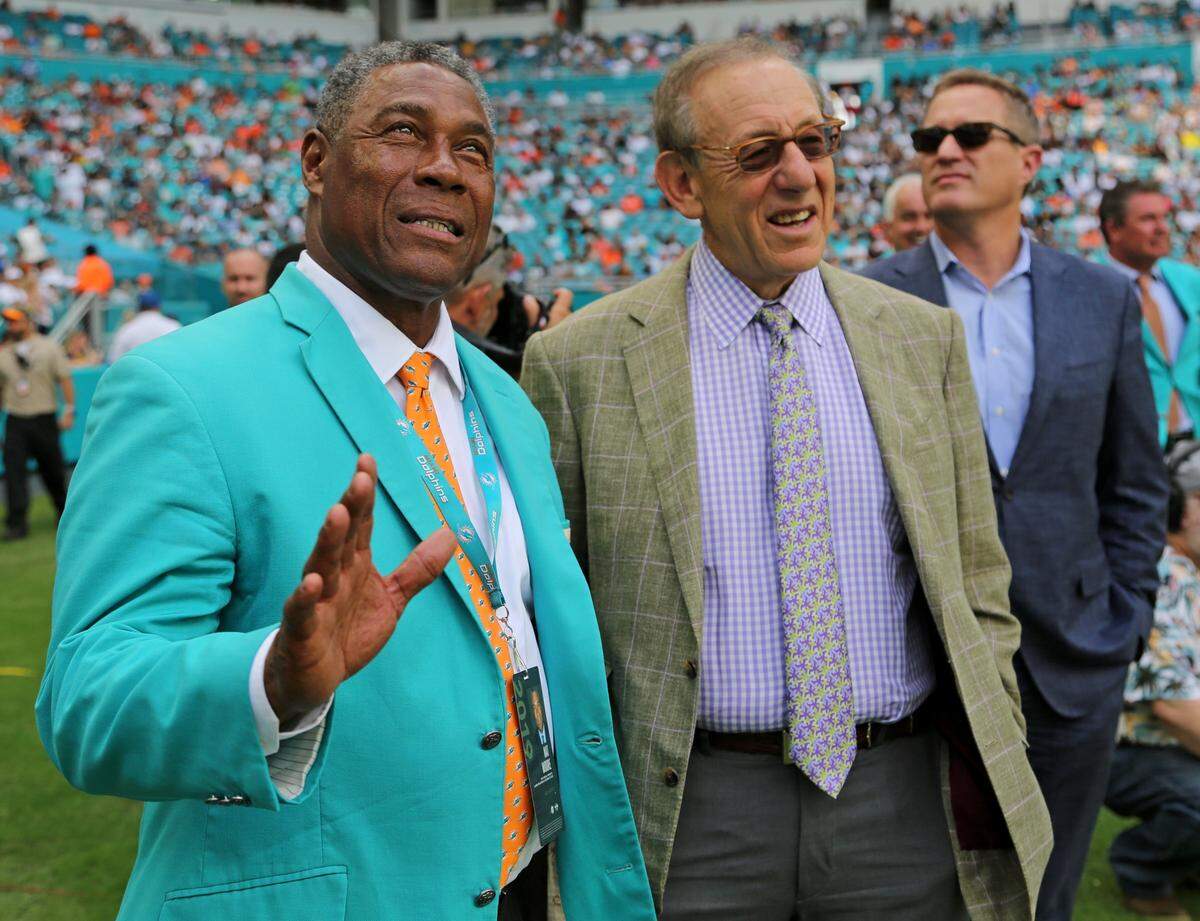
Ross acknowledges that the union fights, construction challenges, architectural problems and other troubles he faced at Hudson Yards don’t rival the struggle of building a great NFL team.
“It’s harder to build a world champion football team,” Ross admits. “Here, I can do what I want to do, hire who I want to hire and I can assemble the team I want to. But there’s so many rules in the NFL, you have to be lucky and despite all the work you do with your preparation and scouting for the draft, you can never be sure.
“And it depends so much on one or two people — having the right coach, the right quarterback and not having injuries year in and year out.
“So you have to build culture in the organization and have people come here to win. I got to give the [New England] Patriots a lot of credit for what they’ve done. It’s incredible. Think about it, in a system where everybody’s equal, they win consistently. And sure, the quarterback certainly helped and they have a great coach. It’s an awesome combination.
“I think I have the coach. Now it’s a matter of going into the draft and identifying that quarterback. That’s the work that has to be done.”
This story was originally published December 12, 2019 at 3:25 PM.