
At this point, the Panthers’ power play is a ‘concern.’ The numbers behind the struggle
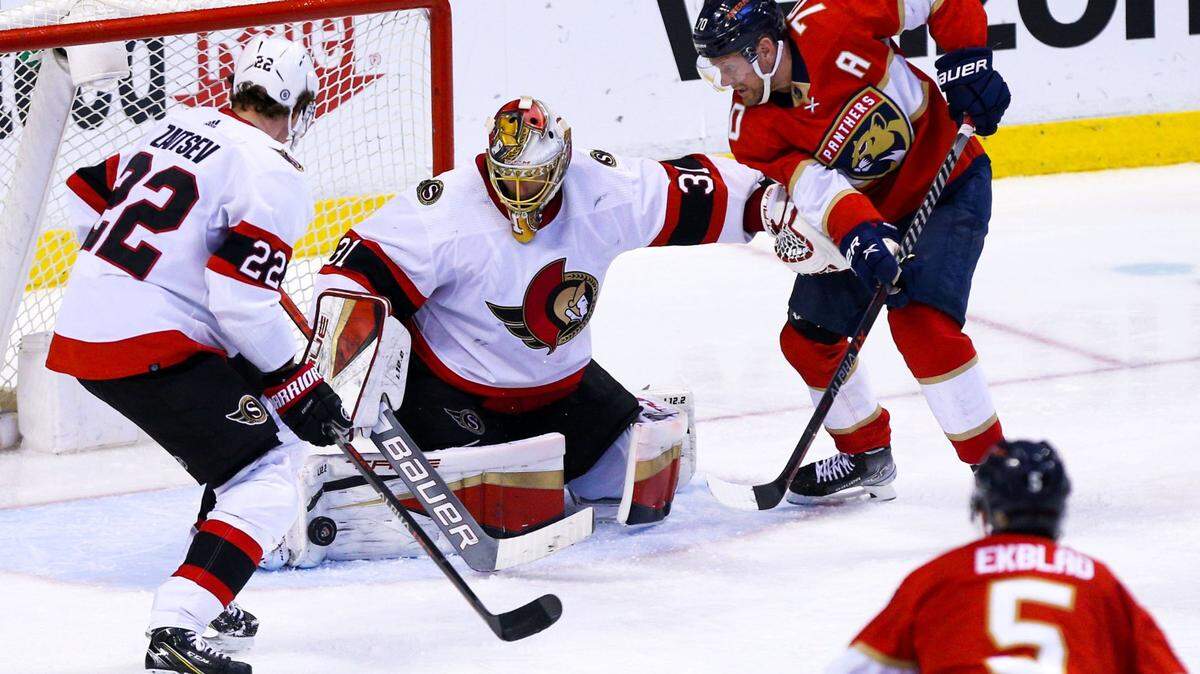
It was on full display again Tuesday night.
The Florida Panthers’ power play failing to generate scoring chances, one of the most high-octane offenses in the National Hockey League struggling with the man advantage.
Their scoring prowess at even strength this season has helped mask the weakness — Florida is third in the league with an average of 3.64 goals per game.
But on a night like Tuesday, a night they lost 8-2 to the Ottawa Senators at home, their power-play problems bubbled to the forefront.
The Panthers went 0 for 6 on the power play, putting up just nine shots on goal in the almost 12 minutes they had at least one extra skater on the ice (including one shot in the 27 seconds in which they were playing five-on-three in the third period).
“It doesn’t feel good, for sure,” defenseman Aaron Ekblad said. “We’ve got to find a way to find confidence and play well with the puck. We know we can do it 5-on-5. I don’t know what it is. Personally, I think I can be a lot better on the power play, and I’ll leave it at that.”
But this isn’t just a one-game blip.
On the season, Florida has scored goals on just 17.6 percent of their power-play opportunities — 16 goals on 91 chances. That puts them 20th in the league through games played Tuesday.
And it’s not just that the Panthers aren’t scoring. They’re also struggling to get consistent and good looks.
According to Natural Stat Trick, an advanced hockey statistics website, the Panthers are averaging 46.11 shots on goal and 44.52 scoring chances for every 60 minutes they’re on the power play this season — both the eighth-lowest marks in the league. Their 15.9 high-danger chances per 60 power-play minutes are the sixth-worst in the league.
To make matters worse, the Panthers have also allowed four shorthanded goals so far this season — tied with the New York Islanders for the third-most in the league and trailing only the five given up by the Los Angeles Kings and New Jersey Devils.
“It’s a concern,” said interim coach Andrew Brunette, who remains in charge of coaching the power play after taking over head coaching duties in October. “It’s something we’ve kind of moved things around and we’re missing some guys personnel-wise, so it’ll be better when it needs to be better.”
The main guy missing over this latest stretch is Aleksander Barkov, the team’s star center and team captain who has been a staple on the team’s top power-play unit.
Since leaving early in the second period of Florida’s 6-1 win over the New York Islanders on Nov. 16, a 12-plus game stretch in which Barkov has played just one game, the Panthers are 6 for 44 on the power play — a meager 13.6 percent success rate.
They were converting on 21.3 percent of their power-play opportunities (10 for 47) prior to Barkov’s injury — still middle of the road but far better than their current production rate.
“It hasn’t really flowed,” Brunette said Tuesday. “Kind of getting stuck a little bit, and nights like tonight where we’re not particularly sharp, it looks worse.”
How exactly did it look Tuesday?
The Panthers were on the power play three times over the first 21:35 of the game. Three early chances to jump on an Ottawa team that had the third-worst record in the league.
Florida put just one shot on goal over those first three power-play chances — a Frank Vatrano wrist shot midway through the first period.
They put more pucks on the net in their ensuing three chances — eight more over five minutes and 33 seconds — but only had two high-danger chances in that span.
“You’re gonna go through some ups and downs,” forward Sam Reinhart said after the game. “I think tonight it was those first one or two battles early and then we’re just chasing from there. [We have to] focus on getting that in puck in control, simplifying a little bit, not try to do too much and ultimately not let that frustration creep into our 5-on-5 game.”
.JPG)