The short but complete Super Bowl history of the Kansas City Chiefs
The Kansas City Chiefs Super Bowl history was half the Super Bowl’s early, American Football League vs. National Football League era. Then, it stopped, to be restarted Sunday.
And, well, yeah, considering the Super Bowl, American Football League and the Chiefs (nee Dallas Texans) all have roots in the same place: the dreams of Lamar Hunt.
Hunt, a down-to-earth ultrarich twenty-something Texas oil heir, couldn’t get into the NFL game, so he founded the American Football League in 1960 with a bunch of other ultrarich guys (and New York Titans owner Harry Wismer). Hunt’s team was the Dallas Texans, which won the 1962 AFL title and promptly moved to Kansas City, leaving Dallas to the then-struggling NFL team.
Hunt played dealmaker and peacemaker to end the AFL-NFL war in 1966, a merging of the league’s that would include the first interleague game, the first AFL-NFL World Championship Game.
And that cumbersome appellation might still be used today if Hunt’s daughter didn’t have a bouncy Super Ball. Hunt made the leap from “Super Ball” to “Super Bowl.”
(In an alternate reality Earth, does College Football Playoff Executive Director Bill Hancock’s kid have that ball instead of Lamar Hunt’s? And, sports fans in that universe are in the middle of NFL World Championship Game Week, giddily approaching the 54th or 100th NFL World Championship Game weeks after LSU beat Clemson in Super Bowl VI?)
“Super Bowl” was in casual use for the first such game, in which Hunt’s Kansas City Chiefs represented the league he founded. It showed up officially on tickets for Super Bowl IV, the last time the Chiefs saw Super Sunday and the last game of Hunt’s AFL.
The results of those two games left dramatically different impressions of both the league and franchise.
SUPER BOWL I
GREEN BAY 35, KANSAS CITY 10
▪ Jan. 15, 1967
▪ Los Angeles Memorial Coliseum
▪ MVP: Green Bay QB Bart Starr
▪ Should’ve Been MVP: Green Bay WR Max McGee. Seven catches for 138 yards and two touchdowns, including the first and still perhaps coolest touchdown in Super Bowl history. All while hung over.
▪ Super Bowl Rank: 28th
Even the Big Daddy of U.S. sports had an infancy.
The crowd of 61,946 fell so far short of a sellout that fans were moved toward the middle of the Coliseum to create a full look for TV viewers.
Most football fans still considered the American Football League maybe better than minor league football, still not in the NFL’s league, literally or figuratively. For them, the season climaxed when Green Bay outlasted Dallas 34-27 in the thrilling NFL title game (not The Ice Bowl. That was the next year). A final series of mistakes by everyone from Dallas offensive lineman Jim Boeke to head coach Tom Landry left the Cowboys’ 2 yards short of the tying touchdown.
Both CBS and NBC broadcast Super Bowl I, but both used the camera shots and production of CBS, the NFL’s network. During the week, a fence had to be erected between the CBS and NBC trucks as the folks working for the NFL and AFL’s broadcast partners absorbed the energy of the interleague rivalry.
Kansas City got the honor of participating in this birth by going 11-2-1, then marching into two-time defending AFL champion Buffalo’s house and knocking the Bills’ mugs into the mud, 31-7, for the AFL Championship.
And when Green Bay arrived in Los Angeles, Kansas City cornerback Fred “The Hammer” Williamson bragged that his head shots (yeah, it was a different game back then) would send Green Bay’s wide receivers staggering back to the huddle, begging quarterback Bart Starr not to send them back into Williamson’s coverage.
Despite Williamson’s noise, Green Bay picked him as a weak spot on a defense with future Hall of Famers on the defensive line (Buck Buchannan), at linebacker (Bobby Bell) and safety (Johnny Robinson).
The head coaches’ pregame demeanors contrasted as sharply as their leagues. Some Chiefs trainers wore mouse ears that Chiefs coach Hank Stram bought at Disneyland to poke fun at criticism of the American Football League “Mickey Mouse league.”
Meanwhile, Green Bay’s Vince Lombardi smiled nervously, knowing his NFL peers felt the Packers must win this first official interleague game decisively.
It didn’t calm Lombardi when starting wide receiver Boyd Dowler got injured on the fourth play. In came hung over Max McGee, once a starter, now a little used backup, still a first-string partier. Yet, it was the 34-year-old McGee who made a one-handed, in-stride catch of a ball thrown behind him for the first Super Bowl touchdown, a 37-yard reception. The Packers took a 7-0 lead, but Kansas City tied the game with a 66-yard drive that ended in a 7-yard touchdown toss from Len Dawson to Curtis McClinton.
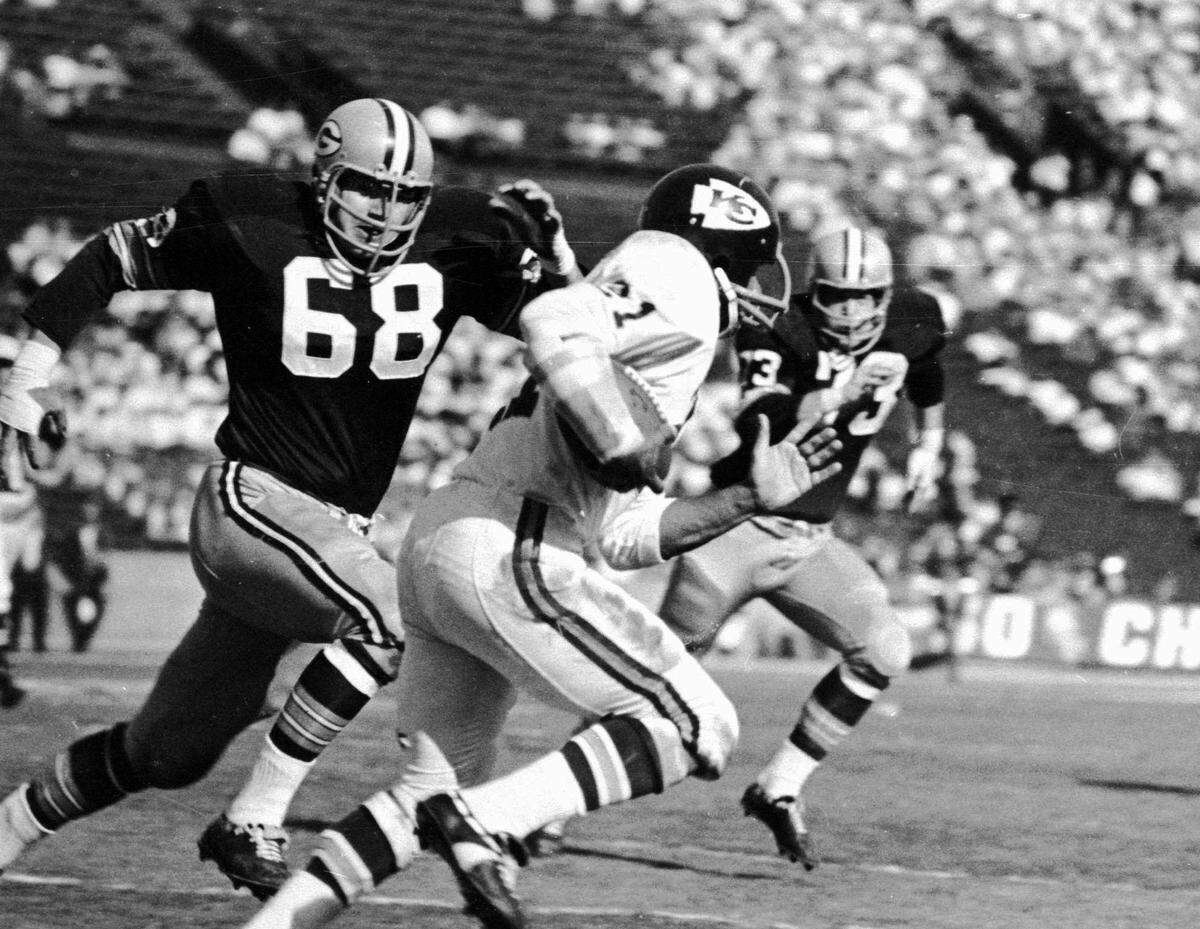
Though down 14-10 at halftime, Kansas City held a slight statistical edge. But early in the second half, Henry Jordan hit Chiefs quarterback Len Dawson’s arm, causing an interception that Willie Wood returned to the Chiefs 5. The first of Elijah Pitts’ two 1-yard touchdowns followed. Those scores sandwiched McGee’s juggling catch of a 13-yard touchdown, part of his seven catches for 138 yards.
McGee certainly felt no effects from “The Hammer.” Williamson got in a few shots on Green Bay’s skill players, but they scored the only knockout — Williamson got KO’d trying to tackle Packers running back Donny Anderson. One of Anderson’s teammates, referring to Anderson’s signing bonus, quipped, “You hit him with your purse, Donny?”
Afterwards, the media pressed Lombardi for a comparison until he finally said the Chiefs weren’t as good as Dallas and several other NFL teams.
“That’s what you wanted me to say, wasn’t it?” Lombardi snapped. “Now, I’ve said it. But, I don’t like to get into that kind of comparison.”
Though the Chiefs wish they had made a better case for comparison, they would remember Lombardi’s words three years later.
SUPER BOWL IV
KANSAS CITY 23, MINNESOTA 7
▪ Jan. 11, 1970
▪ Tulane Stadium, New Orleans
▪ MVP: Kansas City QB Len Dawson. 12 of 17 passing for 142 yards and one touchdown.
▪ Should’ve Been MVP: Kansas City DTs Curley Culp or Buck Buchannan, whose dominance of the middle ruined the Vikings offense.
▪ Super Bowl Rank: 36th
Maybe the difference was inspiration.
The Chiefs were proud AFL men humiliated by Super Bowl I. They wanted redemption in this last game before the AFL-NFL merger and to prove the Jets’ Super Bowl III upset wasn’t a fluke. Owner Lamar Hunt still had major beef with Minnesota. The Vikings were supposed to be an original AFL franchise but jilted Hunt at the last moment for the NFL.
Or, maybe the difference was the Chiefs simply were better than the Vikings: faster, more athletic, bigger (especially on defense), more physical with an all-time great defense that boasted future Hall of Famers at every level.
Few anticipated that. The Vikings had led the NFL in scoring while setting a record for fewest points allowed. Their 12-game winning streak was the longest since Bronko Nagurski’s 1934 Chicago Bears. As Baltimore had the previous year, the Vikings blew out a good Cleveland team, 27-7, for the NFL title. One of the bodies left face down wasn’t figurative. It belonged to Cleveland linebacker Jim Houston after Minnesota quarterback Joe Kapp decided to go through and over Houston.
Vegas put Minnesota as a 13-point favorite.
Meanwhile, what most people saw in Kansas City was a team that, though 11-3, hadn’t even won the AFL’s Western Division.
A diverse, talented, creative offense and the AFL’s high-flying reputation blinded people to a defense that allowed only 177 points during the regular season. In the playoffs, offenses led by explosive quarterbacks Joe Namath (New York Jets) and Daryl Lamonica (Oakland) combined for a paltry 13 points.
Even former Green Bay coach Vince Lombardi, whose reputation as a butt-kicking screamer obscured usually near superhuman perception, all but dismissed the Chiefs chances in Super Bowl IV, giving his opinion with “They have the same quarterback don’t they?”
They did and he had things on his mind. Kansas City quarterback Len Dawson’s name came up in a federal gambling probe early in the week. He would be cleared by Super Sunday. He still didn’t eat much breakfast.
NFL Films talked Chiefs coach Hank Stram into wearing a microphone. Stram’s players noticed “Henry” yapped it up a little more talkative than usual. Lucky for NFL Films. Stram’s “keep matriculating the ball down the field!” remains a code phrase identifying the speaker as a Chiefs fan, longtime NFL fan or NFL fan with a sense of history. For decades, Stram recalled, people seeing him in airports and on the street would shout “65 Toss Power Trap.”
Both teams wore shoulder patches. Minnesota’s noted the NFL’s 50th season. Kansas City’s noted the AFL’s 10th and final season.
Before the game, the first Super Bowl in New Orleans, hot air balloons with mascots of each team were to lift off from the field. Winds slung the hot air balloon with a Viking mascot into the stands. The Chiefs mascot turned off his burner.
Never did a pregame show provide a bigger hint and a half of what was to come.
Using quick hitch passes to foil Minnesota’s pass rush, Dawson drove to three Jan Stenerud field goals, including a 48-yarder on which the first soccer-style kicker in a Super Bowl set a Super Bowl length record that would stand for 24 years.
After the Vikes fumbled a kickoff, Mike Garrett scored on 65 Toss Power Trap for a 16-0 halftime lead. Minnesota had been stuffed for only 24 yards rushing.
Smoke from the faux muskets prevented much of the crowd from seeing the NFL’s reenactment of the Battle of New Orleans at halftime. It also covered up a person losing part of his hand to a misfiring cannon.
Minnesota could relate. On defense, the Chiefs overwhelmed center Mick Tinglehoff with thick nose guard prototype Curley Culp or 6-7 Buck Buchannan. The Chiefs’ defensive size brought Kapp’s comparison to “a redwood forest” and prevented runners from seeing much action (only 67 yards).
A few months after Kansas City’s Super Bowl I loss, they drafted middle linebacker Willie Lanier. Conventional wisdom at the time held that you didn’t have black players at quarterback, center or middle linebacker, the leadership positions that ran the offense and defense.
A lot about the AFL defied “conventional wisdom.” Future Hall of Famer Lanier got one of the three interceptions of Kapp before Aaron Brown drove Kapp into the ground, shoulder first. End of the day.
The Chiefs ran wide receiver Frank Pitts on three end arounds for 37 yards. Otis Taylor turned a third quarter hitch into 46-yard catch-and-run touchdown. He bounced off cornerback Earsell Mackabee as Mackabee suffered a pinched nerve. Taylor gave Karl Kassulke crossed the goal line with a high-kicking stride, a subtle bit of showboating that told everyone the obvious: game over.
Lamar Hunt’s team won the last game any team played under the banner of Lamar Hunt’s league.
Who knew it would be another 50 years before the Chiefs Super Bowl history would continue?
This story was originally published January 31, 2020 at 2:03 PM.