Reeling Heat continues to struggle to hold on to leads and in the clutch: ‘These are painful steps’
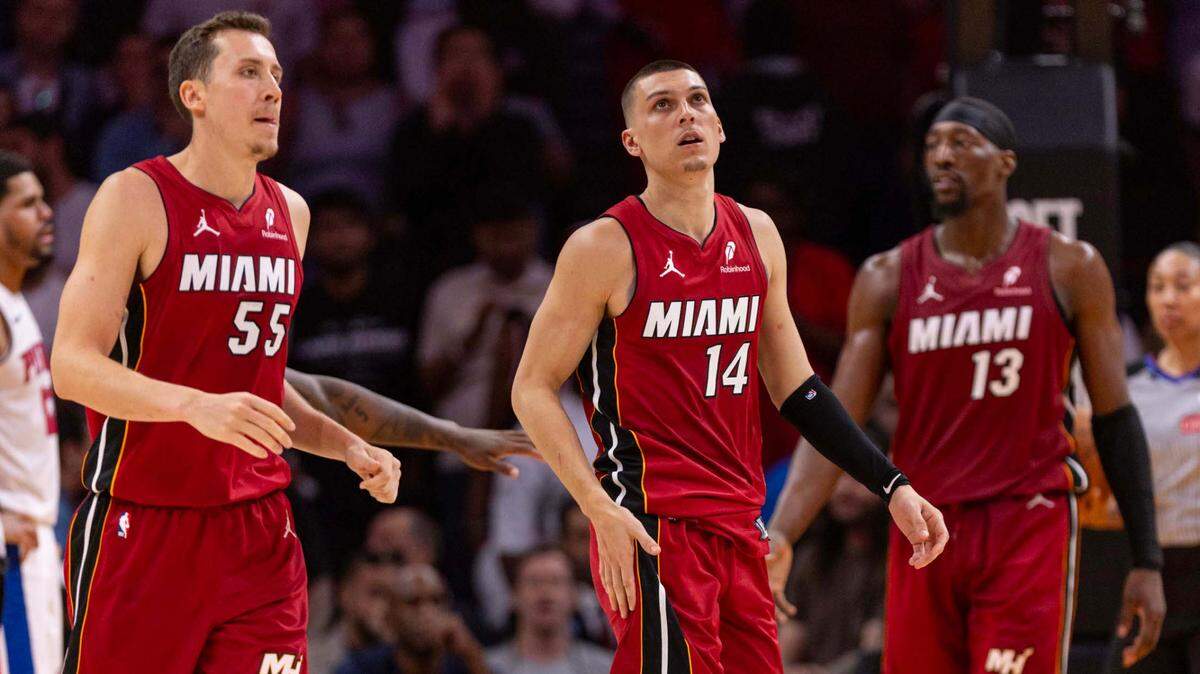
What used to be a strength for the Miami Heat has turned into one of its biggest weaknesses.
After posting an impressive 77-57 record in clutch games (one that has a margin of five points or fewer inside the final five minutes of the fourth quarter) during the previous three seasons, the Heat is on track to have one of its worst seasons in franchise history in large part because of its struggles late in close games.
The Heat currently holds the NBA’s third-worst winning percentage in clutch games this season at 13-23, with its latest clutch loss coming in Wednesday night’s 116-113 defeat at the hands of the Detroit Pistons to open a five-game homestand at Kaseya Center. The Heat led by three points with 4:27 left in the fourth quarter and ended up losing on a game-winning bank-shot three-pointer from Pistons guard Cade Cunningham with 2.9 seconds to play.
“That’s the thing that we’ve been racking our time, our brains, everything, trying to find solutions for that,” Heat coach Erik Spoelstra said when asked if there’s a common thread between the Heat’s late-game issues this season. “We have not come up with solutions, and we’ve pretty much tried everything. This has been one of the biggest challenges of a regular season that I’ve been a part of.”
The Heat’s inability to consistently win close games has led to this challenging regular season, as the Heat (29-40) has now dropped nine games in a row and stands 11 games under .500 with only 13 regular-season games left to play.
The Heat has lost nine consecutive games for just the 10th time in the franchise’s 37 seasons. This nine-game skid is the Heat’s longest losing streak since dropping 11 consecutive games from Jan. 29, 2008 through Feb. 23, 2008.
The Heat also stands 11 games below .500 for the first time since Jan. 30, 2017, when it was 19-30 during the 2016-17 season. This is also the latest in the season that the Heat has found itself at least 11 games under .500 since its 15-win 2007-08 season.
After Wednesday’s defeat, the Heat has now blown a double-digit lead in an NBA-high 19 losses this season. The Heat has also blown 17 fourth-quarter leads in losses this season, which is tied for second in the league.
“The only thing that we have to do now is you just stay the course. You stay with it,” Spoelstra said, with the Heat hoping to end its long skid when its homestand continues Friday against the Houston Rockets (8 p.m., FanDuel Sports Network Sun and NBA TV). “There’s no way to explain some of this, the bank shot at the end. There’s no way to explain that. You just have to find more resolve.
“We’re all getting tested in so many different ways that we do not want to get tested, but there can be a beauty in these challenges and these tests if we just continue to stay stubborn.”
The Heat must find a way to execute better down the stretch of close games to find that beauty Spoelstra keeps referring to. Six of the defeats during the Heat’s nine-game skid have gone down as clutch losses.
So, what’s different for the Heat in the clutch this season compared to the last few seasons? The biggest difference is the Heat doesn’t have Jimmy Butler on its roster anymore after trading the disgruntled six-time NBA All-Star to the Golden State Warriors on Feb. 6.
Most of the Heat’s late-game meltdowns have come since the Butler breakup turned ugly in early January. With Butler playing just five games for the Heat since the start of January amid serving three team-issued suspensions before eventually being traded to the Warriors last month, Miami has missed the player who was its top closer.
Not only is the Heat just 12-26 overall and 6-12 in the clutch since Jan. 2, but it has also been outscored by an NBA-worst 16.6 points per 100 possessions in the fourth quarter during this span. Fifteen of the Heat’s 19 blown double-digit leads and 14 of its 17 blown fourth-quarter leads have come during this stretch.
“I think that’s part of it,” Heat forward Duncan Robinson said when asked whether the loss of Butler is playing a role in the team’s late-game struggles. “But that’s not necessarily new to the deadline. We’ve kind of been dealing with that for a while. So I don’t know if it’s as much adjusting to that. I think it’s been different things in different games. Good teams find a way to win, so we got to just start figuring out ways. It’s going to look different on different nights. But it’s more so just about building that resolve on both ends of the floor. These are painful steps, but there have been steps in the right direction.”
It’s hard to see those positive steps, considering the Heat has posted the NBA’s worst clutch offensive rating, 27th-ranked clutch defensive rating and worst clutch net rating (outscored by 48.3 points per 100 possessions) in seven clutch games during March. For the season, the Heat holds the league’s worst clutch offensive rating, 21st-ranked clutch defensive rating and second-worst clutch net rating (outscored by 17 points per 100 possessions) in 36 clutch games this season.
“I think a little bit has to do with that, for sure,” Heat guard Tyler Herro said when asked whether the departure of Butler has added to the Heat’s late-game issues. “But I think we’re all solution-based right now, just trying to figure out what will work going forward. And we’re just managing all of that, trying to find sets that work. Obviously, we know where the ball is going to go. It’s just making sure we can get to spacing, make sure guys are calm and confident in what we’re going to do, and then just making the right plays.”
Some of the Heat’s problems in the clutch come on the offensive end.
Since Jan. 2, the Heat has the NBA’s third-worst three-point shooting percentage in the clutch at 21.8 percent (19 of 87) and has committed the fourth-most turnovers per clutch game (1.4).
The Heat’s top two outside shooters — Herro (5 of 34 on threes in the clutch since Jan. 2) and Robinson (3 of 13 in the clutch since Jan. 2) — are shooting a combined 8 of 47 (17 percent) from three-point range in clutch situations during this stretch.
And without Butler’s ability to generate free throws, the Heat has the NBA’s lowest free-throw attempt rate in clutch situations since Jan 2.
“I think Jimmy was really good at making the right play at the right time, whether it was for him or a teammate,” Herro said. “So I think that’s just part of mine and Bam’s process of continuing to get better.”
But the Heat’s defense hasn’t been much better, allowing opponents to shoot 50.3 percent from the field and 38.6 percent on threes in the clutch since Jan. 2. Opponents have also scored an NBA-high 5.4 points in the paint per clutch game and an NBA-high 2.4 second-chance points per clutch game during this span.
“We just got to find consistency as a whole,” Adebayo said. “It’s not just putting the ball in the basket. A lot of the times I feel like we let teams score. That causes, obviously, the deflation on the offensive end. Because if you make them miss and we get out and we get a quick transition bucket, it’s a different mindset. It’s those things where we miss an offensive rebound and they get a second chance. So now we’re constantly taking the ball out instead of getting it out in transition.”
Time is running out for the Heat to solve its problems. There’s less than a month left in a Heat regular season that is going in the wrong direction, as Miami appears to be on the way to its first losing season since 2018-19.
“It’s a tough stretch to go through, obviously,” Herro said, with the Heat still almost a near lock to make the NBA’s play-in tournament for the third straight season. “I feel like a lot of people would start second guessing themselves when the process isn’t necessarily getting the results that you want. You lose nine in a row, a lot of self doubt starts to creep in. But you try to rely on the work, rely on the time and the effort we put in to get to this point. We just got to continue to stick with it.”