
Marlins’ Robby Snelling, fresh off season-ending surgery, ready to ‘hammer out rehab’
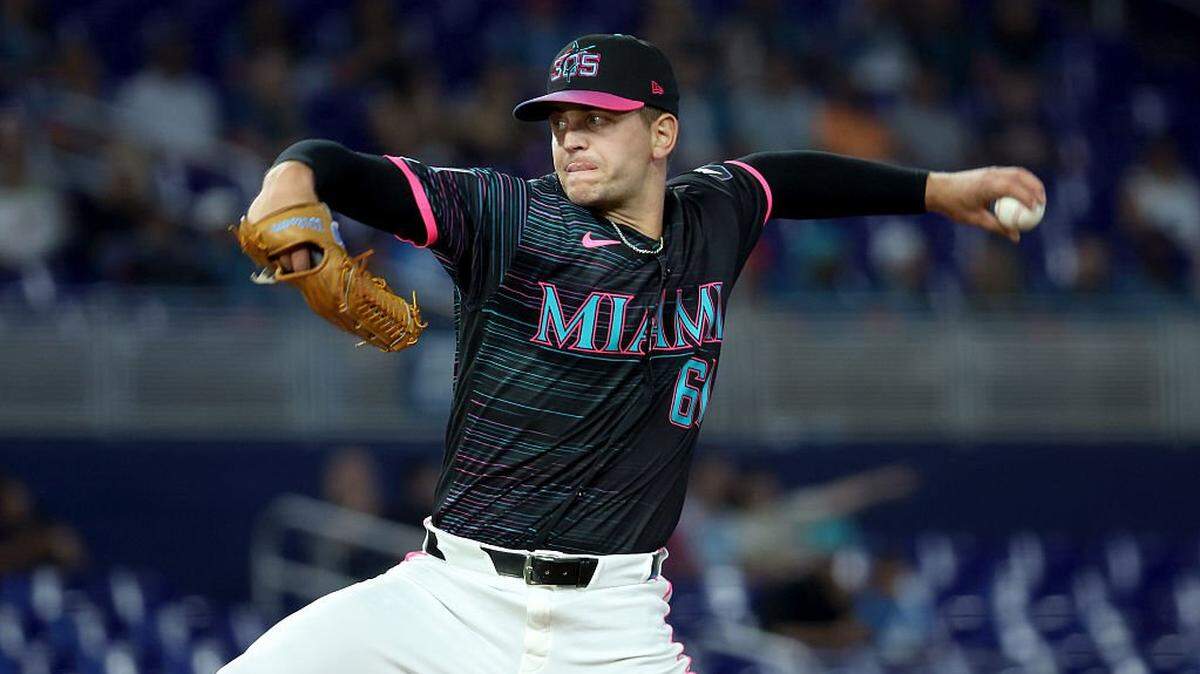
Robby Snelling made his way into the Miami Marlins’ clubhouse on Sunday morning with a full brace covering his left arm, keeping it locked basically at a 90-degree angle.
Two days earlier, Snelling underwent left elbow UCL repair surgery with an internal brace, an operation that will tentatively sideline him for the next 10-12 months. The surgery was performed by Dr. Keith Meister.
It was a tough blow for Snelling, ranked as the No. 2 prospect in the Marlins’ system and the No. 28 prospect in all baseball by MLB Pipeline. He had just made his MLB debut and was expecting to be a critical piece in the Marlins’ rotation.
Instead, he is now out the rest of the season.
Snelling spoke prior to the Marlins’ series finale against the New York Mets on Sunday for the first time since undergoing the surgery. Here is everything he said.
First off, how are you feeling and what exactly was the procedure?
“I’m feeling good for the situation. I ended up getting a repair in my UCL, so I guess best-case scenario for the situation being. I didn’t have to do a total reconstruction, so hopefully that speeds up the timeline a little bit and I get back a little faster. Really just hammer out rehab and get stronger and be able to come back.”
How are you mentally dealing with the whole process?
“I don’t know if it’s really sunken in yet that I’m not going to be playing baseball for the rest of the year, which kind of stinks, but I’ll get there probably once I am able to start hammering out some rehab and be able to shift my mindset more into focusing on getting back than focusing on the fact that I’m not going to be competing for the rest of the year. That’s a pretty tough pill to swallow, but it’s the cards that I was dealt, and there’s a greater plan, so I’m ready to get going.”
Have you spoken to anyone who has gone through this that you can lean on during the rehab and recovery?
“For sure. I have a really good support system. The main guy probably for me is Nathan Eovaldi with the Rangers. I talked to him a bunch. He’s been through a lot in his career, and he’s been a great sound board for me to be able to use. Also, a lot of guys in this locker room. This was the first kind of major injury that I’ve had growing up and playing sports, so the first time that I’ve ever really missed time from a sport because of an injury. Guys in the locker room, like right before I left to go get my consultation and go meet with Meister, they were consoling me, letting me know everything was going to be fine and no matter what happens, it’s part of the game now. They’ve gotten so good at the surgery that it’s basically an oil change at this point, so to be able to look at it that way, as unfortunate as it is, just understanding that a ton of guys have gone through it and also come back and been successful.”
When did you first start feeling that something was off?
“I would say that actually the first time that I felt it was in the game on [May 8], It was in the middle of the game at a certain point. I just felt a pull in my forearm and — like I said, this was the first injury that I’ve ever had; I don’t know what Tommy John feels like. I don’t know what it’s supposed to feel like. Obviously, now I do, but yeah, in the game, I threw a breaking ball. I don’t remember exactly what pitch it was. It was in the middle of the outing, though. It felt a little different than all the other pitches. It felt weird. I threw another fastball, I was still 95, 96, and I was still locating, I wasn’t super worried about it. I thought it just came out different. I wasn’t hurting at all after that. Nothing really tightened up, and I was able to go throughout the rest of the outing the way that I did.
“The following days were pretty sore after that, and I thought that was just from me asking a ton of my body and adrenaline being pumped up for my debut, being worked up, but the soreness didn’t really go away in my elbow once it went away in all my normal sore muscle spots. That’s really when I brought things to the trainers and was like, ‘Hey, this is different, I’ve never felt this before.’”
What was the waiting period like between telling the trainers and finding out you needed the surgery?
“I didn’t want to press any panic button. Like I said, I knew I was gonna be a little extra sore from it being my debut, so I did all the recovery stuff that I could. I really wanted to see how I felt throwing a bullpen when we were in Minnesota, so I did throw my bullpen in Minnesota, and had normal velos. I was still 87 to 91 and my body was feeling OK. I just couldn’t trust my arm to be able to go out on that start and try and throw 95. I wouldn’t have trusted my arm to do that. If I’m in that mental state, that’s not a good spot to be, and you don’t want to be competing at the highest level — one for my health, but also two for what the outcome is going to be for the team.”
Was it tough for this to happen one start into your MLB career?
“It’s probably as tough as it gets, honestly. I mean, you get a taste of it, and obviously, like I was explaining to [manager] Clayton [McCullough] when we found out, it’s just hard kind of being ripped away from something that you’ve been waiting for for so long. Just getting a little bit of a taste of it and realizing how special it is to be up here and how important winning is, it’s refreshing. Because in the minor leagues, you obviously want to win, but a lot of it is about development and then you finally get up to the big leagues, and, yes, development is important, but every time you step out onto the field, you just want to win with your team and the guys that you are with in the locker room, so being removed so quickly from that is really hard.”
.JPG)