
Marlins overhauled player development approach under Bendix. Now, it’s time to see results
When Peter Bendix took over as the Miami Marlins’ president of baseball operations, his primary goal for his first year was, in his words, about “assessing the entire organization, the entire baseball operations department, from top to bottom.”
“Understanding what we have, what we don’t have, what we need and how to get to that point as quickly as we possibly can,” Bendix said.
One of the major areas where he felt the organization needed the most improvement: the player development department. It’s the lifeblood for a franchise like the Marlins, one that perennially is among the lowest in team payroll. For them to succeed, they need to be consistently finding and nurturing their own big-league talent.
So the overhaul began.
It started with two key hires in assistant general manager Gabe Kapler and director of player development Rachel Balkovec. The two work in tandem with director of minor-league operations Hector Crespo, who is in his 10th season with the Marlins.
An emphasis was placed on innovation. The Marlins aren’t always going to have the same tools at their disposal as, say, the Los Angeles Dodgers or the New York Yankees, so they need to get creative in order to stay competitive.
After a full year of building the structure that he wanted to see, Bendix knows that it’s now time for the results.
“It’s an incredibly important time in our organization,” Bendix said. “It’s an incredibly impactful thing that we’ve built, and we’re starting to see the fruits of it.”
‘Raise the bar’
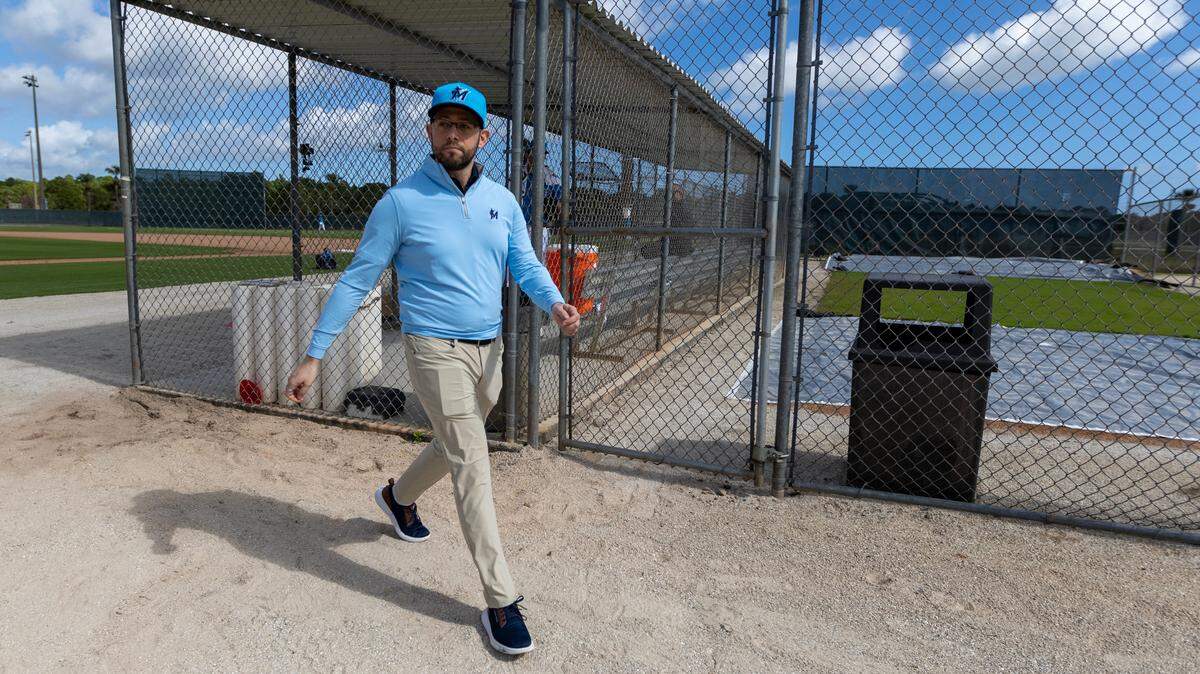
A walk around the back fields with Kapler at the Marlins’ minor-league complex in Jupiter gives a little insight into how the Marlins are operating.
On one field, two rounds of batting practice are occurring simultaneously, with one batter seeing pitches from a machine off the mound and another being thrown pitches by a hitting coach on flat ground.
On another, one of the team’s “live pitch design sessions,” which has replaced traditional bullpens for pitchers and allows pitchers to work on their arsenals in live-yet-controlled settings, could be taking place.
And on yet another, there could be agility drills or fielding drills occurring, with the team’s focus being on multiple players participating in the drill at the same time to minimize the amount of time players are waiting around.
“It’s encouraging,” Kapler said, “but at the same time, we need to continue to raise the bar.”
Kapler, Balkovec and Crespo work in tandem to brainstorm ways to improve with the resources at their disposal. If there’s anything they can do that might give them a slight advantage in their circumstances, they’re going to explore it.
“We all believe in trial and error,” Kapler said. “We can roll things out and give them a shot without having them be perfect, and then when we know that they’re imperfect, we don’t get surprised when there’s some chaos associated with them. But the trick is that we’re all watching these practices and affirmatively and on purpose being dissatisfied with them. We don’t want to be patting ourselves on the back like ‘Look at these cool practices that we’ve created.’ We want to be like ‘What if we move the screen 5 feet to the right side? How does that improve an angle or a view for a hitter?’ Myself and Rachel and Hector will walk around and always see something that can improve.”
And while it starts with the three of them, along with Bendix’s blessing to execute their plans, it’s the trickle-down effect from them to the staff and then ultimately to the players to make sure everything works.
Balkovec stressed the importance of building a staff that has a “blue-collar mentality.”
“We need people who are going to be innovative, creative, not complain about, ‘Oh, we don’t have this resource, or we don’t have this thing’ or whatever,” Balkovec said. “We just can move forward and completely max out what we have available to us to be the best at development in baseball, and we had to hire people that had that mentality. And I think that we did a good job of hiring people like that who are going to come in and just absolutely blow past the competition. Even if they have more resources, we’re going to do it better with whatever resources we have available.”
Crespo, who has been with the Marlins since 2016, said the state of the department is “just an absolute 180 of where we’ve been before.”
“My biggest thing was just helping them kind of hit the ground running,” Crespo said. “Just ensuring that their vision was carried out to the fullest degree and as quick as possible. They brought some really good ideas, and my job was to make sure that we could do it as fast as possible and as efficient as possible as well.”
Influx of talent
Adding to the talent pool also helps.
The Marlins took a step back at the big-league level in 2024, trading most of their top players from team that ultimately finished 62-100 to restock their farm system.
In total, Bendix shipped off more than a dozen players to get this done.
While a few of those trades have helped the big-league club immediately — left-handed pitcher Trevor Rogers to Baltimore for infielder Connor Norby and outfielder Kyle Stowers as well as utility player Vidal Brujan to the Cubs for first baseman Matt Mervis being the most prominent examples — the majority of Bendix’s moves had the future in mind.
Consider that 13 of Miami’s top 30 prospects to start the 2025 season according to MLB Pipeline came via these trades:
▪ Outfielders Dillon Head (No. 7) and Jakob Marsee (No. 24) were part of the four-player return from the Padres for Luis Arraez.
▪ Catcher Agustin Ramirez (No. 4) plus infielders Jared Serna (No. 16) and Abrahan Ramirez (No. 21) came from the Yankees in the Jazz Chisholm Jr. trade.
▪ Pitchers Robby Snelling (No. 8) and Adam Mazur (No. 13) plus infielder Graham Pauley (No. 25) were part of the four-player return from the Padres for pitchers Tanner Scott and Bryan Hoeing.
▪ First baseman Deyvison De Los Santos (No. 12) and outfielder Andrew Pintar (No. 30) came to the Marlins from Arizona in the A.J. Puk deal.
▪ Shortstop Starlyn Caba (No. 2) was the headliner in return from the Philadelphia Phillies for left-handed pitcher Jesus Luzardo.
▪ And infielders Echedry Vargas (No. 18) and Maximo Acosta (No. 20) came to Miami in the Jake Burger trade with the Texas Rangers.
“Our group has done a really nice job of bringing in talent into the system,” Kapler said. “It’s just elevated the system in general. The floor and the ceiling are both higher at this point.”
And the talent is layered throughout the organization.
The Marlins had 13 of their top-30 prospects take part in big-league camp during spring training. Two — utility player Javier Sanoja and Pauley — opened the season on the MLB roster.
“We encourage those guys to be sponges,” Crespo said of the prospects who took part in big-league camp. “Obviously, there’s some veteran guys on that team that have so much more experience just to be a sponge and listen to conversation, see how guys prepare. ... It truly is a top-down player development system, so all those guys have been amazing to work with, and our group is getting better because they have access to those guys.”
From there, seven are in Triple A Jacksonville, six are with Double A Pensacola, five with High A Beloit, eight with Single A Jupiter, one projected to start at the rookie-level Florida Complex League and one sidelined with injury.
Balkovec said the organization’s top prospect pool being layered throughout the different levels of the minor-league system is “both exciting and also a little bit of pressure in a positive way.”
“These guys still have to develop,” Balkovec said. “We have top prospects, but as everyone knows, top prospects don’t always make it, and the pressure’s on us to help them continue to develop. ... We have a lot more talent, but we still have a long ways to go.”
.JPG)