
Three players the Miami Marlins need to start producing again to end second-half slump
The Miami Marlins have been a shell of themselves since returning from the All-Star Break. They entered Monday having won just five of their past 21 games, tied with the Arizona Diamondbacks for the fewest wins since play resumed. They went from a season-high 14 games over .500 to being just three games over .500 (58-55) for the first time since early June.
And yet the Marlins are still within striking distance of a playoff spot, only a half-game behind the Chicago Cubs and Cincinnati Reds for the final National League wild card spot. Miami and Cincinnati begin a three-game series at Great American Ball Park on Monday.
If the Marlins want to truly contend and make a run at their first playoff appearance in a full season since winning the World Series in 2003, they are going to need to get out of this slump they have been in to start the second half of the season.
In addition to the spark from the team’s trade deadline acquisitions, a few players who have been on the roster all season will need to step up and return to their early-season form.
Here are three of those players. All stats are through games played Sunday.
Jorge Soler
The Marlins’ outfielder/designated hitter went into the All-Star Break tied for sixth in MLB with 23 home runs and ninth with a .527 slugging mark. It was more than enough to make him an All-Star for the first time in his 10-year MLB career.
Since play resumed, Soler is hitting just .188 (15 for 80) with three home runs and eight RBI. He has 25 strikeouts in 89 plate appearances — a 28.1-percent strikeout rate that is up from the 23-percent rate he had before the break.
He’s not elevating the ball as much, either, and that’s costing him. Look at the breakdown of his balls in play from the first half compared to the second half:
▪ Ground balls: 35.2 percent in the first half (83 of 236 balls in play); 41.1 percent in the second half (23 of 56 balls in play). On the season, Soler is batting just .170 when he hits the ball into the ground.
▪ Line drives: 24.2 percent in the first half (57 of 236 balls in play); 19.6 percent in the second half (11 of 56 balls in play). His batting average on line drives? .716.
▪ Fly balls: 31.4 percent in the first half (74 of 236 balls in play); 32.1 percent in the second half (18 of 56 balls in play). Of his 92 fly balls, 20 have been home runs, another 10 have fallen for hits and two more have been sacrifice flies.
▪ Pop ups: 9.3 percent in the first half (22 of 236 balls in play); 7.1 percent in the second half (4 of 56 balls in play).
He has been indecisive with his pitch selection, which has impacted his timing and, therefore, his results.

Jazz Chisholm Jr.
When it comes to Chisholm, it’s not necessarily about returning to form. It’s about staying on the field.
Chisholm missed 60 games in a 66-game stretch in the middle of the season due to a pair of injuries. He sat out 39 games from May 14 to June 26 due to turf toe after banging his foot on a concrete part of the center field wall at loanDepot park, returned for a week and then missed another 21 games with an oblique strain.
He returned to the lineup again on July 31, with the Marlins planning to be extra cautious with Chisholm and giving him planned days off early in his return.
Chisholm played five games ... and then exited on Saturday with a right hamstring cramp he felt while trying to steal a base. He did not play Sunday.
When Chisholm is healthy, he is productive. In 50 games played, the center fielder is hitting .253 with 10 home runs, 24 RBI and 15 stolen bases.
Has Chisholm been doing anything different with his pregame routine to try to minimize injuries?
“I’m with the trainers every day,” Chisholm said. “I get a massage every day. I’m in the weight room every day. I’ve got to get my body ready for every game. Things just keep happening. Hopefully, one day I just turn into Superman and don’t get hurt anymore.
He continued: “In the minor leagues, I was rarely hurt and I barely did anything in the clubhouse, just went out there for stretch and played the game, but now I’m stretching all the time; I’m trying to make sure my body’s ready for every game and I’m still getting hurt even though some of them are freak accidents. ... I’m trying to be as healthy as I can.”
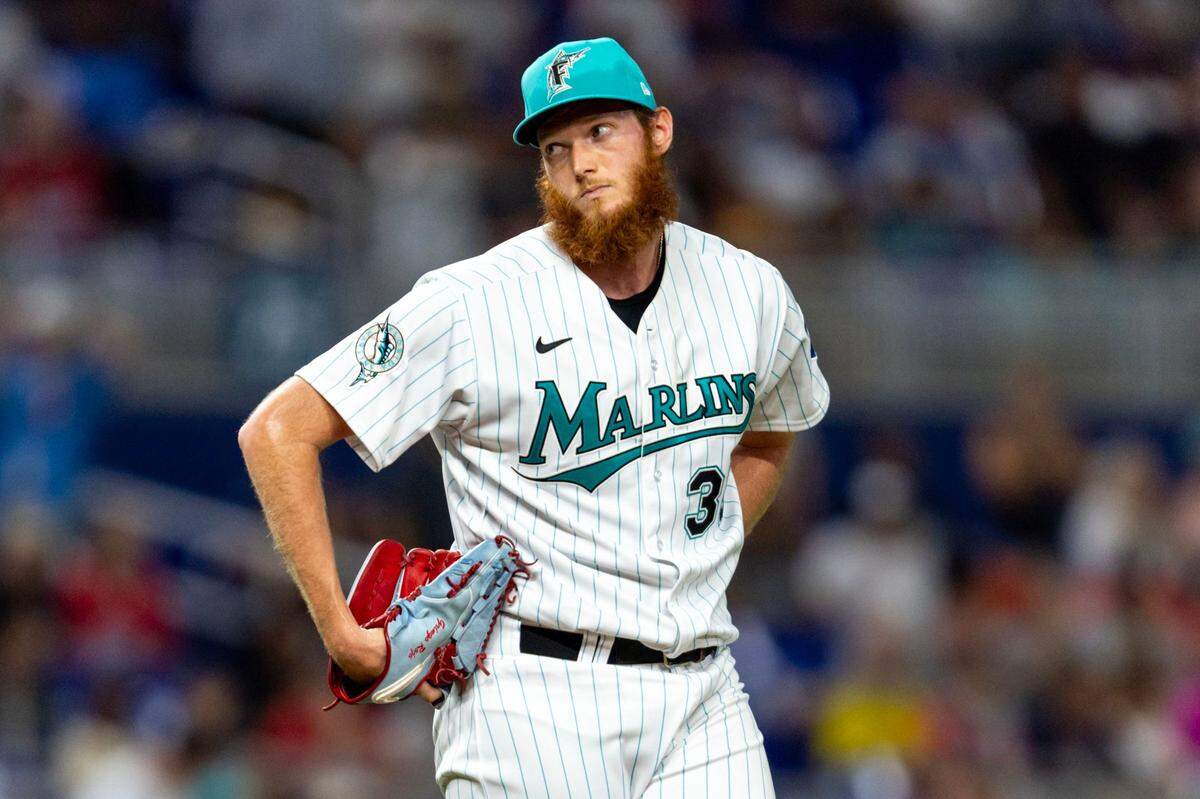
A.J. Puk
Puk, who the Marlins acquired this offseason from the Oakland Athletics for outfielder JJ Bleday, quickly emerged as the team’s closer to begin the season. He converted 14 of 16 save opportunities and had allowed just eight earned runs while striking out 29 and walking just four in his first 27 appearances.
Then came the rough stretch in July. Over the course of nine games from July 5-30, Puk blew four of five saves, gave up an extra-innings, walk-off home run in another and overall gave up 11 earned runs over 7 2/3 innings — a 12.91 ERA.
Since the trade deadline, with the Marlins acquiring high-leverage right-handed relievers David Robertson and Jorge Lopez, Puk is now pitching earlier in games and in less stressful situations in an attempt to get him back on track.
.JPG)