
Marlins’ Jazz Chisholm Jr. more comfortable in center field. What the numbers are saying
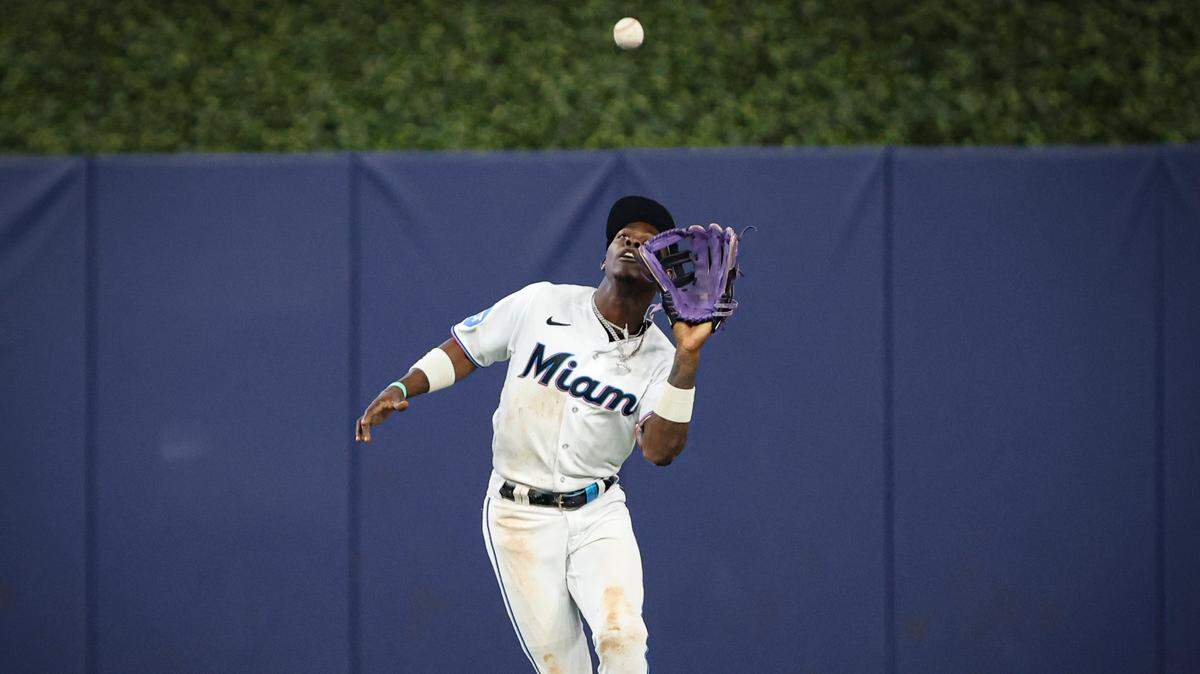
Jazz Chisholm Jr. watched Mike Yastrzemski sent a line drive his way in the eighth inning of the Miami Marlins’ home game against the San Francisco Giants on April 18.
“I can’t catch this ball,” Chisholm told himself immediately.
Wait... was that Chisholm doubting himself? Or merely him challenging himself as he continued his early-season adjustment to playing center field, a move he offered to make after being a middle infielder his entire career?
The answer came seconds later. Chisholm sprinted toward the warning track, getting there with just enough time to make an over-the-shoulder grab and rob Yastrzemski of extra bases.
“That was just a blacked-out moment where I just put my head down and just started running for the ball,” Chisholm said after the game. “I just went and by the time I got to the ball, it was still in the air. That’s all I got.”
Chisholm might not have had the words then, but when it comes to his comfort level in center field, he has an answer now.
“It feels like first nature if you ask me now,” Chisholm said. “It’s getting easier.”
Not just easier. Based on advanced analytics, Chisholm has been one of MLB’s better defensive center fielders this season in two key metrics approaching the 40-game mark of the season.
“You’ve seen it from Day 1 of spring training to where he’s at now,” said Marlins outfielder coach Jon Jay, who worked with Chisholm almost daily in the month and a half leading up to spring training. “And the cool thing is he’s going to continue to get better. His process has been great. He wants to learn. He wants to get better every single day and he’s got a good attitude. You’ve seen the progress he’s made. That’s all him putting in the work.”
So what exactly are the metrics saying? Let’s dive in.
Outs above average
Chisholm’s three outs above average entering Monday are tied for second among all center fielders, according to Statcast. Only the Chicago White Sox’s Luis Robert, a Gold Glove winner in 2020, has more with four.
The four players Chisholm is tied with in second: The Toronto Blue Jays’ Kevin Kiermaier (a three-time Gold Glove winner), the Houston Astros’ Jake Meyers, the New York Mets’ Brandon Nimmo and the Seattle Mariners’ Julio Rodriguez.
Statcast calculates outs above average for outfielders by looking at the catch probability, which takes into account “the distance an outfielder must go, the time he has to get there, and the direction he travels to put a percentage of catch likelihood on each individual batted ball.” From there, the player is assessed points either positively or negatively based on if he makes the play. An outfielder’s outs above average total is a cumulative look at every play.
Big plays
Chisholm is standing out when it comes to making tougher plays, too.
He is the only center fielder so far this season to make what Statcast deems as five-star plays — plays with a catch probability of 25 percent or fewer. There have been just 12 total five-star catches across MLB to this point in the season.
Even more, Chisholm is 11 for 17 overall on making plays Statcast views as three-star or tougher (a catch probability of 75 percent or less). The 17 opportunities are the second most in the league, and the 64.7-percent success rate is the highest of anyone with more than 6 opportunities.
“There are a lot of fly balls in center field that he has run down in the gaps, coming in, going back,” Marlins manager Skip Schumaker said. “He’s done an amazing job for me for one month of playing center field in the big leagues.”
Outfielder Jump
Chisholm ranks in the 92nd percentile in outfielder jump, a metric that shows “which players have the fastest reactions and most direct routes in the outfield.” It’s simplest definition is “How many feet did he cover in the right direction in the first three seconds after pitch release?”
Chisholm’s average jump is 37.4 feet, which ranks fifth in MLB among all outfielders.
▪ Reaction: Feet covered (in any direction) in the first 1.5 seconds. This is essentially measuring an outfielder’s first step. Chisholm ranks 18th out of 95 qualified outfielders in this category, averaging a foot above league average with his reaction.
▪ Burst: Feet covered (in any direction) in the second 1.5 seconds. Think of it like a way to measure acceleration. Chisholm ranks 14th here, not surprising considering his speed.
▪ Route: Compares feet covered in any direction to feet covered in the correct direction over the full three seconds. This is where Chisholm is still developing. He ranks 30th in his route running, still above average but not nearly as much as the other two categories that rely more on athleticism.
“You watch Jazz play center field and he’s one of the best in center field right now in today’s game,” Schumaker said. “He’s done an excellent job of working hard at getting that right because he cares. ... There’s a care factor when you play defense.”
.JPG)