
‘He’s got to trust his stuff’: Breaking down the ebbs and flows of Marlins’ Edward Cabrera
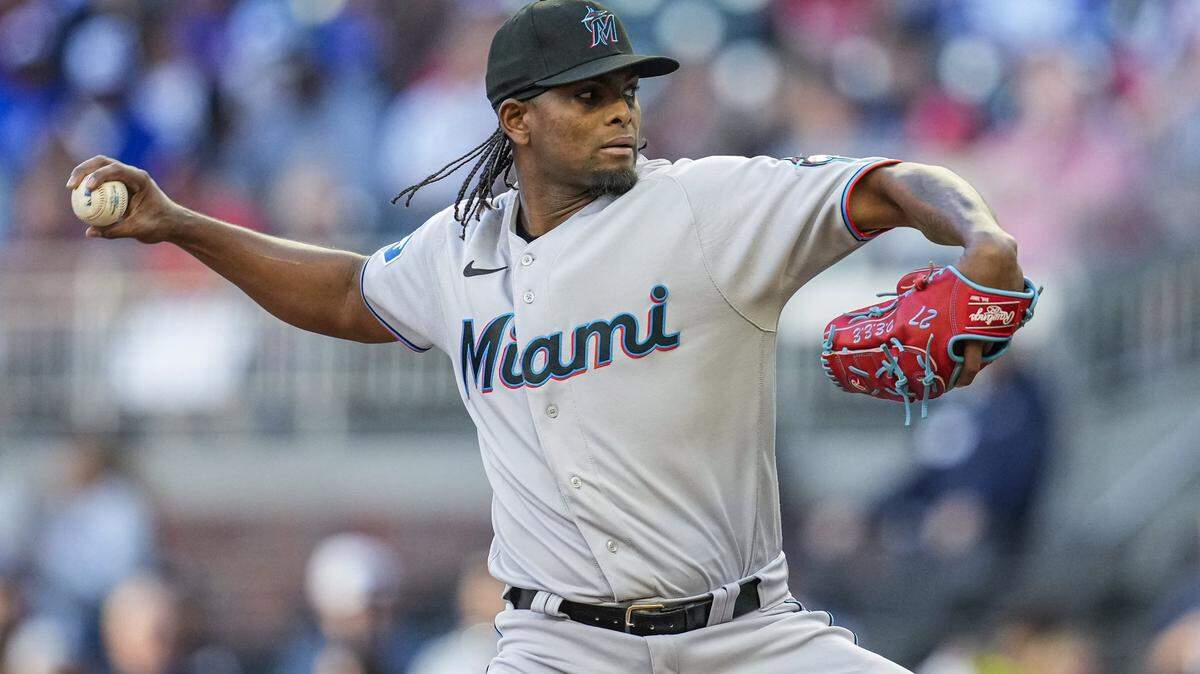
As he faced the Atlanta Braves’ Ozzie Albies in the fourth inning on Monday, Miami Marlins right-handed pitcher Edward Cabrera had to pause for a moment. He felt pressure in his left knee as he landed awkwardly after releasing a pitch. A team trainer, pitching coach Mel Stottlemyre Jr. and manager Skip Schumaker made their way to the mound to check on the young pitcher. Cabrera threw a couple warmup pitches before remaining in the game.
Physically, Cabrera said he felt fine.
Mentally, it had a lasting effect on the rest of his outing, one that was short-lived.
“Not going to lie to you, sometimes I was thinking about [the knee],” Cabrera said. “I was trying not to think on every pitch, and I wasn’t thinking [about it] every pitch. But yeah, it was in my head.”
Cabrera walked the next batter he faced in Marcell Ozuna. Then, he left a curveball right over the heart of the plate for Sam Hilliard, who crushed it 415 feet for a two-run home run to straightaway center. Cabrera was eventually pulled with one out in the fifth inning in Miami’s eventual 11-0 loss to the Braves at Truist Park. He gave up a season high four earned runs on four hits and four walks while striking out six.
“These are things that happen in the game,” Cabrera said. “I always have said I’ll always continue battling.”
Battling is an apt term to describe Cabrera’s season through his first five starts. He has walked an MLB-high 20 batters over 22 innings. His ERA is 4.91. Opponents are hitting .229 against him.
This coming after a 2022 season in which he had a 3.01 ERA with 75 strikeouts against 33 walks and just a .177 batting average against in 71 2/3 innings over 14 starts.
On Monday, Cabrera held his own through three innings against one of the most lethal lineups in the league. He avoided major damage in the second inning by getting Ronald Acuna Jr. to ground into a two-out fielder’s choice and the only blemish on his record to that point was a solo home run to Sean Murphy in the third.
But after the Albies at-bat in the fourth when he landed awkwardly, results went sideways. He walked three of the final seven batters he faced and just 13 of his 31 pitches to those seven batters landed for strikes.
Overall, Cabrera threw first-pitch strikes to just seven of 22 batters he faced. Working from behind forces Cabrera to be more reliant on his fastball to even the count instead of using his changeup and curveball, two pitches with big swing-and-miss potential that have been his primary out pitches.
“When he wasn’t throwing first-pitch strikes, this is kind of what happens,” Marlins manager Skip Schumaker said. “That was kind of the story: Behind in the count. If you do that against a good hitting team, this is kind of what it looks like. Back to the drawing board with Cabby and build him up a little bit, let him know that he’s a really good big-league pitcher if he believes in it, but he’s got to trust his stuff.”
Cabrera, for his part, has said his confidence hasn’t wavered even when the results haven’t been there. The struggles are tough, yes, but he knows he can pitch well because he has done it before.
And the Marlins need him to do it again.
With Miami so heavily relying on its rotation to keep it in games and with that rotation dealing with injuries to the likes of Johnny Cueto and Trevor Rogers, the Marlins need Cabrera to find a turning point.
He showed some of those strides in his previous two starts, holding the Philadelphia Phillies and San Francisco Giants to a combined four runs over 11 innings while striking out 12 and walking just three.
But then another bump in the road on Monday.
“Every time I go out there on the mound, I don’t think much about the opponent. I trust my teammates. I know they’re a good team, but I don’t think too much about that.”
.JPG)