
As Marlins enter ‘crunch time,’ the next three weeks will determine direction of season
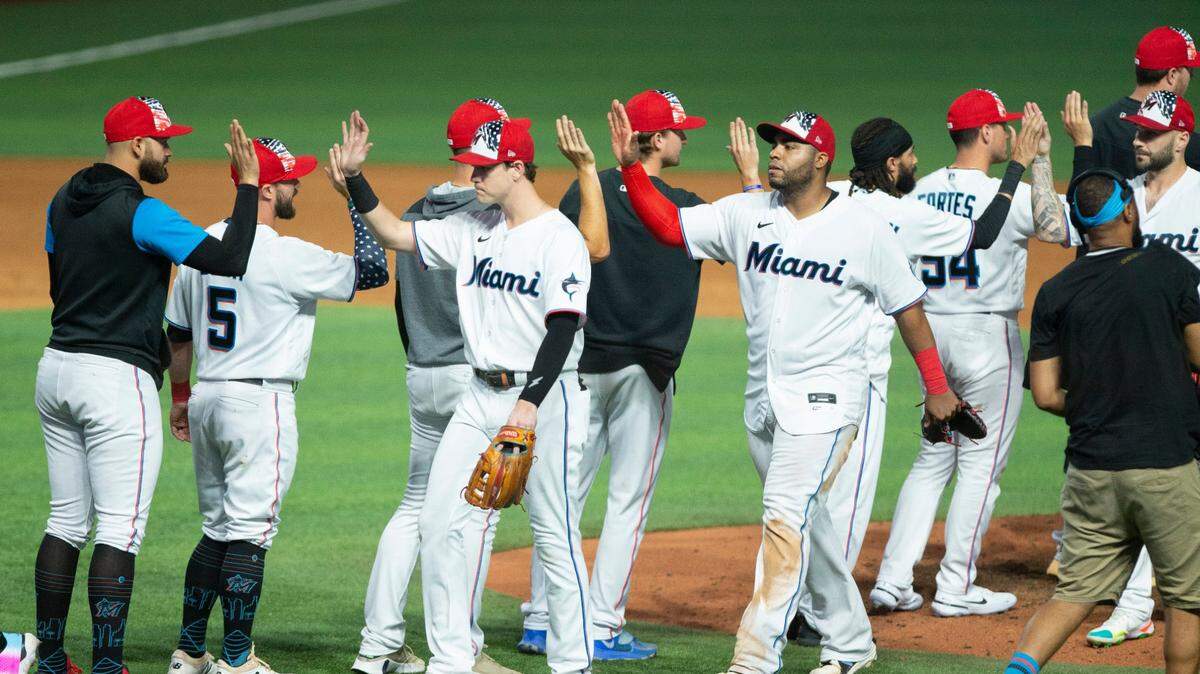
Everyone in the Miami Marlins organization, from the front office to the coaching staff to the players in the clubhouse, understands the situation at hand. The Marlins are just past the halfway point of the season and they are hovering on the outside looking in of a playoff spot.
Deadlines are approaching, and decisions need to be made.
What the Marlins do over the next three weeks — a stretch that, frankly speaking, should play in their favor — will determine the direction of their season and what course of action they take when MLB’s trade deadline arrives on Aug. 2.
Will they finally, for the first time in a non-shortened season, be in position to call themselves playoff contenders in the Bruce Sherman ownership group era?
Or, will they fail to take advantage and it will be another August and September focused on development and looking forward to next year?
“It’s crunch time,” high-leverage reliever Anthony Bass said. “We want to put the pressure on the front office to let them know that we want to make a run in the postseason. July is the month to do it.”
If they stay afloat in the playoff race and become buyers, adding another bat — ideally an outfielder — to supplement their lineup and another high-leverage reliever would likely be the priorities.
If they end up sellers, first basemen Jesus Aguilar and Garrett Cooper would be logical options to ship off, as would high-leverage relievers such as Bass (a righty on an expiring contract) and Steven Okert (a lefty with four years of team control).
“We have a stretch right here where we can make things happen,” shortstop Miguel Rojas said, “so by the trade deadline, we have an opportunity to be aggressive and hopefully keep this group together. ... That’s everybody’s goal: Keep this group together after the deadline.”
After Saturday’s 5-4 extra-innings, walk-off to the New York Mets, the Marlins are 40-43 on the season and five games out of the final wild card spot, currently held by the Philadelphia Phillies (46-39).
Solely in terms of wins and losses, Miami fell into this hole because of a horrendous month of May in which it went 7-19 — including losing nine of the first 10 games, with seven of those defeats (and 11 overall in the month) decided by one run — that put them at 19-27 on the season.
They have since climbed their way back into the race, going 15-13 in June and 5-3 so far in July.
Miami has also been aided by the fact that several teams they are directly competing with in the playoff race have hit rough patches.
Just look at the four teams directly ahead of Miami in the playoff race. The Phillies are the only one trending in a positive direction having won seven of their past 10 games.
The rest of the group? The St. Louis Cardinals and San Francisco Giants have each lost eight of their past 10 games. The San Diego Padres, currently in the second NL wild card spot, have also lost six of their past 10 to lessen the gap between the second and third spots in the wild-card race.
“You’ve seen teams kind of come back to the pack,” Marlins manager Don Mattingly said. “It’s become bunched up, and that’s really what we were looking for to keep ourselves in the race.”
The schedule ahead
Miami wraps up its series with the Mets on Sunday and has three more games against the NL East leader this month — July 29-31 at loanDepot park.
Outside of that, the rest of the Marlins’ schedule in July, on paper at least, is relatively easy. They play all seven of their games against the Pittsburgh Pirates, four against the Cincinnati Reds, one with the Texas Rangers and three against the Phillies. That’s 12 games against teams with sub-.500 records and a series against a Phillies team the Marlins are 4-3 against so far this season.
If the Marlins take care of the games they should take care of — and it’s worth noting they’re 17-8 against teams who currently have a losing record — it sets them up well.
“You have to win the games you have a chance to win,” Mattingly said. “Put yourself in a position to win those games.”
Where to improve
Fielding as close to a full, healthy roster would go a long way in putting Miami in the best position to win.
Of course, it’s virtually impossible to field the same team, the same 26-man roster, over a full 162-game MLB season. Injuries happen. It’s inevitable.
That said, the Marlins have had injuries come in bunches and caused them to deviate from their initial strategy of rotating guys in and out of the lineup based on matchups and scheduled days off to maximize the players they had.
Most recently, the Marlins were without both infielder Joey Wendle and third baseman/outfielder Brian Anderson for basically all of June, Wendle sidelined by a hamstring injury for the second time this season and Anderson out with back spasms.
Both returned to the lineup over the past two weeks only for another two to be sidelined. Jazz Chisholm Jr. has been out since June 29 with a right lower back strain. Outfielder Jorge Soler has been out since July 1 with bilateral pelvis inflammation.
Miami is also without two of its five main starting pitchers. Jesus Luzardo has been out since May 12 with a left forearm strain and Edward Cabrera since June 13 with right elbow tendonitis. At the time of both injuries, the Marlins were optimistic both pitchers’ time away would be minimal. That hasn’t been the case.
As a result, they are now relying on Braxton Garrett and Daniel Castano to hold down the final two spots of the rotation.
The team is also currently without Anthony Bender and Cole Sulser, two of their high-leverage options out of the bullpen. With limited off days and so many close games, high-leverage guys (Bass, Okert, Scott) have been taxed. If Marlins buy, adding another high-leverage arm will be a priority.
“Given all the injures,” Marlins general manager Kim Ng said, “we’re holding our own.”
The Marlins hope a return to health will also result in a boost in offensive production. The front office made improving the lineup a focal point this offseason when it signed Avisail Garcia and Soler as free agents and traded for Wendle.
After struggling to hit in key situations the first two months of the season, the Marlins appear to be turning a corner.
They entered Saturday hitting .274 with runners in scoring position since the start of June — the highest average in the National League in that span — and have averaged 4.7 runs per game in those 36 contests.
“Guys have kind of calmed down at this point in the season,” bench coach James Rowson said. “They’re just going up there and looking to have quality at-bats.”
That has translated to wins.
And, the Marlins hope, it will be sustainable over the next three weeks and beyond.
This story was originally published July 10, 2022 at 6:30 AM.
.JPG)