
The makings of an ace: How Marlins’ Sandy Alcantara is becoming one of MLB’s top pitchers
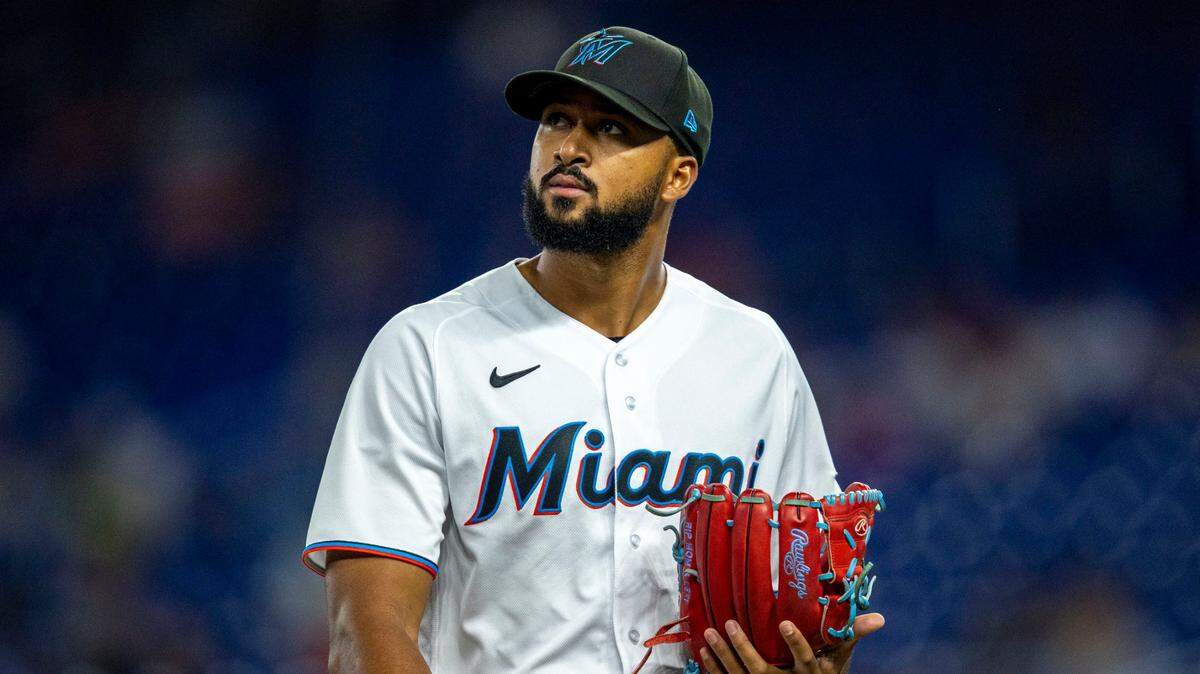
As Sandy Alcantara walks off the mound after a start this season, his mind is already moving forward.
The real work is about to begin.
While the results are what everyone sees out of the Miami Marlins’ star right-handed pitcher — and, to be fair, the results over the past month have been great — the 26-year-old Alcantara prioritizes the build up process, the behind-the-scenes work, that leads up to what happens when he steps on the mound every fifth game.
It’s a methodical, regimented routine during his time between starts — from a lengthy workout the day after to an exact number of pitches when he throws a bullpen — that has evolved as the pitcher continues to master his craft and understand what is required to be an ace.
“I put my mind in the right spot,” Alcantara said, “and try to put everything together.”
Everything is coming together.
Alcantara is establishing himself as one of Major League Baseball’s top pitchers this seasons, on pace to earn his second career All-Star nomination and in position to be a contender for his first Cy Young Award. He is living up to his goal of being a workhorse on the mound, one who has the chance to throw a complete game every start.
He knows this is still just the beginning, still just the initial stages of the rise he has been hoping to make for years now. Sunday will be his 100th career appearance as a big-leaguer, just his 86th start with the Marlins after being acquired from the St. Louis Cardinals in December 2017 as part of the Marcell Ozuna trade.
But Alcantara, with his four-pitch mix and a determination to improve, also knows that he is at the point where recognition is coming his way. His name is being compared to some of the game’s best.
That was one of his goals entering this season, his third as the top pitcher in the Marlins’ rotation. The baseball world finally is starting to learn who he is.
“Right now,” Alcantara said, “there are people talking about me and how I’m doing a great job.”
He’s not satisfied just to get to this level, though. He’s not wired that way.
If he has the chance to get on the mound, to throw another pitch, to make another play, he’s going to find a way to elevate his game.
“I’m a guy who doesn’t want to get comfortable,” said Alcantara, who signed a five-year, $56 million contract extension this offseason that includes an option for a sixth year. “I just want to keep getting better step by step. If I’m here today [his hand at his chest], I’d like to be here [his hand near his head] the next day. I like to compete.”
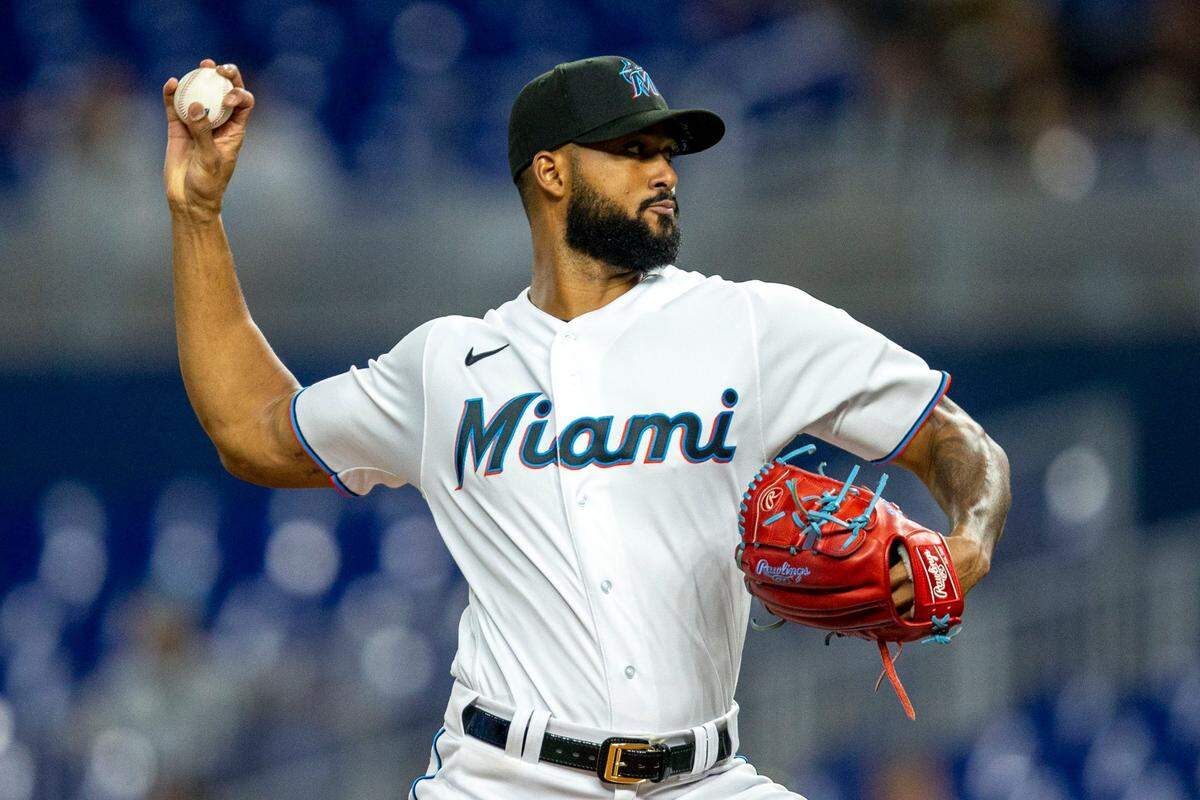
‘Trains to go nine’
Alcantara’s drive to succeed is intrinsic, fueled by his desire to live up to his potential and proudly represent his family — including his late mother and brother, both of whom he honors with an inscription on his glove.
And turning that aspiration for success into reality begins with his preparation off the mound, his four-day plan that gets him ready to be in peak form for each of his starts.
The first day after a start rarely if ever involves picking up a baseball. Instead, he’s in the gym where a two-and-a-half hour circuit workout awaits him — squats at 400 pounds to improve his lower-body strength followed by lighter weights with the chest press, triceps and forearms to keep his upper body strong but not too tight and a 60-minute run on the treadmill to finish things up.
Day 3 is his bullpen session. He throws 18 pitches, enough to get quality work in but not too much to overwork himself. Days 2 and 4 are slower days — get to the ballpark early, undergo treatment, maybe throw a low-intensity long toss session.
“He trains to go nine,” Marlins manager Don Mattingly said. “He’s built to go nine.”
The training has translated to the field, giving him the consistency the Marlins have been yearning to see from him since he became a regular in their rotation in 2019.
Entering Sunday, Alcantara leads MLB with 91 1/3 innings pitched, has the second-best ERA (1.68) and is holding opponents to the fourth-lowest batting average against (.192).
He also enters his start Sunday having thrown at least seven innings while giving up no more than two earned runs over seven consecutive outings. Alcantara is the only Marlins pitcher to ever accomplish that with all of the starts coming in the same season.
(Kevin Brown also had seven consecutive starts of at least seven innings and no more than two earned runs, but they was split between the end of the 1996 season and start of 1997).
“He’s starting to resemble the vintage Sandy that we know,” pitching coach Mel Stottlemyre Jr. said.
The Marlins have seen this evolution unfolding for a while.
Since the start of the 2019 season, when Alcantara made his first Opening Day roster and cemented himself in Miami’s rotation, his 536 1/3 innings are third most in MLB behind only Zack Wheeler (550) and Gerrit Cole (539 2/3). His 3.17 ERA is second only to Cole (2.90) among nine pitchers who have thrown at least 500 innings in this four-year stretch.
When Mattingly looks at Alcantara’s trajectory, he sees shades of Clayton Kershaw, the eight-time All-Star and three-time Cy Young Award winner for the Los Angeles Dodgers who Mattingly managed for five seasons.
“You don’t want to put him in anybody’s category or put any kind of label on him, but he is getting to be that guy that you count on him,” Mattingly said. “It’s almost like it’s six or seven [innings] on a bad night. He keeps his pitch count down early. He’s getting everything over. There’s a lot to handle.”
.JPG "MarlinsPhilliesBaseball (7).JPG")
More than just ‘great stuff’
How, exactly, does Alcantara do it?
Start with his mentality. A switch flips on game day. He knows there’s a job to do and his normally jovial demeanor quickly becomes serious.
“When I cross that line,” Alcantara said, “I don’t care about anybody. It’s time to compete.”
From there, examine his arsenal. He has four elite pitches that he is comfortable throwing in any situation. He has added a four-seam fastball that he throws at the top of the zone to complement his sinker, his natural fastball. His changeup is among the best in baseball, holding opponents to a .202 slugging mark this season. And his slider that is holding opponents to a .149 batting average rounds out the arsenal.
All four pitches average at least 90 mph, with his fastballs hitting triple digits and his changeup’s 91.8 mph average velocity by far the hardest thrown in the league among those who have thrown the pitch at least 250 times this season. The next hardest? Merrill Kelly, at 88.4 mph.
“But besides the great stuff,” Stottlemyre said, “it’s the willingness to attack the zone. It’s something we talked about a long time ago and I think now he’s able to finally put sequences together and see swings and not only see that but be able to execute it and go places with his pitches now. He exposes a lot of different parts of the zone.”
Now, watch as he gets better as the game progresses.
Opponents are hitting .194 against him in the first three innings of the game this season and .226 in the fourth through sixth innings. In the seventh inning and beyond? Their batting average drops to .098.
“When Sandy pitches,” Mattingly said, “it’s like he’s playing catch at 98 mph. It just looks easy.”
Alcantara paces himself for this. He conserves his energy early in his starts so that he can unleash his full potential late.
“I know how to use my velo and how to use my pitches,” Alcantara said. “I try not to do too much in the first three or four innings, then after that just try to throw as hard as I can.”
The data backs this up. According to Statcast, Alcantara’s average fastball velocity has been the highest this season in the eighth (98.2 mph) and seventh innings (98.1 mph). It averages anywhere from 97.4 mph to 97.7 mph over the first six innings.
Alcantara also frankly doesn’t care how he gets his outs. He doesn’t prioritize strikeouts, although he is able to get those, too. He frequently induces weak contact early in counts, which gives him the ability to work deeper into games.
“The kind of cool thing about Sandy — and I better say it quietly analytics won’t like it — they love the punchouts, but Sandy doesn’t care. He’s all about getting outs,” Mattingly said. “Sometimes teams are gonna try to put you in play early. The price of that is low pitch count. If they’re not getting hits, you’re getting nine innings of Sandy — and that’s a tough, tough act.”
Anything less than a complete game almost feels like a disappointment. Nine innings is always the goal. Alcantara has averaged just over 107 pitches per game over this current seven-game stretch.
“I think I’m ready to throw more than that,” Alcantara said.
How many pitches exactly?
“130, 150,” Alcantara said. ”I want to finish all games.”
The last time a pitcher threw 130 pitches in a game? The Oakland Athletics’ Mike Fiers when he needed 131 pitches for a no-hitter on May 7, 2019.
The last time a pitcher threw 150 pitches? Livan Hernandez on June 3, 2005 for the Washington Nationals.
It’s an old-school mentality his manager certainly appreciates.
“If it was a different time in the game, he’s probably throwing 130, 135 [pitches a game] easy,” Mattingly said. “That’s just the way it would have been. Nobody would have said anything.”
He’ll take the mound again on Sunday. After that, the slate is wiped clean. The process begins again.
“I’ve just got to keep doing my job,” Alcantara said, “and keep telling myself that I can be that guy.”
This story was originally published June 19, 2022 at 7:00 AM.
.JPG)