
How Anthony Bender’s ‘adventure’ of a baseball career resulted in him joining the Marlins
Marlins manager Don Mattingly has asked the questions multiple times: “Who is this guy and how did we get him?”
General manager Kim Ng was on the job for about two weeks when his signing became official, a low-key minor-league deal that didn’t turn heads when it was made on Nov. 30 but has paid dividends over the past few weeks.
“He’s a guy that I don’t want to say came out of nowhere,” Ng said, “but he kind of did.”
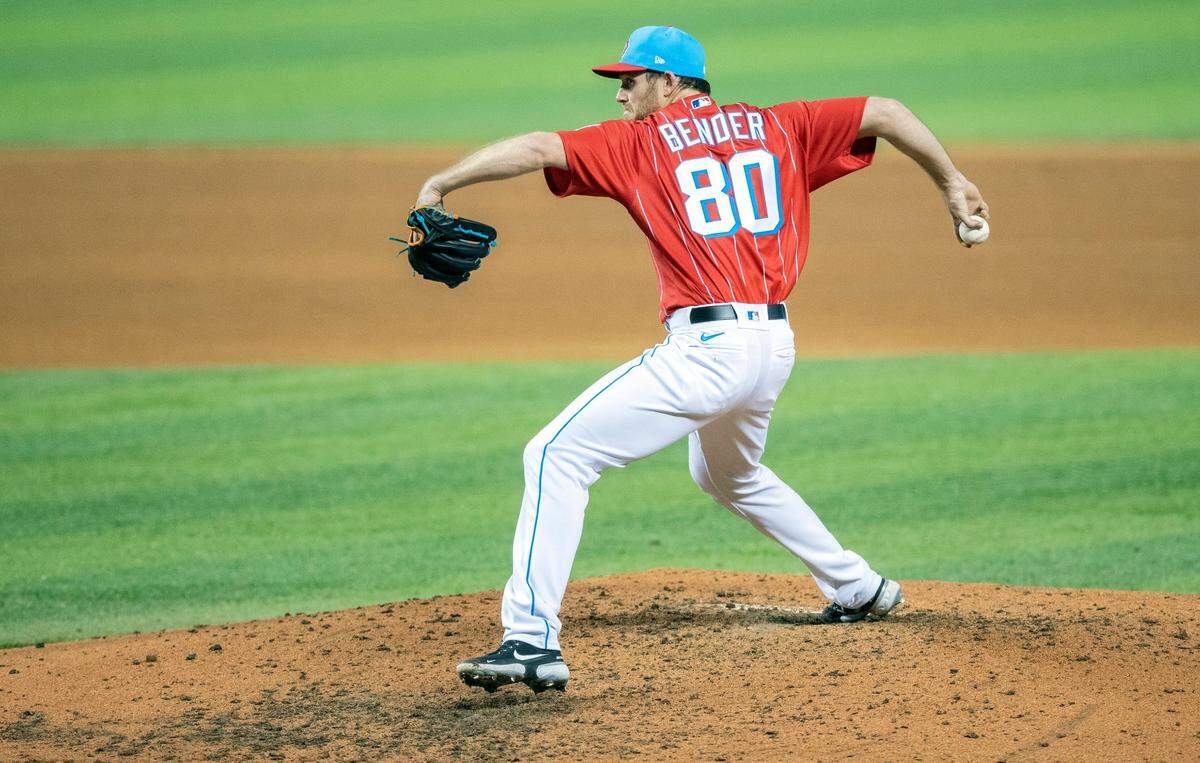
The mysterious man in question: Anthony Bender, a 26-year-old relief pitcher with a 98 mph sinker, a slider that induces a lot of swings and misses, and a heck of a journey to get to this point.
A 20th-round draft pick out of junior college in 2016. Released as a minor leaguer in 2019. Limited to playing independent ball last year during the COVID-19 pandemic before becoming a minor-league free agent once again.
And yet here he is, serving as a stabilizing middle reliever in a revamped Marlins’ bullpen and the latest under-the-radar pitcher the Marlins have acquired in recent years to make an impact for the club. Heading into Friday, Bender has held opponents to five hits, a walk and an unearned run while striking out 11 batters in 9 2/3 innings of work.
“It’s been quite the adventure,” Bender said, “and I wouldn’t trade it for anything. It just makes it that much more special. That’s what you wait for.”
How the Marlins found Anthony Bender
While Bender had to wait, the Marlins wasted little time showing their interest in him this offseason.
Bender was a couple months removed from winning a championship with the Milwaukee Milkmen of the American Association of Professional Baseball when minor-league free agency officially began and teams could make contact with players and agents.
Bender was one of the rare players that all areas of the Marlins’ baseball operations staff — from player personnel to scouting to analytics — had identified as a potential fit.
“We go through thousands of players by hand,” Marlins assistant general manager Dan Greenlee told the Miami Herald earlier this month. “We look through all these different lenses at these guys and it’s during that with Anthony Bender, the more lenses you look through, everything’s really checking out. ... You really only have a few guys standing at the end of it that you just feel like you have to have. Anthony Bender was one of those guys for us.”
Greenlee credits a multi-pronged approach from different departments inside baseball operations for finding a success story like Bender.
It starts with the pro scouting department led by Hadi Raad and the analytics department led by Myles Lewis. They are at the forefront at identifying players who could be potential diamonds in the rough.
It’s similar to how they approached acquiring other pitchers who have had success with the Marlins over recent years, a list that includes the likes of Nick Anderson before the 2019 season, Richard Bleier and James Hoyt immediately following the Marlins’ COVID-19 outbreak in 2020, and Rule 5 selections Elieser Hernandez and Zach Pop.
“Talent can come from anywhere,” Greenlee said, “and we’re really respectful of that. We don’t judge guys by their environment. We judge guys by their talent.”
Finding the players is “really only half the battle,” though, Greenlee said. From there, they need to sell the player on the what the Marlins can offer.
In Bender’s case, the Marlins were one of about a half dozen teams who reached out to his agent during the first few days of free agency.
The Marlins put a “full-court press” on Bender, Greenlee said. In addition to being the first team to reach out to him, the Marlins also added a personal touch to their pitch. They sent Bender a physical letter expressing their interest in him. Director of baseball operations Adrian Lorenzo was “really active on the phone, persistent with agents and keeping a pulse on everything.” The Marlins’ video department helped with the pitch, too.
The attention and effort resonated with Bender, who added that his mom still has the letter and that he’s “sure it’s somewhere in our kitchen.”
“It’s nice to hold something,” Bender said, “instead of just looking on your phone at the online stuff like that.”
Bender officially signed a minor-league deal with an invite to spring training on Nov. 30, the first step toward another opportunity to make his MLB debut.
‘Stay the course’
To understand Bender’s drive, you have to understand his path to his big-league debut.
After a high school career as a two-way player at Casa Grande High School in Petaluma, California, in which he had a .335 batting average as a hitter and a 2.11 ERA with 132 strikeouts in 136 innings as a pitcher with a fastball that barely touched 90 mph, Bender went on to spend three years at Santa Rosa Junior College in northern California.
It was his second year at Santa Rosa, the 2014-2015 season, when Bender began to evolve as a pitcher. He didn’t play for the Bear Cubs that season, focusing instead on his academics in an attempt to play at the Division I level for Cal State Northridge in 2017. During that time, he revamped his workout routine, started a new pitching regiment and began doing Bikram yoga to improve flexibility.
“I had a whole year off to just focus on getting stronger and more making my body move more efficiently,” Bender said. “My third year [at Santa Rosa] was when that all kind of synced up. I got my mechanics going. I was stronger. I was able to move quicker in the right ways.”
His fastball velocity increased as a result, too.
“When you’re in the velo building stages, it’s really exciting,” Bender said. “I would do weekly full effort, max effort bullpens. The first week, I hit 94 and I was like, ‘Holy smokes that’s hard.’ And then the next week, I hit 95. The next week, I hit 96, and then the next week I went into like a game and hit 97. I was like ‘Dude I don’t think I’m ever going to stop climbing.’”
Damon Neidlinger, who has been the head coach at Santa Rosa Junior College for 17 years, credited Bender for not disappearing during that year he sat out and said his internal motivation to succeed even when he wasn’t contributing showed a glimpse of his character.
“I think one of the things I was most impressed with is just the fact that this is how much of a humble freaking young guy that he is,” Neidlinger said. “He’s got confidence in his abilities, but during that year, he had to kind of sit and watch. ... He found a way and continued to stay the course.”
A year later, after helping Santa Rosa to a California Community College Athletic Association championship, the Kansas City Royals selected Bender in the 20th round of the 2016 MLB Draft. He stayed in the Royals organization for three years before being released before the start of the 2019 season.
It marked the first time Bender had any thoughts of doubt creep into his head, although the concerns were short-lived.
“If anything,” Bender said, “it helped me want it even more.”
He played two games for the Sioux City Explorers of the American Association of Professional Baseball before signing a minor-league deal with the Milwaukee Brewers. He spent the rest of 2019 in the Brewers’ organization, reaching Double A by the end of the year. After not being selected to be part of the Brewers’ 60-man player pool during the 2020 season, a year in which there was no minor-league baseball due to the COVID-19 pandemic, Bender went back to independent ball and played a full season with the Milwaukee Milkmen. He appeared in 25 games for the Milkmen, striking out 25 batters over 21 1/3 innings.
“The first time you see him [pitch], you can sort of tell that he’s different than other guys,” Anthony Barone, the manager for the Milwaukee Milkmen, told the Milwaukee Journal Sentinel. “He has a special ability, and you can see it right away. That first bullpen that he threw, it just got my attention. It didn’t take long to see how talented he was.”
‘His stuff is kind of off the charts’
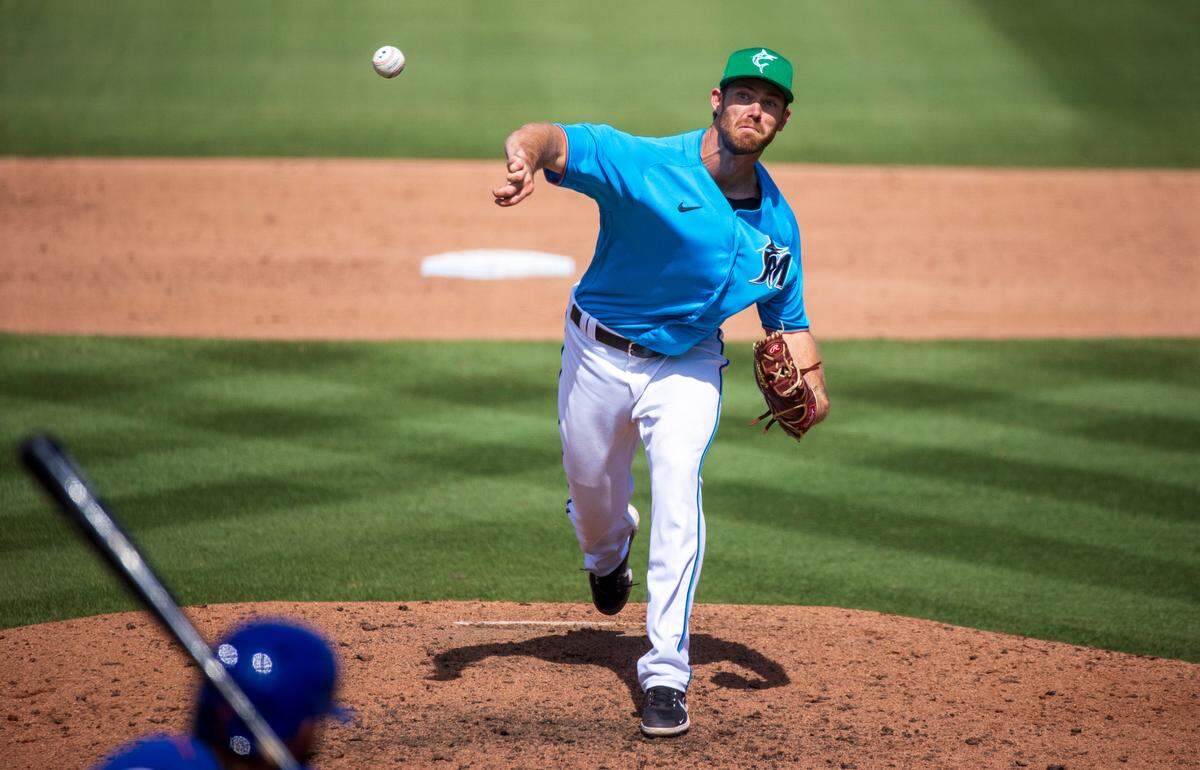
Ng’s first true recognition of Bender’s internal makeup came on March 20. It was Bender’s fifth appearance in Grapefruit League play during spring training, the eighth inning against the Washington Nationals at the Ballpark of the Palm Beaches. Bender had retired all 15 batters he had faced to that point in spring training, nine via strikeout.
And then came the moment, when the Nationals’ Carter Kieboom lifted a pitch to left field for a leadoff double — Bender’s first blemish of camp. Bender retired the next three batters he faced on a pair of groundouts and a strikeout.
“He actually hit his glove like he was surprised or that he was annoyed that he gave up the hit, his first hit in spring training,” Ng said. “I did chuckle to myself, but I think that tells you where he is in his mind set.”
After the journey he had to that point, it’s understandable. Bender knew the importance of making a good impression. He probably didn’t have many chances left.
So he kept impressing. He didn’t give up a run in spring training. He continued to hone in on his skills at the alternate training site the first month of the regular season. He was on the taxi squad for the Marlins’ second road trip of the season and told to stay behind with the club in Miami when they returned from the three-city trip.
And then, on May 5, he made his MLB debut, striking out two batters over a scoreless inning and hitting 98.5 mph on the radar gun.
The results since then have been been sterling. He has allowed just six of 35 batters to reach base and has struck out 31.4 percent of the batters he has faced. He has yet to give up an earned run in nine appearances as part of a bullpen that has quietly become one of the best in baseball.
“You don’t want to judge too much off spring,” Mattingly said. “Obviously his stuff is kind of off the charts with his movement. Now, he’s been able to come and do it here. You can’t say the spring thing anymore. It’s been nice. It adds another quality arm to our pen.”
As for Bender, he’s confident this is just the start.
“I feel ready for my time,” Bender said, “and I’m really excited to be here right now.”
This story was originally published May 28, 2021 at 9:02 AM.
.JPG)