
Brian Anderson has made strides. Marlins want to find out ‘how good he’s going to be’
The same question was posed to three people during spring training.
Where have you seen the most growth out of Miami Marlins third baseman Brian Anderson?
Manager Don Mattingly and hitting coach Eric Duncan both expressed similar sentiments. Anderson’s believing in himself more. He’s confident in his abilities as each season passes. That, in turn, is helping him become a more well-rounded player.
Anderson’s introspection, however, might be the most telling.
“Honestly, for me, I’m starting to realize that I belong at this level,” Anderson said by phone on Friday. “I think the first couple of years, you’re really trying to just grind each and every day to stay in the big leagues, and now I feel like I belong here.”
Anderson is the Marlins’ most veteran homegrown player, a third-round pick by the team in the 2014 MLB Draft who is heading into his fourth full major-league season. He has shown Gold Glove-caliber talent at third base while also steadily improving at the plate.
Anderson, 27, was pivotal for in 2020, leading the team with 11 home runs and 38 RBI while posting a .810 OPS as the Marlins reached the playoffs for the first time in 17 years.
The 2021 season will be his latest chance to continue his upward trajectory and make a statement regarding his value. Anderson, who is under team control through the 2023 season, has made it known that he would like to stay with the Marlins long-term. First-year general manager Kim Ng, however, has made it clear that the team’s plan for now is to see how the 2021 season unfolds before starting contract talks.
So for now, Anderson’s focus is on the season, which begins Thursday against the Tampa Bay Rays.
“He just has to make the decision,” Mattingly said, “on how good he’s going to be.”

Breaking down his offense
Anderson has been pretty good for the Marlins.
He has a career .266 batting average, .349 on-base percentage and .431 slugging mark with 42 home runs, 177 RBI and 182 runs scored in 366 MLB games.
Anderson doesn’t focus on hitting home runs. His focus rather, is to hit the ball hard and aim for the outfield gaps. The results, he says, will come from there.
Those results so far:
▪ His batting average is better than it should be, according to analytics: According to Statcast’s analysis of the 1,003 balls Anderson has put into play during over his big-league career, his career batting average is 14 points higher than what metrics and analytics would expect it to be (.252). Only Nolan Arenado (plus-.037), Kris Bryant (plus-.030) and Rafael Devers (plus-.017) have better rates than Anderson among regular third basemen since Anderson made his MLB debut on Sept. 1, 2017.
▪ Just get the ball in play: Anderson has a .325 career batting average on balls in play, which ranks second among third baseman with at least 1,000 plate appearances since he made his MLB debut and 35th in all of baseball in that time frame (teammate Jorge Alfaro, coincidentally enough, leads MLB with a .376 BABIP). He’s one of just six third basemen with a BABIP of at least .300 in that span. The others: Bryant (.330), Justin Turner (.321), Devers (.320), Anthony Rendon (.317) and Arenado (.304).
▪ Making hard contact: Anderson’s barrel rate, defined by Statcast as the rate at which a player has a batted ball with an ideal combination of exit velocity and launch angle to result in base hits, has increased every year he has been in the big-leagues, topping at 9.6 percent in 2020 (league average is 6.4 percent). His 43 percent career hard-hit rate, defined as the rate of balls put into play with an exit velocity of at least 95 mph, is well-above the league average of 35.1 percent.
“He’s the type of hitter that if you make a mistake in the zone, he really does have a chance to punish you,” Duncan said.
▪ Having guys on base helps: Anderson has a .336 batting average with runners in scoring position and just a 19.5 percent strikeout rate. He is hitting .292 if he runners on base at all. Meanwhile, he hits just .245 with no one on base and has 208 strikeouts in 862 plate appearances in such situations (24.1 percent).
▪ Batting fifth: Anderson has primarily batted anywhere between second and fifth in the lineup during his career.
Mattingly’s plan for 2021 is to keep Anderson toward the back end of that extreme, with Corey Dickerson and Starling Marte expected to bat first and second and two of Jesus Aguilar, Adam Duvall and Garrett Cooper batting third and fourth daily.
The numbers certainly support that decision.
In 86 games and 353 plate appearances batting fifth, Anderson has hit .307 with a .371 on-base percentage, .473 slugging and .844 on-base percentage — all better than his production at any other spot in the lineup with the exception of slugging (.492 when hitting fourth).
“Any time you add quality bats in the lineup, you’re gonna see better pitches,” Anderson said. “There’s certainly more names in the lineup this year that they’re really trying to focus on, so just having those guys always having good at-bats day-in and day-out obviously is gonna help me hopefully get some better pitches as long as I stay disciplined.”
Don’t forget about his defense
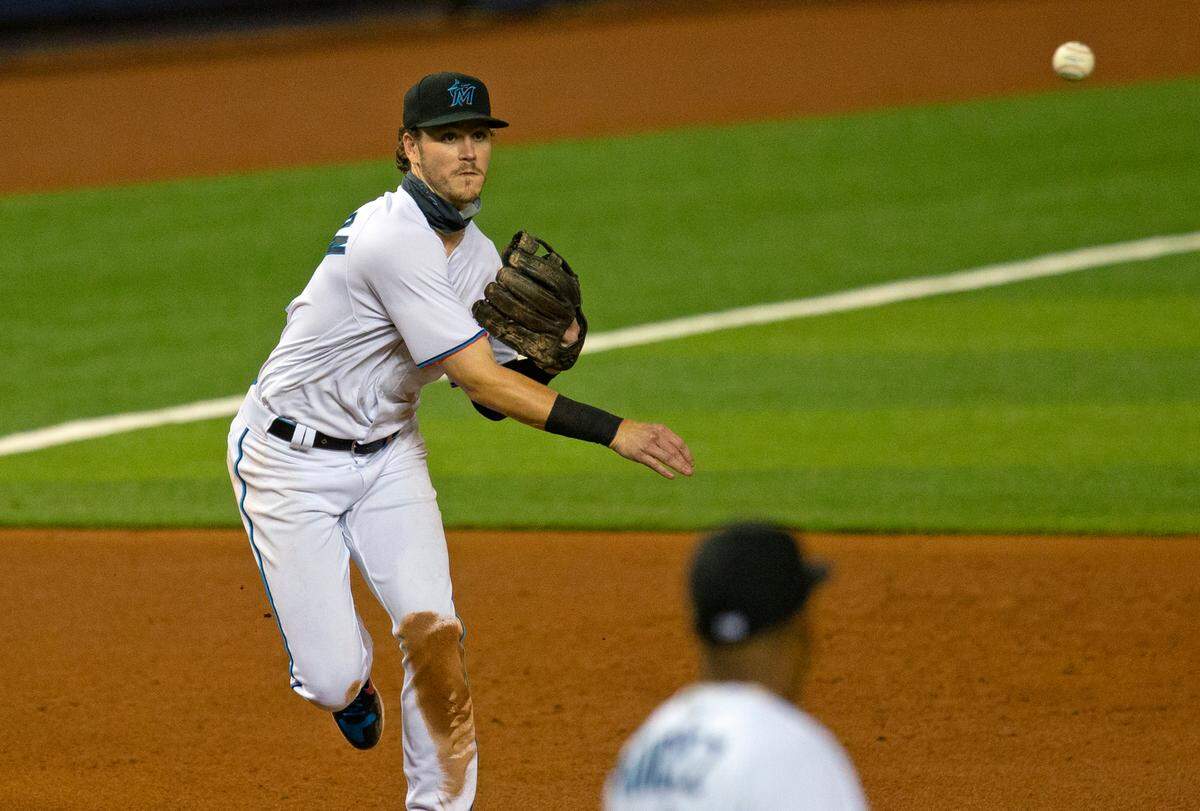
In addition to his offensive prowess, Anderson was a first-time finalist for a Gold Glove Award last season after posting a .946 fielding percentage over 468 innings, 460 of which were at third base. He helped turn 11 double plays over the shortened 2020 season, tied with Jose Ramirez for sixth most among third basemen.
But his prowess at the hot corner goes deeper than that.
According to advanced analytics by FanGraphs, Anderson last season successfully made plays on 77 percent of balls put into play that should normally be fielded by a third baseman (94 out of 122). That was the fourth-highest rate among 17 qualified third basemen, behind only the Arizona Diamondbacks’ Eduardo Escobar (79.1 percent, 68 of 86 plays), the Chicago White Sox’s Yoan Moncada (79 percent, 79 of 100 plays) and the New York Yankees’ Gio Urshela (78.3 percent, 72 of 92 plays). The league average among the 17 qualified third basemen was 73.3 percent.
And remember: 2020 was the first season in which Anderson played exclusively at third base (save for one inning at second base and one start at first base during a doubleheader against the Orioles immediately following the team’s COVID-19 outbreak). He spent 2018 and 2019 flipping between third base and right field.
“If definitely can help, not having to worry about where you are in the field,” Anderson said. “I try to have my routines and stick to them so I can go out there and compete.”
Anderson’s next step
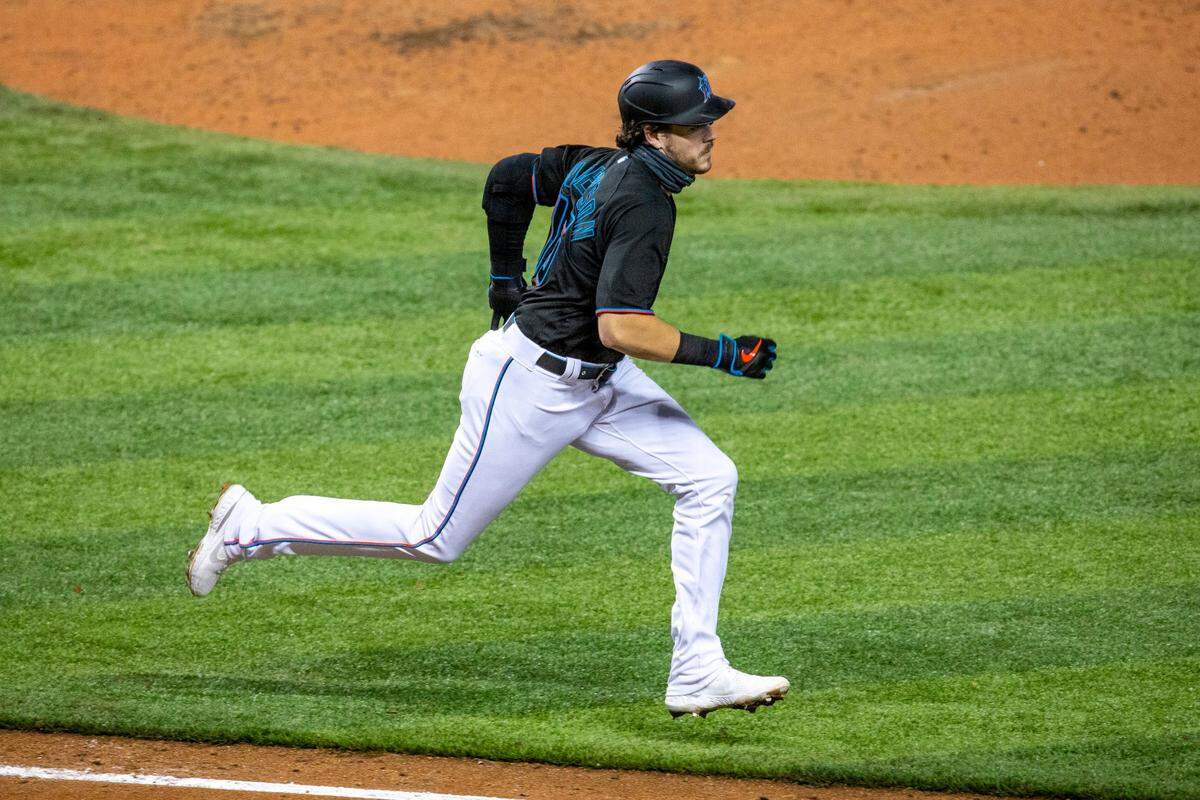
So where does Anderson go from here? He points to the need to get more consistent, continue to find ways to put less pressure on himself and let the results come naturally.
“I have to go out there every day,” Anderson said, “and keep proving myself.”
This story was originally published March 26, 2021 at 3:10 PM.
.JPG)