
A look at the Marlins’ catcher situation and what progress needs to be made in 2021
It’s not viewed as necessarily the highest priority on the Miami Marlins’ offseason to-do list, but it is one that needs to be addressed.
As the Marlins head into 2021, they are most likely going to stick with their primary catching duo from 2020 in Jorge Alfaro and Chad Wallach.
Marlins general manager Kim Ng understands the situation behind the plate.
Alfaro, acquired along with Sixto Sanchez and Will Stewart as part of the J.T. Realmuto trade in February 2019, was supposed to be the Marlins’ primary catcher. He’s had mixed results since then (.256 batting average, 16 doubles, 21 home runs, 73 RBI, 56 runs scored but 190 strikeouts against 26 walks over 161 games while being average at best defensively).
Wallach, the better defensive catcher of the two, started all five of the Marlins’ playoff games with manager Don Mattingly prioritized pitching and defense over having an extra power bat in the lineup.
“I think last year, Alfaro probably wasn’t where we had hoped he would be, but I think that we were very fortunate to have Wallach there to pick up some of the slack,” Marlins general manager Kim Ng said earlier this offseason. “I think at this point we’re hoping both come into spring training ready to go and we’ll make decisions then.”
Alfaro and Wallach more or less represent opposite ends of the spectrums as players.
Alfaro is more offensive-minded. He’s had more success at the plate (career .732 OPS vs. Wallach’s .600), has more power (career 90.4 mph average exit velocity vs. Wallach’s 88.1 mph) and is more nimble on the basepaths (Alfaro’s career 28.5 mph average sprint speed ranks second in MLB only to Realmuto’s 28.7 mph.)
But with Alfaro’s biggest strength comes one of his biggest weaknesses. While the 27-year-old catcher has the potential to destroy a baseball every time he takes a swing, his contact rate is abysmal.
Alfaro’s 39 percent swing-and-miss rate over the past two seasons is the fourth-worst in baseball among batters who swung at a minimum of 500 pitches. He has a 33.6 percent strikeout rate over the last two seasons.
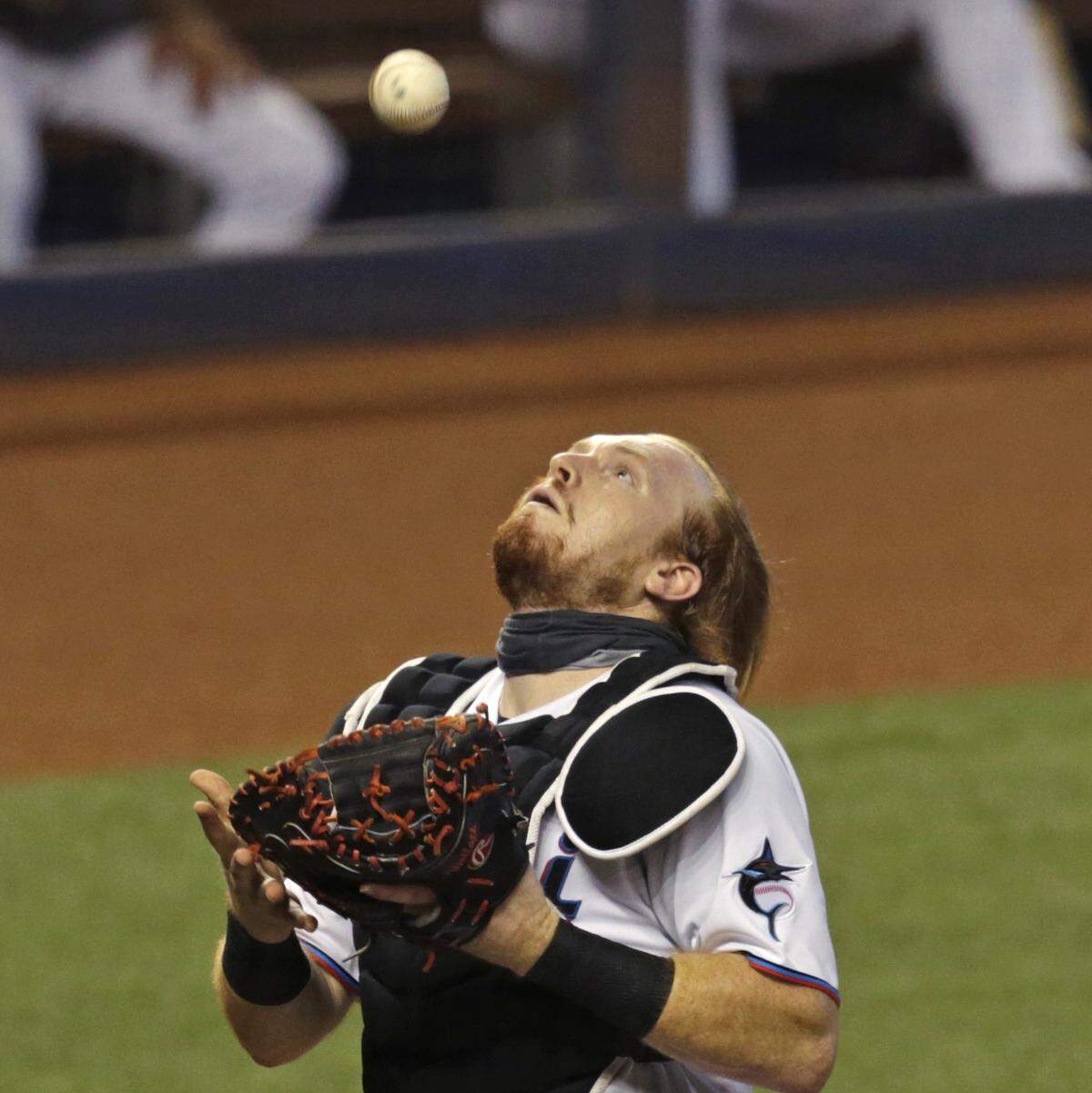
Wallach, meanwhile, prioritizes defense and game-calling. He has allowed just two passed balls over his career and has thrown out nine of 25 potential base stealers (a 36 percent success rate that tops Alfaro’s 27.5 percent efficiency).
He helped get Pablo Lopez out of a mid-season funk. After Lopez had a two game stretch in which he gave up 12 runs over 5 2/3 innings, Lopez posted a 2.01 ERA with 26 strikeouts against five walks and 11 hits allowed in 22 1/3 innings over his final four starts.
Wallach is also a moderately better framer, which helped get extra called strikes on the edge of the strike zone. According to Statcast, 45.8 percent of non-swings on pitches just outside of the strike zone with Wallach behind the plate were called strikes. That’s not great, ranking 43rd out of 52 catchers who had at caught at least 500 pitches fitting this description. There were 19 catchers in the league who had at least a 50-percent rate.
But it was better than his counterpart. Alfaro ranked last at 41.3 percent.
The Marlins’ other options
While the Marlins might seem content with sticking with who they have behind the plate, there’s always the possibility of bringing someone in via free agency to provide competition or mentorship to the young duo of Alfaro and Wallach.
Notable catchers still on the market (not including Realmuto) include Tyler Flowers, Jason Castro, Wilson Ramos, Austin Romine, Stephen Vogt, Sandy Leon and Kurt Suzuki among a slew of others.
Their top catching prospect, Will Banfield, hasn’t played above Class A ball and is likely at least two years away from seeing any sort of action at the MLB level.
This story was originally published December 24, 2020 at 11:58 AM.
.JPG)