
With roster pool set, Marlins ‘walk that fine line’ between development and winning
Michael Hill went through various permutations of what the Miami Marlins’ 60-player roster pool could look like. Hill, the Marlins’ president of baseball operations, knew he had to find the right balance.
With the uncertainty of the minor-league season, he wanted as many of the club’s top prospects to be guaranteed practice time and keep getting valuable reps. But with an unprecedented 60-game season that could give the Marlins a chance to be a dark horse in a year where baseball becomes a sprint instead of a marathon, maximizing talent and being ready for any number of unknowns — from positive COVID-19 tests to freak injuries — needed to be addressed as well.
“It’s been ongoing discussions for us essentially since we shut down in mid-March,” Hill said, “just trying to walk that fine line.”
The first step came Sunday when the Marlins announced their initial list of 57 players who will be part of their roster pool for summer camp workouts that start Friday to get ready for the season that for the Marlins starts on July 24. The selected names — the majority of whom opened spring training with the Marlins in February — consist of the players on the team’s 40-man roster plus a healthy mix of additional top prospects and veterans on minor-league deals.
That list will expand to the full 60 in the coming days with the addition of 2020 first-round pick Max Meyer, veteran infielder Sean Rodriguez and veteran right-handed relief pitcher Nick Vincent.
Another needed point of emphasis: No Marlins player has chosen to opt out of the season as of Monday due to potential health concerns.
“Everyone is is back,” Hill said. “We’ll go through our intake process to clear them to participate. And then we’ll move forward towards the start of the season.”
How the pool works
It’s important to remember that a player isn’t guaranteed a spot on the big-league roster just because he is part of the roster pool.
In fact, not everyone is even going to Marlins Park for the second round of camp. Seventeen of the 57 players will open the training session at the Marlins’ alternate training site at the Roger Dean Chevrolet Stadium Complex in Jupiter, where the team normally holds spring training.
The players named serve as the pool for the Marlins to pick from for their big-league roster, which on Opening Day will consist of 30 players and eventually be dwindled down to a maximum of 26 after the first month of the season. Players can be added to the pool at any time during the season as long as a club stays at or below the 60-player limit. However, a team is not allowed to add players back to the pool if they are released or outright waived. Those on the 60-day injured list or the newly implemented COVID-19 Related IL do not count against the 60-player limit.
Those who aren’t on the active roster during the season will be assigned to the team’s alternate training site — Jupiter, in the Marlins’ case. Up to three players, one of which must be a catcher, can serve as a taxi squad on road games when the season begins. Intrasquad games and practices are allowed at the alternate training site.
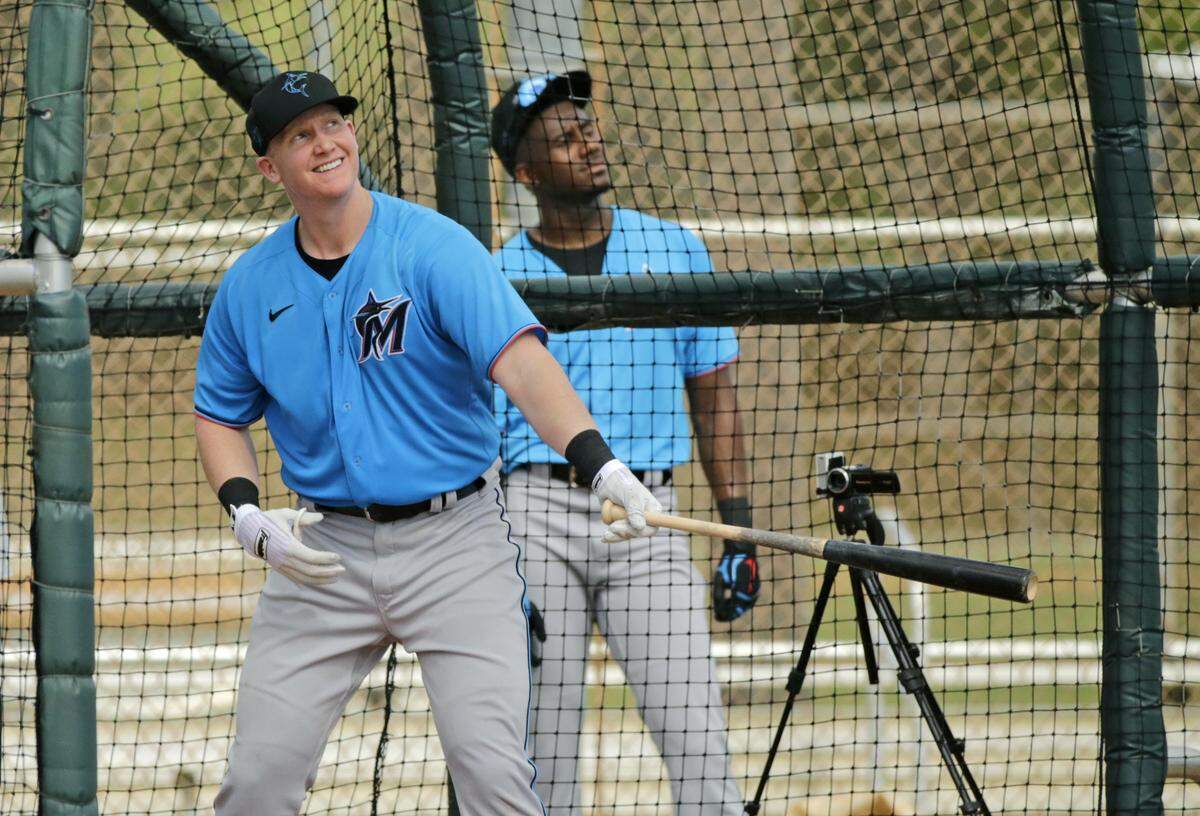
Constructing the roster
Having those four extra roster spots to start the season will give the Marlins some flexibility to sort some of their roster battles that were still undecided when spring training stopped.
At that time, the Marlins were still figuring out their fifth starter (likely between Elieser Hernandez and Jordan Yamamoto), their bullpen, their right fielder to platoon with Matt Joyce (Lewis Brinson, Harold Ramirez, Garrett Cooper and Monte Harrison among the main contenders) and the last spot of what would have been their four-player bench.
But the biggest difference the Marlins have to factor in is having the designated hitter spot to work with this year as part of the health and safety protocols put in place for the 2020 season. Hill said the Marlins plan to rotate players around in the DH slot throughout the season but also singled out Cooper and Jesus Aguilar, both of whom were contending for reps at first base.
Doing so will allow players to get needed off days during the season
“When you look at the challenges that we’ll face in a 60-game sprint and keeping guys healthy and giving them necessary rest, the thought is that we’ll cycle guys and take advantage of that DH position,” Hill said. “... We’ll look at our versatility and the fact that we can cycle guys through the DH spot and keep them fresh.”
Prospects to watch
Four of the team’s top 30 prospects — and three of the top 10 — are among the 40 players who will start camp at Marlins Park, which is where the main contenders to open the season on the 30-man roster are practicing.
The quartet: Shortstop Jazz Chisholm (No. 3 in the organization and No. 66 in MLB), outfielder Harrison (No. 9 in the organization), right-handed pitcher Nick Neidert (No. 10 in the organization) and left-handed relief pitcher Alex Vesia (No. 27 in the organization).
“At this point, we want to make sure that those players are getting the necessary work,” Hill said. “You don’t know how this is going to unfold and you want to make sure that they’re continuing to get what they need so that if and when they’re called upon, they’ll be able to help us win ball games.”
Harrison, Neidert and Vesia were the last three top prospects remaining in spring training when MLB went on hold. Chisholm was sent to minor-league camp in the second round of spring training cuts.
Chisholm, obtained from the Arizona Diamondback for pitcher Zac Gallen at last season’s trade deadline, is viewed as Miami’s shortstop of the future. The Bahamas native is a plus defender with the potential to hit for power but needs to cut down on his strikeout rate.
Harrison, one of four players obtained as part of the Christian Yelich trade with the Brewers in January 2018, is regarded as one of the Marlins’ most athletic prospects. He can hit for contact and power, steal bases and hold his own defensively. If not for a wrist injury, he likely would have made his MLB debut last season.
Neidert, obtained as part of the Dee Gordon trade, started at Triple A last season but missed significant time during the regular season after undergoing knee surgery. He dominated at the Arizona Fall League, posting a 1.25 ERA with 19 strikeouts in 21 2/3 innings over five fall league starts.
Vesia, the Marlins’ 17th-round pick in 2018 and the only one of the four not on the team’s 40-man roster, is riding a 41-inning scoreless streak dating to last season. This includes 11 1/3 innings in the Arizona Fall League and six innings in spring training.
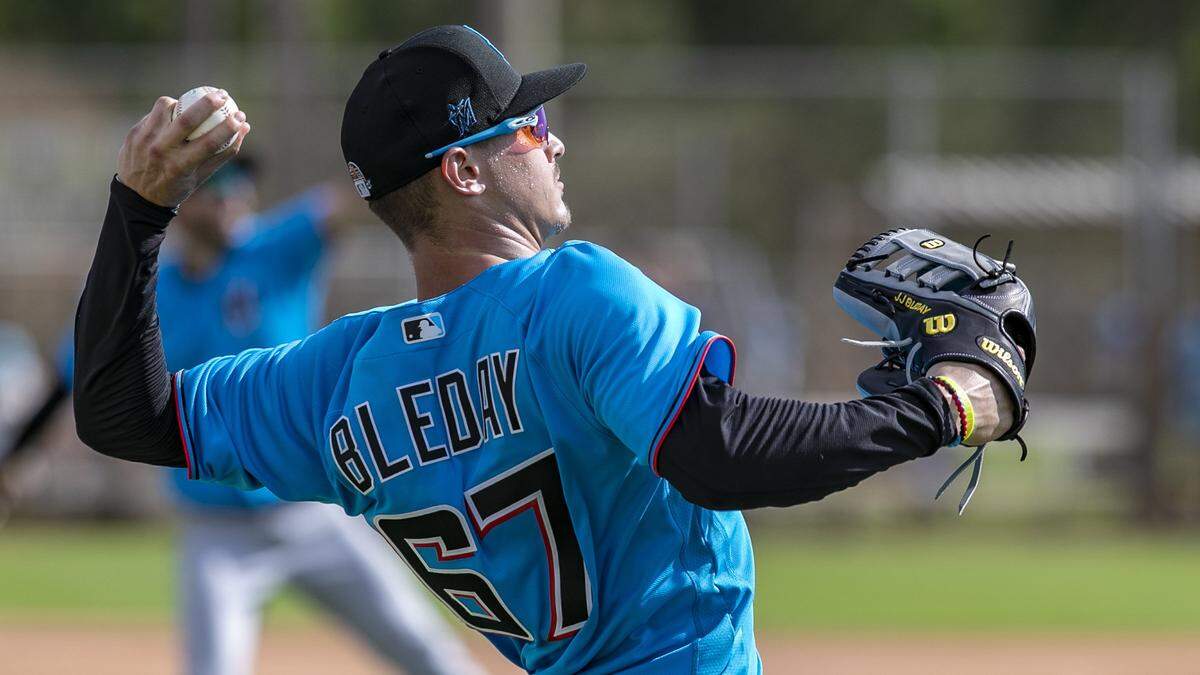
Needed reps
Including those four, the Marlins have 19 of their top 30 prospects among the 57 players in their roster pool, even though most are unlikely to see playing time at the major-league level this year.
Outside of the dozen prospects already on the Marlins 40-man roster, the list includes 2019 first-round pick outfielder JJ Bleday (No. 2), 2016 first-round pick left-handed pitcher Braxton Garrett (No. 6), 2017 first-round pick left-handed pitcher Trevor Rogers (No. 8), infielder Jose Devers (No. 11), rising outfielder prospect Jerar Encarnacion (No. 15) and 2019 second-round pick catcher Will Banfield (No. 25). Max Meyer, the Marlins’ 2020 first-round pick, will also be part of the roster pool once he signs his contract, which is expected to happen later this week.
By adding prospects who are unlikely to play in the big leagues this year — Bleday, Meyer (eventually) and Banfield most notably — it allows the organization to continue giving those players needed reps under team supervision with the minor-league season all but officially canceled.
“We wanted to make sure that we got our top prospects, as many as possible, back into the development setting,” Hill said, “so that we can continue their improvements and get them eventually ready for the big leagues.”
.JPG)