
Seagulls? Check. Flamingos? Not yet. Marlins miss deadline to rebuild ‘Homer’ outside
The Miami Marlins missed a Jan. 1 deadline to rebuild the home-run statue that Derek Jeter wanted banished from centerfield, but the installation outside of the county-owned ballpark is expected to be finished later this month.
With “Homer” still under construction outside Marlins Park, the team could face a $2,000 county fine for every day the seven-story mechanical sculpture’s rebuild remains incomplete.
Fines appear unlikely for delays in reassembling a piece of art originally designed to lead the park’s celebration of Marlins home runs but now slated to come to life outside Marlins Park daily as a selfie backdrop. The head of Miami-Dade’s arts arm said Wednesday he wanted the fines waived because the missed deadline stemmed from unexpected difficulties converting the statue’s whirring seaside icons, lasers and fountains from interior use to outdoors.
“They’ve done a great job,” said Michael Spring, a deputy to Mayor Carlos Gimenez. Spring negotiated the relocation agreement for Homer that Jeter sought from the Gimenez administration shortly after he and partners bought the team in 2017 for $1.2 billion. “To get the artwork permitted outside, they realized they had to re-engineer the inner workings to meet code.”
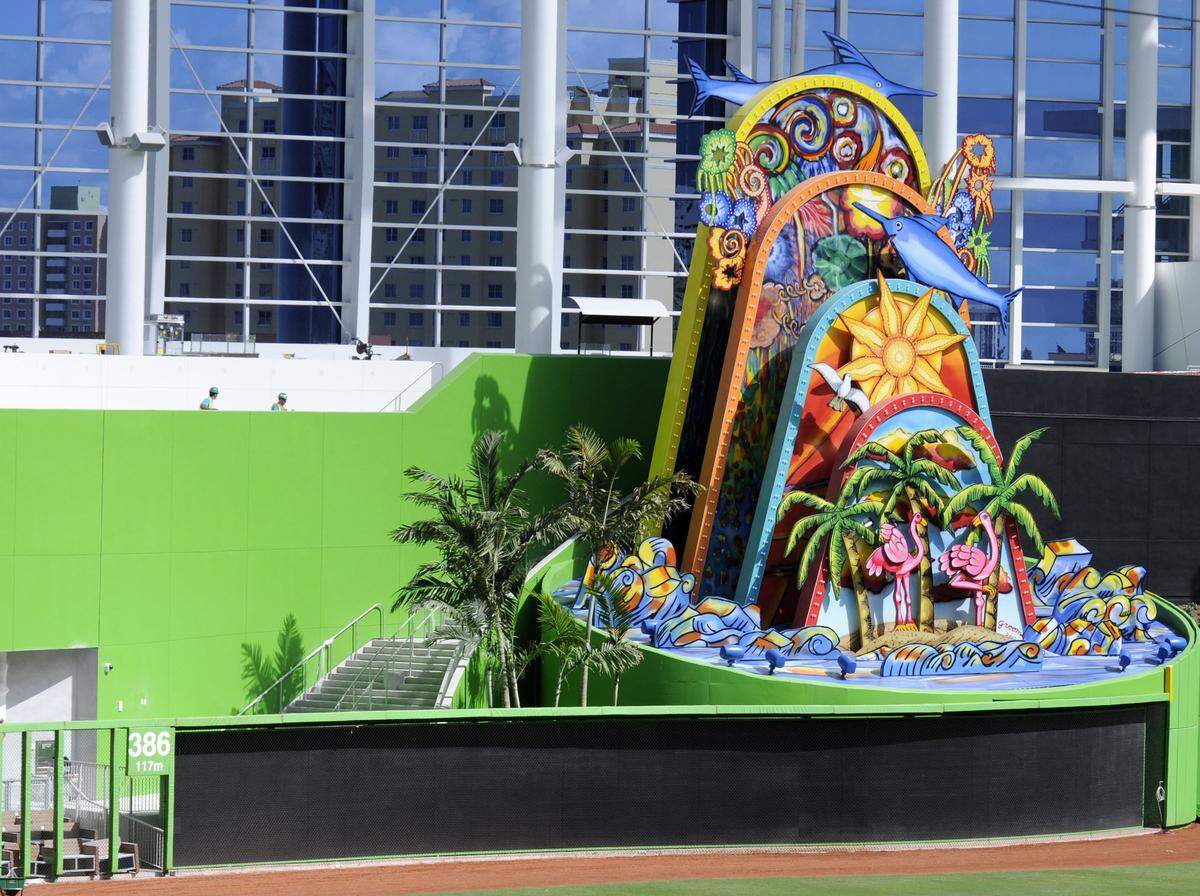
While former owner Jeffrey Loria, a New York arts dealer, championed the county-commissioned statue from renowned pop sculptor Red Grooms, the Jeter group wanted “Homer” gone and the former New York Yankees star personally lobbied Gimenez for permission to move it.
Early plans involved moving “Homer” to the Miami waterfront or Miami International Airport, but the county and team eventually settled on a location on the exterior grounds of Marlins Park. The Marlins used the space where Homer once stood to build a new multi-story spectator area now branded “Autonation Alley.”
Gimenez appeared before Miami-Dade’s Art in Public Places board in October 2018 to win a modification of the original county agreement with the Marlins that brought the statue to the tax-funded stadium in Little Havana for its first Opening Day in 2012. All county buildings are required to install artwork, and Miami-Dade pays $20,000 a year to maintain Homer.
Moving Homer gave Jeter his most visible break with Loria, a friend of Grooms and collector of his work. Loria had urged the artist to submit a proposal to Miami-Dade for the stadium’s centerpiece art under a 2009 county development deal with the team to build the stadium. The kitschy statue’s seaside icons, water jets and lights were timed to come to life long enough for a typical player to run the bases after a home run.
The county-owned art charmed some and annoyed others (including Gimenez, who told the media he wasn’t a fan of Homer). David Samson, the former team president under Loria, called the decision a cave to Jeter at the expense of Miami-Dade’s commitment to artistic integrity. In 2018, Grooms, an artist in his 80s, urged the county’s Art in Public Places board to leave Homer in place, but the relocation agreement passed unanimously.
“It’s very concerning any private individual will have an opportunity to impact a piece of public art,” Samson said. “I could care less about Jeter. What about the next person?”
This week, Homer’s 70-foot structure appeared fully assembled outside Marlins Park. But its face was only half-finished. In place were the seagulls and fish that whirred to life for a Marlins home run. But the flamingos whose wings also flapped at a home-team homer were missing, as were the curlicue neon lights previously flanking the the top of the “sculpto-pictorama.”
Under the Marlins agreement to move Homer, the team agreed to cover extra expenses tied to having the statue outside. The Marlins said the team still plans to have the statue come to life whenever the Marlins hit a home run at Marlins Park.
Chip Bowers, head of business operations for the Marlins until last year, also said in 2018 that the statue would come to life every day at 3:05 p.m., creating what he called a reliable “Instagrammable” moment in honor of Miami’s original 305 area code.
The Marlins declined to comment for this story, but a representative who did not want to be quoted blamed delays on high winds complicating crane work for Homer. The representative also said the 3:05 daily activation for Homer remains “the plan.”
The agreement approved by the arts board in 2018 states the Marlins “shall remit” to the county $2,000 “per day for each day the completed movement of Homer is delayed” beyond Jan. 1, 2020.
Spring said he’ll be asking the Art in Public Places board to modify the agreement to allow for a later deadline “given the time and resources it has taken [the Marlins] to get this right.”
“We are excited about how the sculpture looks in its new location,” Spring said in an email, “and looking forward to it being back on the roster well before the new season!”
This story was originally published January 9, 2020 at 7:47 AM.