
Hetherman’s defense was a Hurricanes breakthrough in 2025. What’s in store for Year 2?
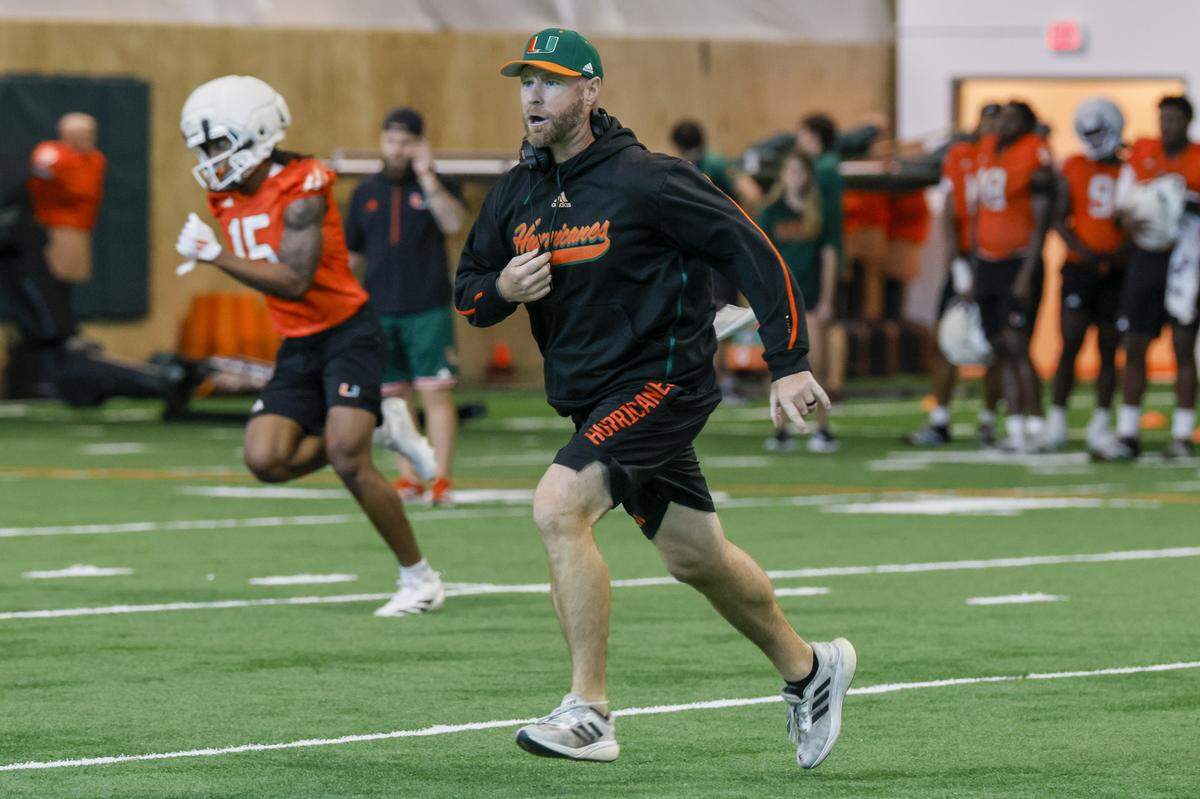
It’s not hard to find Miami Hurricanes defensive coordinator Corey Hetherman on a practice field.
He’s the one flying around, first with the linebackers during individual drills and then weaving and bobbing toward the rest of the position groups with his unit.
“He has the best gait of anybody I’ve ever seen,” Hurricanes offensive coordinator Shannon Dawson said of Hetherman’s pacing around throughout practices.
There’s a method behind Hetherman’s madness, which is probably the most apt description of his coaching style. He demands his players to play in such an intense fashion every snap they’re on the field, whether it’s in practices or during games. It’s only fitting he coaches with the same demeanor.
“The biggest thing is the energy, the excitement,” Hetherman said after practice Thursday. “We want our guys to love coming into the building. We want our guys to love being here. ... My favorite thing is coming in the building. I love being here. I love it when our guys compete. I love watching our guys go out and get better every single day — and that’s the environment we want to create for our defense and for the whole team is the excitement. Guys flying around, then guys celebrating together and enjoy playing together as a team.”
Hetherman’s side of the ball had plenty to celebrate last season. The turnaround Miami’s defense had in 2025 during Hetherman’s first season leading the unit is a major reason the Hurricanes reached the College Football Playoff National Championship Game. Miami finished the season ranked fifth in points allowed per game (14.8) and 12th nationally in yards allowed per game (294.1) and per play (4.68). Hetherman was a finalist for the Broyles Award, given annually to college football’s top assistant coach.
So what’s in store for Hetherman’s encore season?
“It’s a clean start,” Hetherman said.
As much as Hetherman’s group succeeded in 2025, as much as those strides have been well-noted, Hetherman knows he and the Miami defense can’t rest on those laurels.
The group returns plenty of key characters — all four of its main outside cornerbacks (Xavier Lucas, OJ Frederique Jr., Ethan O’Connor and Damari Brown), two veteran linebackers (Mohamed Toure and Chase Smith), two safeties on the rise (Zechariah Poyser and Bryce Fitzgerald) and its primary defensive tackles (Justin Scott and Ahmad Moten Sr.).
But Rueben Bain Jr. isn’t lining up for Miami in 2026. Neither is Akheem Mesidor. Nor Keionte Scott. Nor Jakobe Thomas. Nor Wesley Bissainthe.
“The guys that left are a very, very talented group,” Hetherman said. “They changed the game.”
But Hetherman knows a lot of talent remains on this defense and that newcomes and depth players from last year will help augment the losses.
On the defensive line, Missouri transfer Damon Wilson II plus returnees Marquise Lightfoot and Armondo Blount will be the main players tasked with replacing Bain and Mesidor’s production on the edge. Hayden Lowe, who missed his true freshman season with injury, should be in the mix as well.
At linebacker, sophomores Kellen Wiley Jr. and Ezekiel Marcelin Jr. plus redshirt junior Kamal Bonner (who played sparingly in 2025 while dealing with injury) should be in the mix behind Toure and Smith.
And look to Boston College transfer Omar Thornton and true freshman JJ Dunnigan to supplement the depth at safety and potentially get time at nickel corner (the main position Hetherman and Co. needs to figure out before the season).
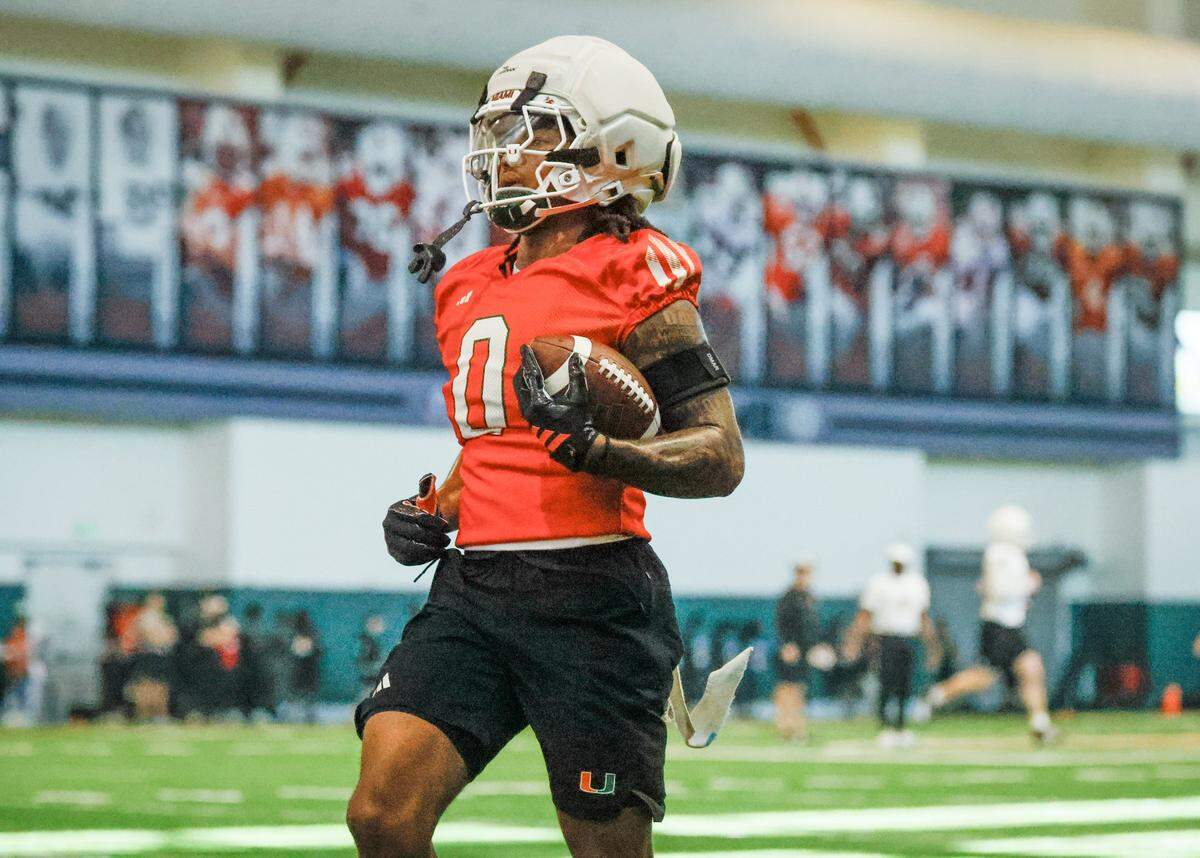
All that said, Hetherman isn’t setting a depth chart just yet. Instead, his focus is on mixing and matching players with various levels of experience to make sure everyone on the roster is comfortable playing with each other.
“In spring ball and fall camp, one of the biggest things we try to do is I don’t want the same guys playing with each other,” Hetherman said. “All of a sudden, you start figuring out ‘This guy makes all the calls. That guy doesn’t say anything.’ We are getting guys to pick each other up. I want older guys playing with younger guys. I want experienced guys playing with guys that need to get the experience. We want our guys picking each other up and coach each other up. I love it when you see something happens on a field and before a coach can even do anything, you see one of the other players go jumping in a good way, in a positive way. ‘Hey, man, that’s what we’re doing.’ ‘Hey, keep your head up.’ ‘This is how we’re going to play this.’ Keep communicating. Keep pulling each other up. It’s awesome to see our veteran guys take that ownership, take that leadership. ... That brings everyone in the program up, gets everyone to the same level, and then we don’t blink who’s on the field.”
That has Hetherman’s wildly controlled approach to coaching. It’s one that, according to his offensive coordinator counterpart Dawson, is fitting for his role because of the ramifications that come should the defense fail.
“Defenses can’t punt,” Dawson said. “So if they mess up, [the opponents] score. If we don’t get a third down, we punt, which is not good — everybody’s booing you, and everybody hates you — but we don’t give up seven points. And so the defense is just wired a different way, and that’s a good thing,”
Miami repaed the benefits of that approach last year.
With Hetherman back, they’re looking to build on it even more in 2026.
“There’s a lot of competition at all three levels, and that’s just gonna make us better, Hetherman said. “As you can see, every rep, there’s nothing guaranteed, so they’re competing. They’re laying everything out there to get better and push themselves every single day. And our guys, they love each other. They’re competing together, and it’s making the entire room better, which is excellent for us.”
This story was originally published March 26, 2026 at 2:53 PM.
.JPG)