
‘That’s our leader’: How Mario Cristobal got Miami Hurricanes back to relevance
![Miami Hurricanes head coach Mario Cristobal pumps his fiest as he leaves the field] College Football Playoff semifinal against the Mississippi Rebels in the Fiesta Bowl at State Farm Stadium on Friday, January 9, 2026 in Glendale, Arizona.](https://www.miamiherald.com/public/latest-news/d1n195/picture314260040/alternates/LANDSCAPE_1200/MIA_2025-01-08AD4291UMvsOleMissFiestaBowl.JPG "Miami Hurricanes head coach Mario Cristobal pumps his fiest as he leaves the field] College Football Playoff semifinal against the Mississippi Rebels in the Fiesta Bowl at State Farm Stadium on Friday, January 9, 2026 in Glendale, Arizona.")
“We want to make sure the program here is always a program you can be proud of for the right reasons. A program of relentless competitors. Always, always a team that nobody wants to play. That’s what we want to be. That’s what you’ve got to work to be because I can’t proclaim that. I can’t tweet that. We’ve got to get together with these coaches and these young men and we’ve got to be that. We need to speak that into existence. We’ve got to work that into reality.”
Mario Cristobal said these words Dec. 7, 2021, the day he was introduced as the Miami Hurricanes’ head coach — the new overseer of his alma mater and a once-proud football program. He won two national titles with these Hurricanes as a mauling offensive lineman, helping pave the way for championships in the 1989 and 1991 seasons.
The Hurricanes have won one national title since then, in 2001.
The drought had reached two decades, with four full-time head coaches and two interims having come and gone since Larry Coker last led Miami to the top of the college football world, by the time Cristobal made his way back to Coral Gables.
It was time for a change. Cristobal sought to be that change.
His goal was simple: Get the Hurricanes back to a place where they are nationally relevant, where they are competing for championships annually, where they are stable enough to avoid the long droughts of success that preceded him.
Accomplishing the goal wasn’t going to be a quick fix. It was going to take some time to do it right.
But in four years’ time, Cristobal has the Hurricanes on the cusp of an elusive sixth national championship — on the brink of accomplishing what he set out to do when he took the job.
The No. 10 Hurricanes (13-2) play the No. 1 Indiana Hoosiers (15-0) in the College Football Playoff National Championship Game on Monday night (7:30 p.m., ESPN). The game is on Miami’s home field at Hard Rock Stadium.
It’s the latest moment of validation for Cristobal’s plan to get the Hurricanes back on the map, the trying times at the start of his tenure and the endless work behind the scenes finally reaping benefits.
It took a commitment from the university, the athletic department and roster he assembled to make it happen.
He and they hope they’re merely getting started.
“That’s our leader,” edge rusher Akheem Mesidor said, “and I’m ready to do whatever it takes for him. If he tells me, ‘You run through this wall and we’re gonna get to the national championship,’ I’m gonna run through that wall. I believe in him. We all believe in him. So whatever he says, we’re all gonna follow.”
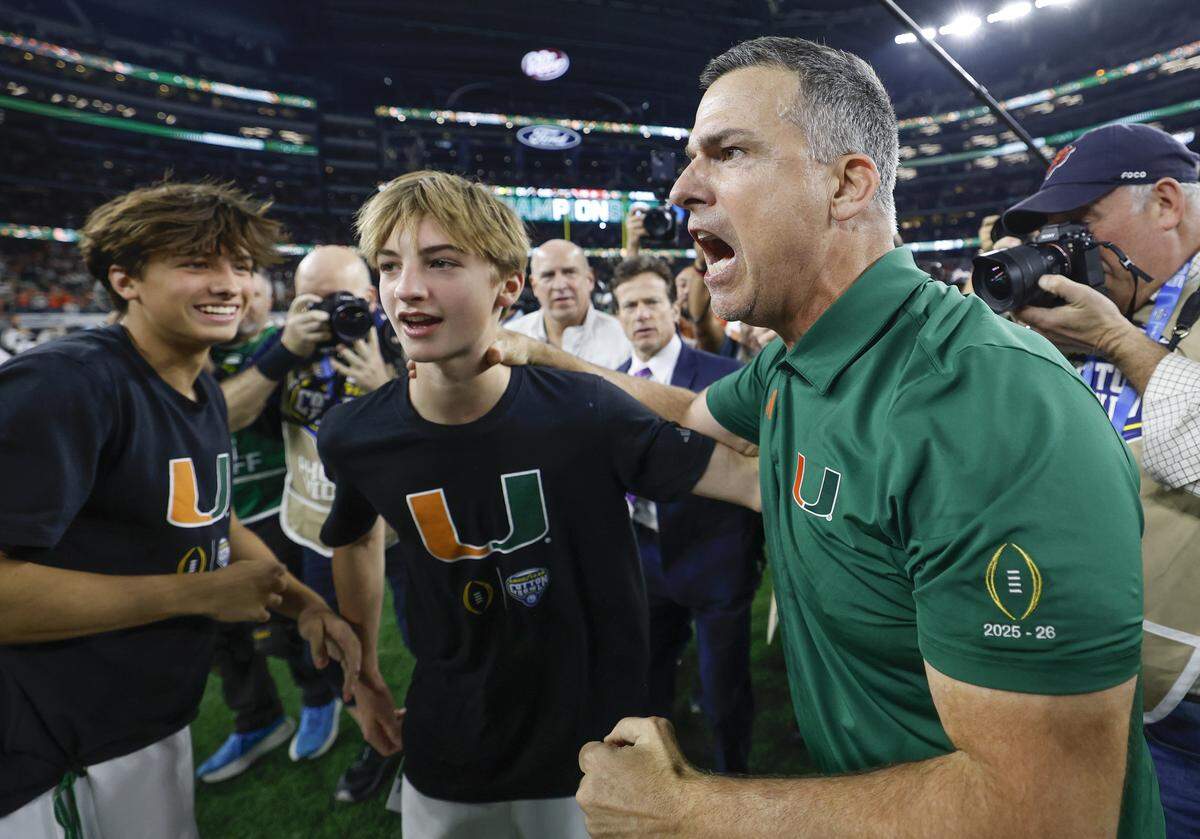
‘He doesn’t have an off switch’
Cristobal’s passion, his drive, his non-stop work ethic that has Miami on the precipice of a national title has been ingrained in him his entire life.
He’s the son of Cuban-American immigrants, mom Clara and dad Luis Sr. They worked multiple jobs. They learned English. They paved the way for their children to live out their dreams.
“They were hard-nosed. They were tough,” Cristobal, 55, said. “They made sure we understood the meaning of true work and to make absolutely zero excuses.”
Cristobal leads his football program the same way.
Rest is for the weary, with long days fueled by cafecito. Hard work and maximum effort is mandatory. Anything less than your best — whether perfect or not — is unacceptable.
“He was hard on us to get us to this point right now,” freshman phenom wide receiver Malachi Toney said.
%20(1).jpg "Mario Cristobal Football Uniform_88 (1) (1).jpg")
He’s been this way dating back to his high school days at Christopher Columbus High in Westchester.
John Lynskey, Columbus’ Ambassador of Alumni affairs who was on the coaching staff when Cristobal played for the Explorers, said Cristobal is “the same guy now he was back then,” even 40 years later.
“He doesn’t have an off switch,” Lynskey said. “He doesn’t do anything half speed. He’s a perfectionist. Guys liked him off the field. Hated him on the field. Never heard the whistle never stopped. You better have had your mouthpiece in around Mario.”
Cristobal carried that mentality with him as a player for four years at Miami and into his coaching career, which included two stints at UM (1998-2000 as a graduate assistant; 2004-2006 as an assistant coach), three years at Rutgers under Greg Schiano (2001-2003), four years at the University of Alabama under Nick Saban (2013-2016) and two stints as head coach at FIU (2007-2012) and Oregon (2018-2021).
“You don’t change your roots,” said Hurricanes offensive line coach Mirabal, who played with Cristobal at Columbus in the late 1980s and has been on Cristobal’s coaching staff at each of his head coaching stops. “He’s never changed his roots, and he’s never forgotten his roots. He’s true to himself. He’s true to his identity. He’s true to who he is. He’s very serious. He’s very direct. ... He’s true to himself and he’s true to these players. Sometimes people say he’s got a gruff exterior, but he’ll do anything for these cats right here.”
That said, Cristobal did learn from all his stops.
While a player at Miami, he watched as Dennis Erickson entered as a head coach and knew “he was walking into a place that had a tradition and a standard that was going to be upheld no matter what, but that he could also bring some schematic advantages that was going to make Miami even better.” He led Miami to both titles that Cristobal was part of.
Cristobal added that Erickson changed his and his brother Luis’ lives “forever.”
“We were two local Cuban kids, two nobodies who really by the grace of God, and two really, really hard-working Cuban parents that didn’t know much English, he gave us a chance, gave us an opportunity,” Cristobal said.
His six seasons at the helm of FIU were the “ultimate experience in cutting your teeth,” Cristobal said. FIU was a program that went 0-12 the season before he was hire and had to deal with a loss of scholarships due to NCAA rule violations from before his tenure.
“You have to do everything when you take over a situation like that,” Cristobal said. “... It’s the ultimate challenge. And you find out truly what you’re made of and who has your back. ... You have to be a coach, you have to be a CFO, CEO, a provost. You have to do it all.”
And despite turning things around, eventually leading FIU to the school’s first two bowl games in program history in 2010 and 2011, he was fired following a 3-9 season in 2012.
“I’m pretty stubborn,” Cristobal said. “Always have been stubborn. In my mind, we were going to win a national championship there. And people would look at me like I was crazy. Sometimes if you don’t move and God wants you to move, he’ll kick you so you can move. For whatever reason, that’s the way it worked out.”
It worked out in the long run. Cristobal then went to work under Saban, where he learned the “value of the assistant coach.”
More specifically, how they “have to carry the message back to their room.”
“Selecting people that are on board with a philosophy and a vision that’s going to be challenging because you have to push people and you have to make them uncomfortable,” Cristobal said. “They have to understand, first and foremost, that every single day, their job is to fight and battle human nature and a tendency to lean towards complacency and being comfortable. I think that’s something Coach Saban did in a masterful way every single day, is make sure that never set into the program.”
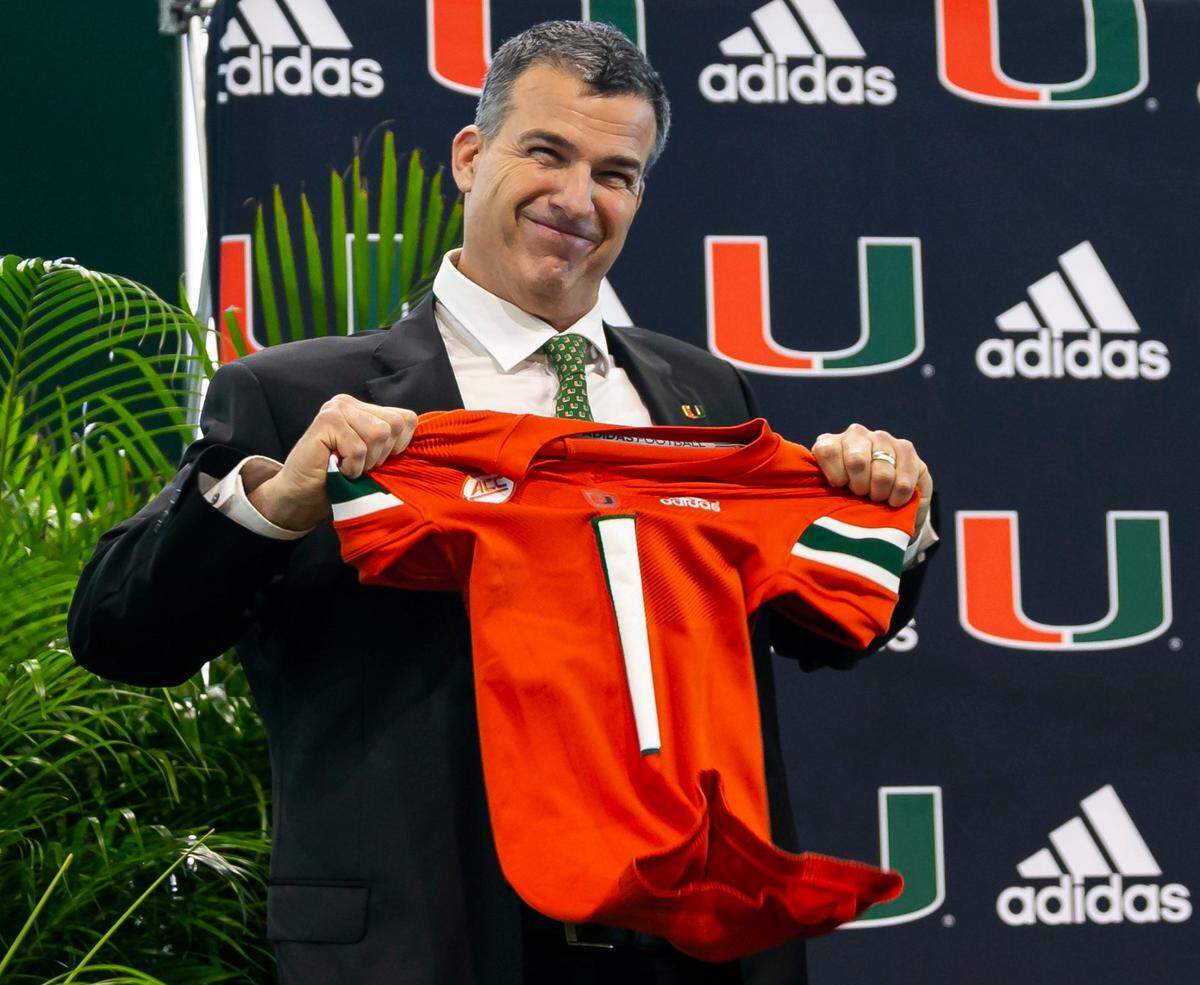
‘Mario is one of us’
But before could get back to his roots, he had to get the job.
That was a relatively easy decision by those tasked to make it.
Cristobal’s understanding of the Hurricanes’ past — what has made them successful and what it would take to make them consistently successful again — made him an easy candidate.
“We said, ‘Who should we get to coach?’ said UM president Joe Echevarria, who at the time was a senior adviser to then-UM President Julio Frenk. “And we said, ‘Mario’s the right person for us.’ Mario is one of us. He understands community, he understands the university, and he understands this team and what it means to the brotherhood.”
Added wide receivers coach Kevin Beard, who won a national title as a player at UM during the 2001 season: “That’s what we all came here for. That’s what wakes you up in the morning. That’s what allows you not to get tired and have a mindset of doing whatever it takes to get us back to this point — whether it’s less sleep, more grind and just pouring in more — it means more to us because we know what it means.”
They also knew that meant building the program up the right way. No shortcuts. No quick fixes.
Take the time to get the right people — coaches and players included — and get the program built from the foundation upward.
“He had a plan the whole time,” said right guard Anez Cooper, one of five players from Cristobal’s initial recruiting class still with the team. “Get everybody to buy in, and get the guys who didn’t want to buy in out. I’m happy I bought into the program and we’ve gotten to where we are.”
He did this primarily through his recruiting prowess at the high school level and then filling in gaps as they came through the transfer portal.
But commitment from the university and athletic department to give the program what it needed was a required boost, as well.
Cristobal credited the “elite leadership” of people like Echevarria, executive VP for university operations Rudy Fernandez, athletic director Dan Radakovich and UM board of trustees chair Manny Kadre — “strong-minded, hungry, driven people that understand the importance of everything and how it’s supposed to work” — for all being in alignment on this front.
“That’s everything,” Cristobal said. “I would recommend that anybody looking for a head coaching job never take it unless those things are in place. I have gone through something like that. In a sense it’s good. The best training ground I ever had was to be part of a process where things weren’t aligned. You learn a lot, and sometimes there’s casualties that come with that from an employment standpoint. ... The involvement of awesome people with the level of passion that they have, the way they work, the impact they’ve already had on the community and what they’re willing to do for the University of Miami, that’s what we want to be aligned with. That’s what I want to be aligned with, so every day I’m extremely grateful for the fact that we’re in lockstep and looking forward to continue to progress.”
It all has allowed the Hurricanes to progress on the field.
And the team is now at a point where the players are a complete extension of Cristobal on the field. They are maniacal and not settling for anything less than their best.
“That’s how it’s supposed to be,” said edge rusher Rueben Bain Jr., one of the stars of Cristobal’s first full recruiting class in 2023. “You can tell the players represent the coach. You can tell how we operate. ... We’re going to seize whatever opportunity we have.”
How long did it take for that to happen?
“Up until now,” Bain said. “We’ve seen it in bits and pieces the last few years, but now I feel like this is the real representation of Mario Cristobal ball and how he wants football played.”
‘He loves adversity’
It hasn’t always been easy for Cristobal, though.
And he’s fine with that.
“He’s a guy that will get the job done no matter what,” running back Mark Fletcher Jr. said. “He loves adversity. He will push through it.”
And there has been plenty of adversity along the way.
Four games into Cristobal’s UM tenure provided a wake-up call of just how far away Miami was from contention when the Hurricanes were upset 45-31 by Middle Tennessee State. Miami never led in that game and was down 21-3 minutes into the second quarter. Miami finished that season 5-7.
“It was heartbreaking,” said senior linebacker Wesley Bissainthe, who was a freshman on that 2022 team.
In 2023, there was the decision not to kneel out what should have been a win over Georgia Tech; the Yellow Jackets recovered a fumble and led a game-winning drive. it was the start of a downward spiral for that season. The Hurricanes went 7-6.
After a 9-0 start in 2024, with the best offense in the country led by Heisman Trophy finalist quarterback and eventual No. 1 draft pick Cam Ward, Miami lost two of its final three regular-season games and were one of the first teams on the outside looking in of the College Football Playoff after being ranked as high as No. 2 nationally.
“We’re getting closer,” Cristobal said after the season. “Keep working.”
They finally got over the hump this season, albeit not without some trouble to wade through.
Miami’s 5-0 start — with wins over rivals Notre Dame, Florida and Florida State included in there — was nearly derailed when they lost twice in a three-week span midseason to Louisville and SMU.
Instead of wallowing, instead of giving up, this Hurricanes team finally learned how to finish a season.
They won their final four games by a combined score of 151-41. They gave themselves a chance to make the playoff field, which the committee granted by putting them as the last at-large team in the field.
“From Mario, I just saw that as a leader, he created a really good environment of not ‘Oh, woe is me,’ but ‘OK, guys, let’s pick ourselves up. Let’s move forward. Let’s do the things that we know we’re capable of doing, and do them at a high level,’” Radakovich said. “At that point in time, you saw that there was just a general uplift of everything around the football department, and great things happened from there. And it was due to Mario’s leadership.”
And since then?
Miami beat No. 7 Texas A&M in College Station, Texas, 10-3 behind a gritty defensive effort and an inspired final drive on offense, with Fletcher paving the way and Toney scoring the game-winning touchdown.
And then the Hurricanes topped the reigning national champion Ohio State Buckeyes 24-14 in the Cotton Bowl, the defense once again stepping up and the offense
And then UM beat the No. 6 Ole Miss Rebels 31-27 in the Fiesta Bowl, closing out a back-and-forth game that had four lead changes in the final seven minutes with Carson Beck’s 3-yard rushing touchdown with 18 seconds left on the clock.
They’ve come a long way since that loss to Middle Tennessee State.
“It’s completely different,” said Hurricanes safety Jakobe Thomas, who was on that Middle Tennessee State team. “The Miami team we played back in ’22 was not this team now. Coach Cristobal changed the culture around this place.”
This all leads to Monday.
It’s the first time they’ll be playing for a title under Cristobal.
But win or lose on Monday, if Cristobal has anything to say about it, it won’t be the last.
“We’re one year ahead of plan,” Echevarria said. “We had a five-year plan. Nothing wrong with being ahead of plan. We’re ahead of plan, but we’re here and now. We need to stay here. We don’t need to go back. We need to stay right where we are. And Mario has done a fantastic job.”
This story was originally published January 18, 2026 at 5:30 AM.
.JPG)