
Are the Hurricanes peaking entering the College Football Playoff? What numbers say
The Miami Hurricanes found their stride during the final month of the regular season, and that’s in large part the reason they are still in contention to win a national championship.
Miami won its final four games — home against Syracuse and NC State, on the road at Virginia Tech and Pittsburgh, all essentially must-win games after already suffering two losses — by a combined score of 151-41. That was enough to get the Hurricanes (10-2) the No. 10 seed and final at-large bid into the 12-team College Football Playoff.
UM opens the postseason with a first-round matchup at the No. 7 seed Texas A&M Aggies (11-1) on Saturday at Kyle Field in College Station, Texas (noon, ABC/ESPN).
And as Miami gets set for what it hopes is the first of four more games, which would culminate in the national championship game on Jan. 19 at Hard Rock Stadium, it’s worth asking: Are the Hurricanes peaking at just the right time?
Coach Mario Cristobal certainly thinks so.
“I think we were playing our best football here at the end, our last four games,” Cristobal said. “And I thought we were playing really good at the beginning of the year. In the middle, we [were] little bit just off, stagnant in a way. ... It’s your job as a coach to adapt. And everybody just sat in there, turned up the energy, the urgency, and we adapted. I do believe these last four weeks have been at all levels. I’m talking from schematically, energy, execution, the ability to play more players.
‘The confidence of our team has really grown strong over the past several weeks.”
So where exactly have things gone better for Miami down the stretch? Here are four key areas.
Offense is scoring more often
The raw numbers show Miami is scoring more points as of late. UM is averaging 37.75 points per game during its past four compared to 32.25 points per game during its first eight — a 5.5-point jump per game.
But the efficiency in which the Hurricanes are scoring is worth examining.
Since the start of the Syracuse game, the first of the four-game win streak, Miami has had 39 offensive possessions, not including kneel downs to end a half. Of those 39 drives, 23 (59%) have resulted in points and 17 (43.6%) have ended in touchdowns.
However, since the final full drive of the first half against Syracuse, Miami has scored on 23 of 34 drives — 67.6% — with half of those 34 drives ended in touchdowns.
During the first eight games of the season, Miami scored on exactly 50% of its offensive drives (42 of 84), with just 39.3% (33 of 84) ending in touchdowns. If only factoring in games against Football Bowl Subdivision opponents (so removing the win against FCS-level Bethune-Cookman), those numbers dip to scoring on 46.1% of drives (35 of 76) and scoring touchdowns on 35.5% of drives (27 of 76).
In the Hurricanes’ two losses to Louisville and SMU, Miami scored on just eight of 23 drives (34.8%) and had touchdowns on just four of 23 possessions (17.4%).
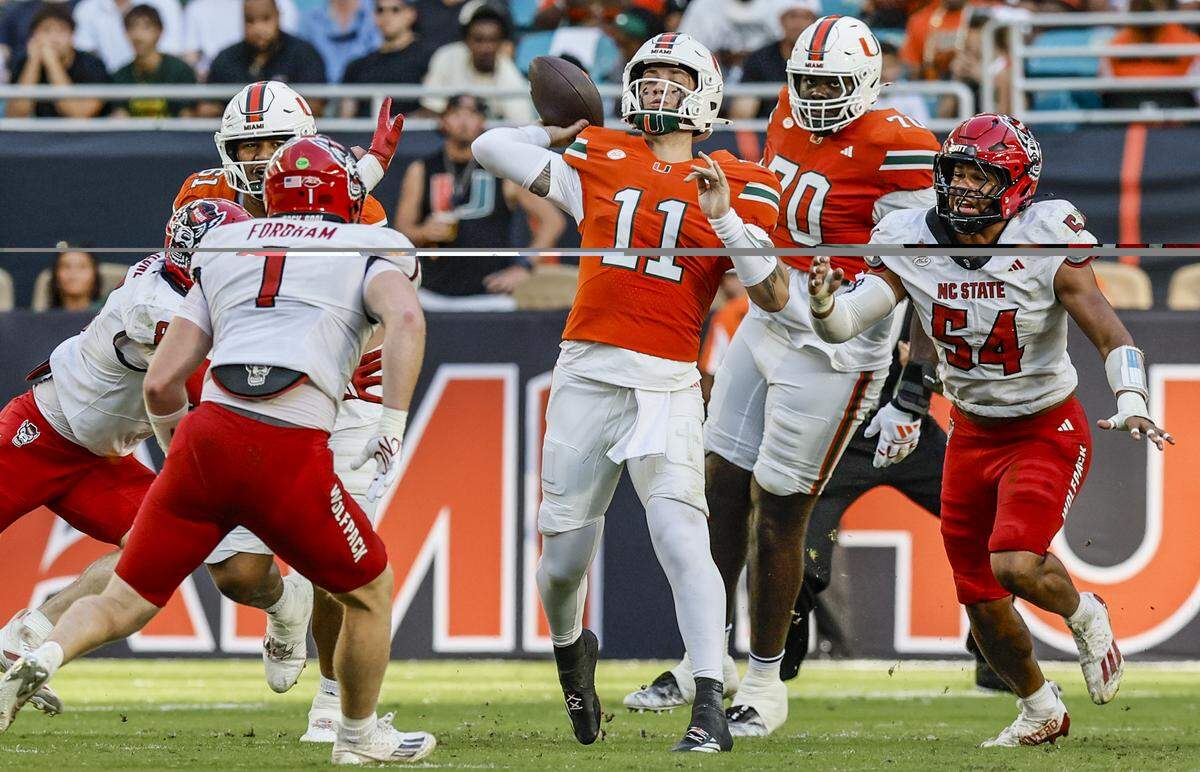
More yards per play
Sticking with that same theme, the Hurricanes have been getting more out of the offense on a per-play basis as of late.
Miami averaged 6.9 yards per play during its four-game winning streak to end the regular season. That would rank 12th nationally and third among all teams in the College Football Playoff (behind only Indiana’s 7.09 and Oregon’s 7.08) if it were sustained across the whole season.
For comparison, Miami averaged 6.04 yards per play through its first eight games, a number that dips to 5.7 yards per play if excluding the Bethune-Cookman game.
A big reason for that uptick in per-play production has come from an uptick in passing game efficiency. Quarterback Carson Beck is averaging 10 yards per pass attempt while completing 79.46% of his passes (89 of 112) for 1,125 yards and 11 touchdowns with just one interception over the past four games.
The Hurricanes were averaging about 8.1 yards per pass attempt over the first eight games of the season.
The run game is averaging about 4.06 yards per carry over this stretch, about on par with its overall average for the season (4.19 yards per rush).
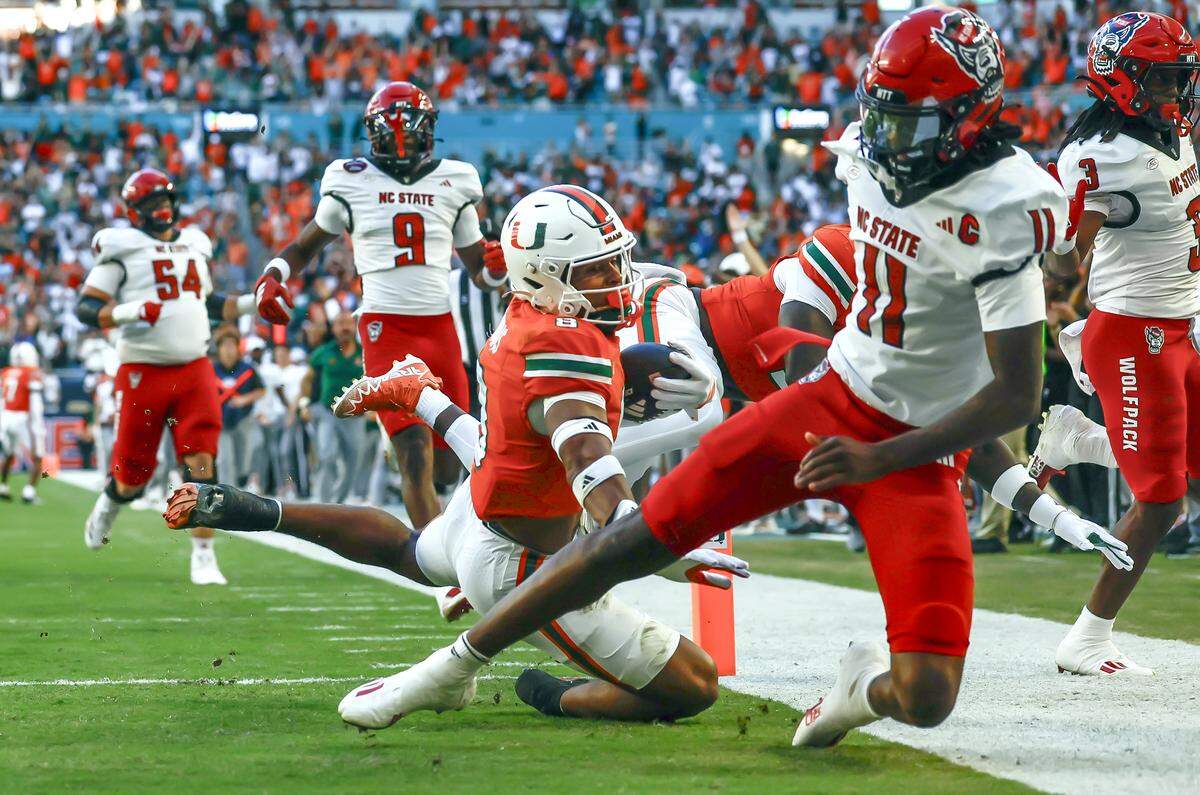
An uptick in turnover margin
The Hurricanes understand the importance of winning the turnover battle, and they have done so by executing on both sides of the ball.
The Hurricanes have a plus-five turnover margin during the past four games — generating seven takeaways (five interceptions and two fumble recoveries) while giving up just two (one interception, one fumble lost).
Miami has scored 24 points off those seven turnovers, including returning a pair of interceptions for touchdowns.
The defense, meanwhile, did not allow the opponent to score on either turnover it generated.

More sacks and tackles for loss
While Miami’s defense has been among the nation’s best all season — it’s why first-year defensive coordinator is a finalist for the Broyles Award given annually to college football’s top assistant coach — the Hurricanes have done a much better job of finishing plays in opponents’ backfields.
UM has generated 31 tackles for loss over the past four games, an average of 7.75 per game. That’s compared to 48 over the first eight contests (an average six per game) and 38 over first seven against FBS (5.43 per game). This includes 17 sacks over the past four games, matching the total from first eight games combined.
This story was originally published December 15, 2025 at 2:29 PM.
.JPG)