
Hurricanes’ Cristobal talks possible playoff expansion, NIL after House settlement
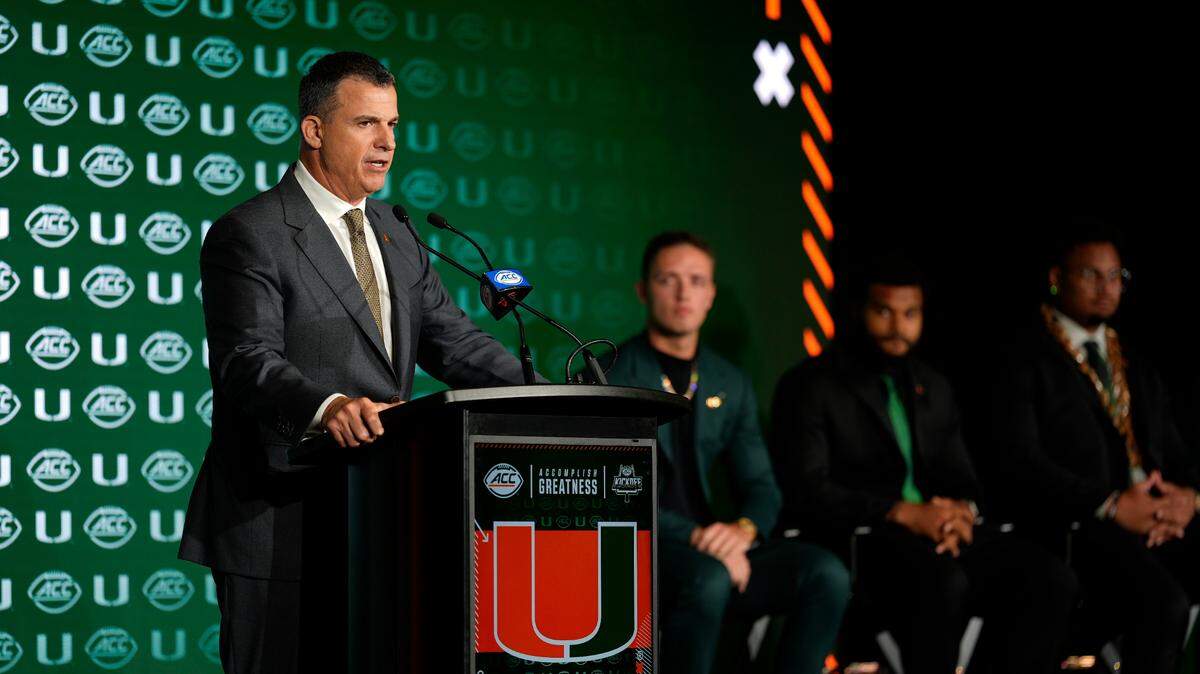
The Miami Hurricanes came oh-so-close to making the 12-team College Football Playoff field last year.
But their 9-0 start was derailed late as UM dropped two of its final three regular-season games to go from a near lock for the playoffs to missing out entirely.
Now talks are continuing about expanding the field even more, potentially to as many as 16 teams.
The current format has the top five conference champions qualify to the field automatically with the next seven highest-ranked teams advancing to the playoff field.
Different conferences are proposing different stipulations should a field expansion be reached. The Big Ten, for example, is advocating for a 16-team field that includes four automatic bids for its conference and the Southeastern Conference, two apiece for the Atlantic Coast Conference and Big 12 and four at-large bids. Others are pushing for either a 14- or 16-team field that still includes the five automatic qualifiers for the top five conference champions and the rest being at-large bids based on final rankings.
Hurricanes coach Mario Cristobal said he is open to the playoff field expanding “as long as it’s fair.”
“As long as it’s settled on the field, as much as it could possibly be settled on the field, I’m all for it,” Cristobal said. “Automatic qualifier stuff, I’m not for. Like, if you automatically stink, should you be allowed in because it’s a rule now? So I think it’s always great to expand. There’s a lot of great football teams, and a lot of teams get better as a year goes on. So allowing people the opportunity to play themselves into the playoffs would be a great thing.”
That mindset follows along with ACC commissioner Jim Phillips, who on Tuesday at the league’s annual football kickoff in Charlotte said he supports expansion models that include five conference champions plus either nine or 11 at-large teams.
“I want to stay committed to access and fairness to all of college football, not only the ACC,” Phillips said.
There will be slight adjustments to this year’s playoff compared to the first iteration of the 12-team format from last season. It will still be 12 teams — five conference champions and seven at-large teams — but the seeding will be straight up, meaning the top four teams regardless of if they are conference champions will get first-round byes. Last year, the top four ranked conference champions, regardless of their actual ranking, were given the top four seeds.
The four first-round matchups this season will be on Dec. 19-20, with the higher-ranked team for each game hosting the game.
The quarterfinals are the Cotton Bowl on Dec. 31 and the Orange Bowl, Rose Bowl and Sugar Bowl on Jan. 1. The Fiesta Bowl on Jan. 8 and Peach Bowl on Jan. 9 will host the semifinals before the national championship is played at Miami Gardens’ Hard Rock Stadium on Jan. 19.
NIL clarity
Cristobal on Tuesday also spoke about the desire for “some form of consistency, continuity and clarity” when it comes to the current status of name, image and likeness policies following the approval of the NCAA’s House Settlement, which allows athletic programs to pay student-athletes directly.
Through the House settlement, which was formally approved June 6 and went into effect July 1, schools are allowed have a cap of $20.5 million in direct revenue they can pay their student-athletes for the 2025-26 academic year. That figure will increase by about 4 percent year over year.
But the approval initially appeared to create more roadblocks. The College Sports Commission, which oversees the new revenue sharing policies, sent a memo to schools early in the process explaining it had denied numerous deals from school collectives because it said collectives did not meet the definition of a “valid business purpose,” which is required to give student-athletes NIL deals. These deals would be in addition to the $20.5 million schools can pay student-athletes.
Yahoo Sports reported Tuesday that an agreement has been reached between attorneys for House plaintiffs and power conferences and NCAA officials to amend the College Sports Commission’s approach to handing deals made with collectives.
“I just think everybody just still wants some form of consistency, continuity and clarity, and we’re not there yet,” Cristobal said. “So again, it’s adapt or die. ... In the meantime, just fight your butt off. Do the best you can by your program, by your players, by your people, and let’s see where the powers that be settled on it, but there needs a lot of there’s a lot of work to be done. Let’s just say that.”
Cristobal also praised UM’s NIL Collective, Canes Collective, for the work it has done since NIL began in 2022.
“We’ve always been very well established,” Cristobal said. “We’ve always been compliant and we’ve been aggressive in the right kind of way and used it in a form and a fashion that benefits our program and our players. In terms of where they are and all the details surrounding all of that, that’s maybe a question for some other time, but you couldn’t find a more professionally run organization than our collective.”
.JPG)