
In quest to move the UDB, developers get multiple chances to win final vote
Three weeks ago, environmental lawyer Richard Grosso requested 10 minutes to convince the Miami-Dade commission that building warehouses outside the county’s current Urban Development Boundary was bad for the Everglades and Biscayne Bay.
“Come on,” Commission Chairman Jose “Pepe” Diaz responded, saying he could only spare four minutes for Grosso during the Sept. 22 hearing. “Let’s keep it tight.”
Then developer lawyer Jeffrey Bercow asked for 10 minutes to defend the project before the board. “I’ll give you 12,” Diaz said, “to make sure you get it all in.”
READ MORE: Miami-Dade commission blocks UDB expansion. Developers get third chance to try again
As commissioners prepare for their third vote Tuesday on approving the proposed South Dade Logistics and Technology District, opponents of the project see an extended process favoring developers. Developers need to switch one no vote to a yes in order to move the Urban Development Boundary (UDB) for the first time since 2013.
At three prior meetings this year, developers won delays after failing to secure the two-thirds commission vote required by the Miami-Dade charter to extend the UDB.
Each time, a majority of commissioners voted to give developers more time to make their case and alter the project to win support from the 13-seat board.
While Bercow walked commissioners through a 10-minute presentation on Sept. 22, the public was last allowed to address commissioners on the South Dade project the first time it landed on the agenda in May.
“It’s not a fair fight,” said Grosso, a lawyer representing the Tropical Audubon Society. “The applicant is treated as the main player, and the public a bit player.”
A representative for the developers was not available for an interview for this story. Diaz also wasn’t available.
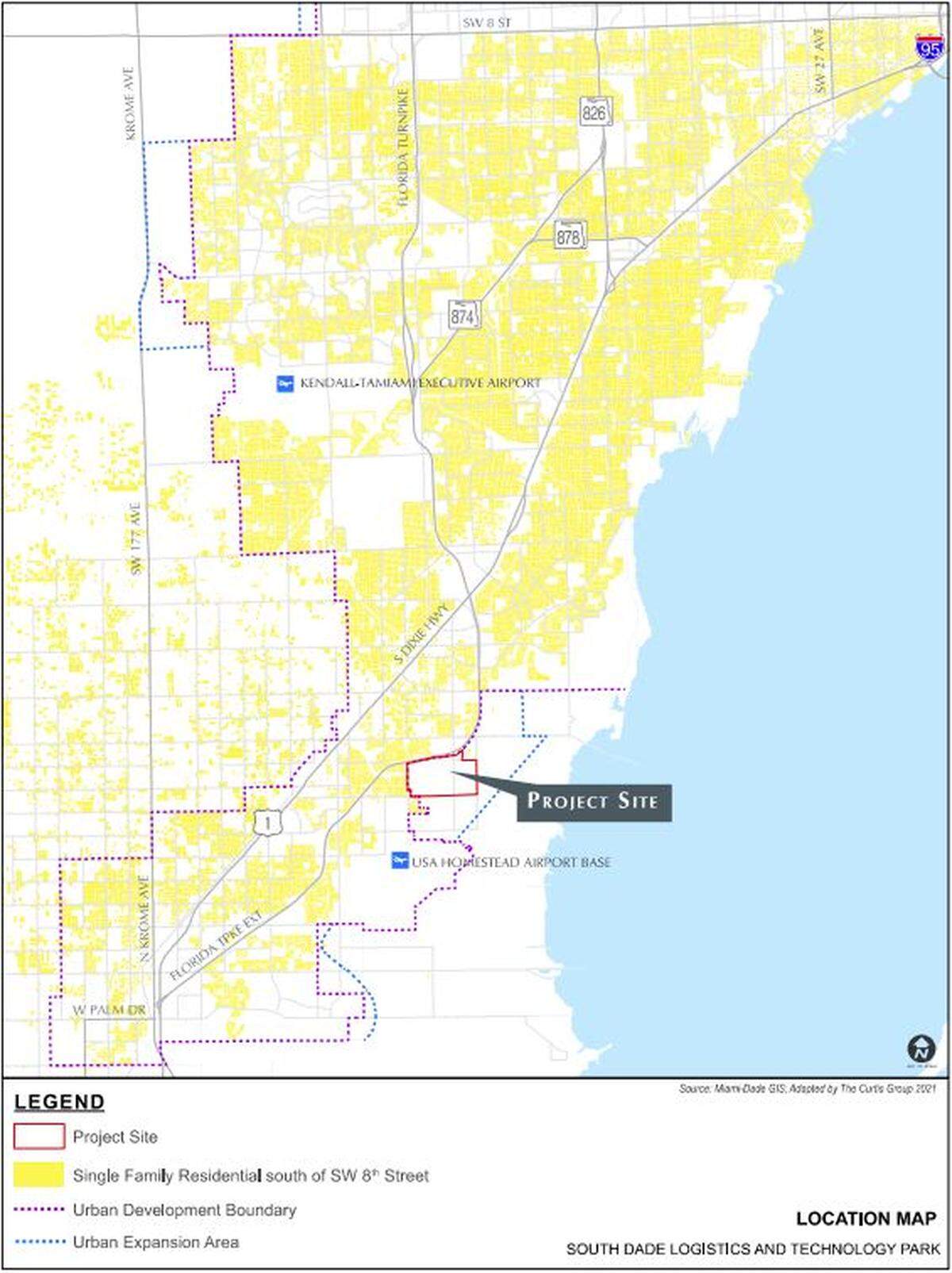
The project proposed by veteran developers Stephen Blumenthal and Jose Hevia would transform farmland into a cluster of warehouses, call centers and other industrial buildings. The site is south of Florida’s Turnpike and north of Moody Drive (Southwest 268th Street), and north of the Homestead Air Reserve Base.
Building it would require extending the UDB and narrowing the area that divides the suburbs from agricultural land and the Everglades. It also would require Miami-Dade to alter rules restricting construction on land prone to storm surge during hurricanes. The project site sits about three miles west of Biscayne Bay and in the county’s “Coastal High Hazard Area.”
READ MORE: To expand the UDB, developer needs Miami-Dade to change county policy on flood risks
Developers say their package of building and infrastructure requirements positions the South Dade project to be a model on how to grow economically while mitigating major flooding caused by hurricanes.
Supporters also tout the commercial project as a way to make residential life easier in South Miami-Dade, with new decent-paying jobs available nearby instead of separated by a frustrating commute north up U.S. 1 to Doral or Miami.
“The fastest growing area in Miami-Dade County is the south,” said Commissioner Kionne McGhee, whose South Dade district sits outside the project area. “The one place that truly needs the help is the south.”
Planning staff under Mayor Daniella Levine Cava recommended commissioners reject the project, saying there was enough available industrial land in the southern part of the county already inside the UDB to house the warehouses and other buildings the developers proposed.
Staff also projected half the jobs developers did, and said the site could be valuable for future Everglades restoration, They said building the project would mean paving over farmland not yet needed for construction, given available land inside the UDB.
“Staff’s analysis remains unchanged,” the county’s Department of Regulatory and Economic Resources wrote in its most recent report on the project, filed ahead of the Sept. 22 meeting. “There is no demonstrated need to allow the premature conversion of agricultural lands for urban uses.”
Developers need eight votes Tuesday to extend the UDB — down from nine before the math changed with the Sept. 20 suspension of Commissioner Joe Martinez following an arrest on alleged corruption charges. (It would be nine again if Gov. Ron DeSantis appoints a Martinez replacement for District 11 before the meeting.)
Martinez was there for the first UDB vote on the South Dade project on May 19, when he and six other commissioners supported the project in a preliminary vote. That was short of the two-thirds vote developers needed. Rather than take a loss, developers secured a two-week delay for a final vote.
On June 1, commissioners didn’t vote on the UDB move. Developers quickly secured another delay to retool their proposal to address objections from some of the commissioners who voted no.
That meant reducing the size of the project to eliminate farmland owned by Leonard Abess, a billionaire real estate investor opposing the effort to bring his land into the UDB.
“We heard you,” Bercow said Sept. 22 while walking commissioners through a presentation of a project with about 50% less acreage than before. “We heard your concerns.”
With a footprint down from nearly 800 acres to 380, hiring forecasts dropped, too. The project was forecast to create 40% fewer permanent full-time jobs than before, but still enough to employ about 7,300 people, according to a developer consultant’s forecast.
Commissioner Jean Monestime switched his vote from a no to a yes at the Sept. 22 meeting, saying he wasn’t convinced by planning staff that land was available inside the UDB to accommodate the industrial space Blumenthal and Hevia want to build.
But that wasn’t enough to move the UDB, with approval failing on a 7-5 vote. Developers still needed another yes vote from the remaining block of commissioners on the no side: René Garcia, Sally Heyman, Danielle Cohen Higgins, Eileen Higgins and Raquel Regalado.
McGhee secured the majority vote needed for a repeat vote at a later date, a redo now scheduled for Tuesday.
The third chance for a developer win frustrated Cohen Higgins, who represents the area that includes the project site and led the push on the board to reject the proposal.
She’s proposed legislation capping at three the number of vote delays developers can obtain before a UDB application is considered dead. The proposed rule is also up for a preliminary vote on Tuesday.
“The fact that a UDB application can undergo unlimited deferrals with unlimited amendments after the public hearing is closed is nonsensical,” Cohen Higgins said in a statement. “As changes occur, the residents of Miami-Dade County deserve the opportunity to be heard.”
This story was originally published October 17, 2022 at 5:30 AM.