
Leonard Abess says he’d make $100M off a rural Miami development. He’s against the project
Billionaire landowner Leonard Abess Jr. estimates a $100 million windfall awaits if Miami-Dade County commissioners approve an 800-acre industrial project that includes about 160 acres of farmland he’s been buying up over the last decade outside of the Urban Development Boundary.
Abess, 73, insists he doesn’t want the money, calling the proposed South Dade Logistics and Technology warehouse and office complex a “fraud” that would pave over “some of the best land in America.”
“There is no profit if you lose your soul,” the 73-year-old retired banker told commissioners during a surprise appearance May 19 after a public hearing had ended on the proposed development. “We are not in alignment with this development one bit. ... My family considers it one of the biggest frauds on this community. The big lie in our community. And a con game.”
READ MORE: Vote delayed on expanding Urban Development Boundary for industrial building complex
It was a made-for-TV moment from a mogul who has kept a low profile since a flash of global fame 13 years ago for sharing millions of dollars with employees when he sold his family’s bank for $945 million.
“I have never seen anything like this in 34 years,” said Commissioner Rebeca Sosa, asking for rebuttal time from the developers for the project off of the Florida Turnpike and north of Moody Drive. Knowing they didn’t have the votes that day, developers Aligned Real Estate Holdings and Coral Rock Development won a two-week delay on the final decision until Wednesday, June 1.
Though he and his wife, Jayne, gave $5 million endowing the University of Miami’s ecology center, environmental groups couldn’t count on Abess opposing the project.
In August, Abess’ lawyers filed a zoning application to allow industrial construction on his farmland within the project site — documents that included plans for a dozen warehouses and office buildings and parking lots for more than 2,000 vehicles.
“He told me to my face he would not object to the application,” Brian May, a lobbyist for the developers, said of two meetings he had with Abess after the initial proposal was filed in May 2021. “Honestly, what he did on May 19 was a complete blindside to the applicants.”
Abess’ lawyers put the zoning application on hold in November, citing “concerns” by regulatory agencies as the project faced warnings from Florida’s Department of Environmental Protection that construction on the land could harm Everglades restoration. The suspension of the Abess zoning request cheered opponents of the project, but let developers point out an industrial application still exists for all 160 acres of farmland in question.
The Abess speech gave a voice to a main objection from county planners, who recommended commissioners reject the project in part because of the developers’ patchy control of a site that’s roughly the size of Key Biscayne.
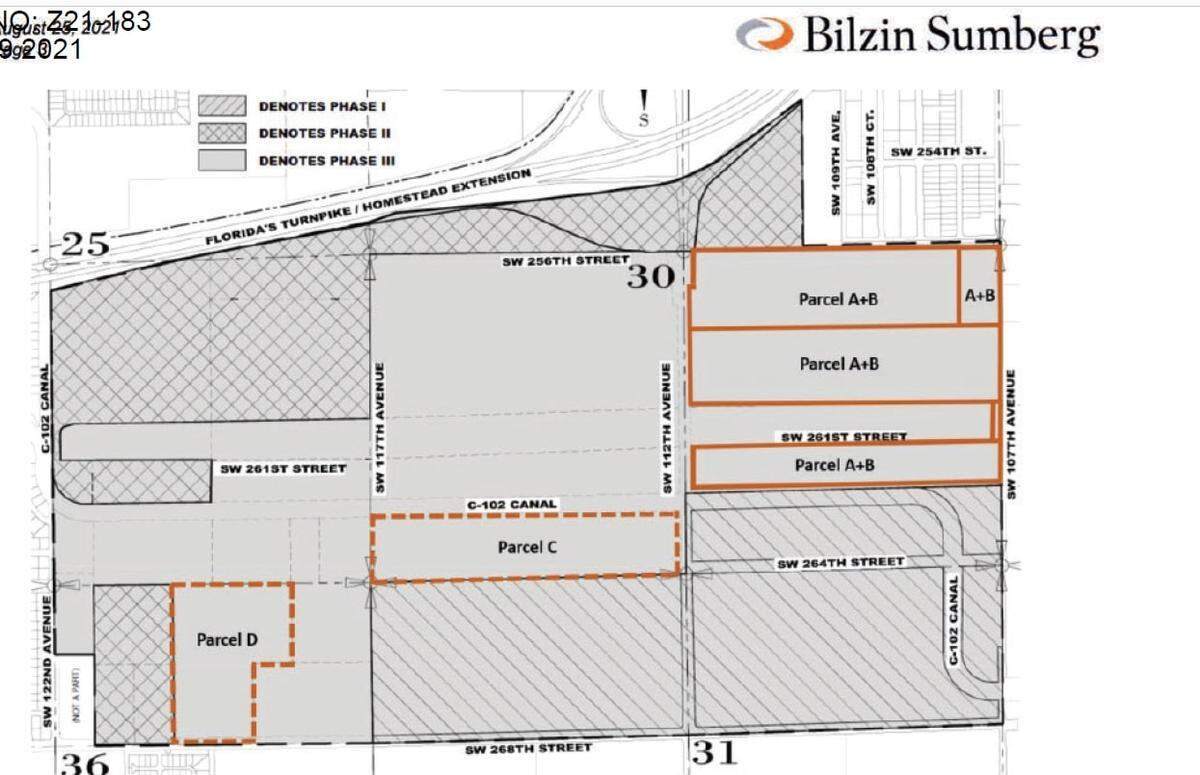
Land owners accounting for about 370 acres agreed to be part of the first two phases of construction. The remaining 423 acres that are part of the third phase of development belong to owners like Abess who haven’t signed onto the project with active zoning applications to allow industrial construction on their land.
In fact, the developers need a change in county policy that currently requires zoning applications for all land proposed to be brought within the UDB.
While it’s billed as being built last, the Phase 3 parcels cut the full project site in half, meaning the second cluster of warehouses would go up on the side farthest from the Florida Turnpike, a sequence county planners said would constitute sprawl.
READ MORE: Tree farm or warehouses: Which is better for Biscayne Bay?
In an economic analysis developers filed in August, a consultant assigned about 4,100 of the projected 11,400 permanent jobs to Phase III. With Abess owning 50% of the Phase III lands according to developers, that would mean roughly 2,000 of the promised jobs come from land owned by someone opposing the project.
“It is uncertain when and if Phase III will develop,” county staff wrote in a May 12 report. “Therefore, the economic impacts from Phase III are tentative at best.”
Abess did not respond to multiple interview requests, and declined to answer questions after the meeting.
How Abess became a key rural landlord
Abess holding companies began purchasing the land included in the South Dade application in the years after his 2008 sale of his majority stake in Miami’s City National Bank for $945 million. Leonard Abess Sr. founded the bank in the 1940s. It was sold decades later, then his son gained control again through a series of deals in the 1980s.
Abess’ own sale of City National brought him global attention for sharing $60 million of the profits with current and former City National employees. President Barack Obama mentioned Abess in his 2009 inaugural address during the depths of the financial crisis, citing him as an example that “hope is found in unlikely places.”
Abess was already one of Miami’s wealthiest residents when he sold City Bank, having paid $16 million to Sylvester Stallone for an estate next to the Vizcaya mansion in 1999. In 2017, Bloomberg estimated Abess was worth about $1.3 billion.
In his comments to commissioners, Abess said he considers himself the largest individual land owner in Miami-Dade, with more than 1,700 acres of farmland south of Kendall Drive. Abess is using some of his farmland to grow limes in an effort to revive that as a Miami-Dade citrus crop.
He’s also sold some agricultural land for housing development. An Abess entity, BAAAMA IX, in 2020 was part of a zoning application to let Lennar build apartments and homes on 45 acres inside the UDB and a quarter of a mile from U.S. 1. The assemblage off of Southwest 232nd Street included 15 acres of Abess agricultural land.
In 2021, the BAAAMA entities sold the property to a development firm for $5 million, according to county property records.
On May 19, Abess told commissioners he stood to make $100 million if the South Dade Logistics upzoning went through and his farmland was brought inside the Urban Development Boundary. While he’s fighting the project, longtime farmers Peter and Ann Robau wrote commissioners over the weekend urging them to clear the way for their acreage to be part of the development rather than stuck in “a declining farming business on the land in perpetuity.”
Citing soil challenges from rising seas, scarce farm labor in Miami-Dade and a younger generation turning its back on farming across the county, the Robaus said it’s time to convert the land to a place that will grow jobs. “The idea that farming is a sustainable business for our land over the long-term is simply not true,” the Robaus wrote in a May 28 letter, “and is not an honest assessment from people who do not actually live in the area and work here every day.”
Meetings with developers — and activists
Publicly, the Abess position on the South Dade project remained unknown as the May 19 vote approached.
On the day of the vote, the developer team arrived early to save spots in the commission chambers and noted an oddity: eight chairs taped off with printed signs stating “Reserved Seating District 8.”
Abess, accompanied by family members and staff, occupied the seats as the meeting got going, but never rose to speak during the two-hour public hearing where attendees were each given 60 seconds to speak. Only once board members began their debate did the District 8 commissioner, project opponent Danielle Cohen Higgins, call Abess to the microphone.
“I thought it was valuable for the board and our community to hear from a landowner who is so vehemently opposed” to the project, Cohen Higgins said in an interview after the meeting. “I thought his voice was a powerful one.”
Abess objected to developers brushing off the land as not valuable to Miami-Dade’s agricultural industry, saying farmers working for him grow corn and green beans there. He also suggested it was misleading to put forth a project that includes his land as part of the job-engine promised South Dade by the developers.
“The speculators, developers, lobbyists and lawyers have called me ‘Phase Three,’ he said. “I do not accept that designation.”
May said Abess lawyers have been in frequent contact with the legal team for the South Dade Logistics project. Developers, he said, had no reason to believe they’d be faced with a property owner launching a public attack on the project at the last minute.
“If he would have told us upfront that he was opposed to this, that he viewed this as something as he could not live with,” May said, “I’m not sure we would have filed the application.”
This story was originally published May 31, 2022 at 7:00 AM.