
Is Florida GOP frontrunner as pro data centers as opponents say? We checked | Opinion
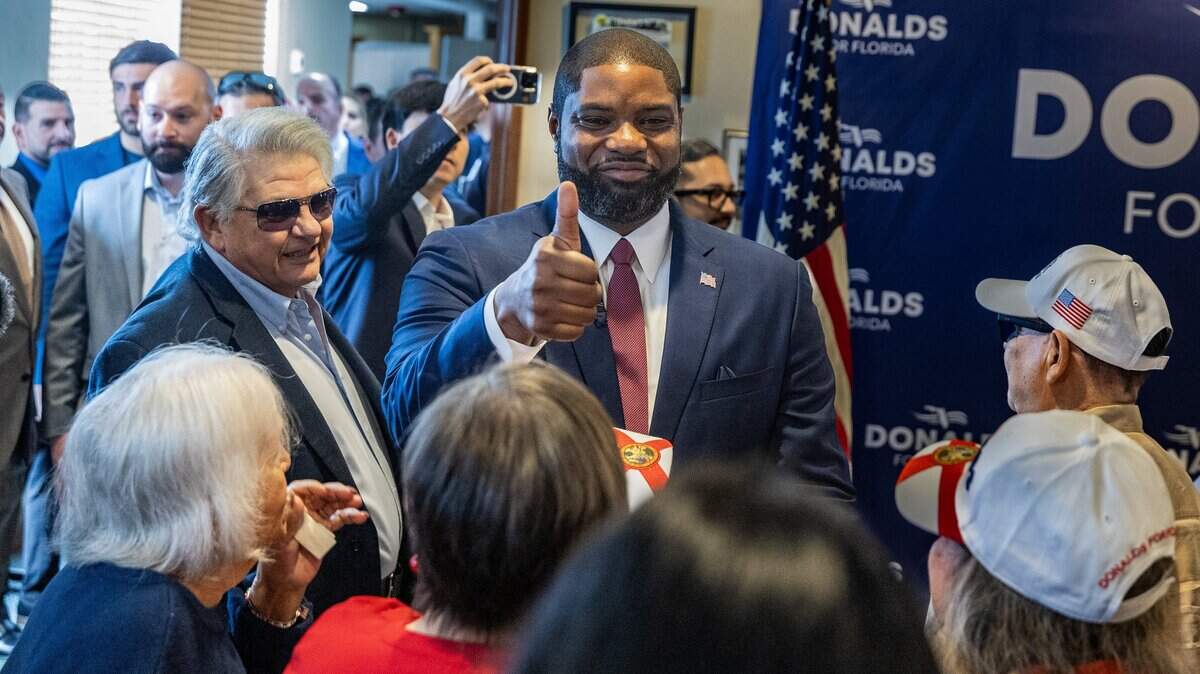
Opposition to data centers has become a powerful political talking point — and some Republicans running for Florida governor have caught on to that. They accuse the GOP primary’s frontrunner, President Trump-endorsed U.S. Rep. Byron Donalds, of "putting AI first” and receiving support from “AI tech bros to build data centers across our state,” as candidate Paul Renner, a former state House speaker, said in a recent video.
Donalds’ public position on data centers is more nuanced than his primary opponents have made it seem. The campaign of Lt. Gov. Jay Collins, for example, shared a social media video — ironically generated by artificial intelligence — that paints a futuristic doomsday scenario if Donalds is elected: robots detaining people for “AI hate speech” and data centers gobbling up electricity from nearby homes.
In recent statements, Donalds looks like he’s trying to impress voters as pragmatic, treading the line between meeting the growing demand for these facilities to power AI and the need for state protections. But he’s supported by the AI industry. A pro-AI political action committee called Leading the Future, funded by tech titans such as the president of OpenAI, has pledged to spend $5 million to support him.
“I’m not anti-data center. I’m pro having a plan,” Donalds said in February at Florida Gulf Coast University. Speaking in Miami this month, he said he disagrees with Trump’s position that states should not regulate AI, saying “I think that the states do need to lead when it comes to setting a regulatory framework,” the Herald reported.
Donalds’ words sound reasonable. Certainly, his position on this issue matters, but so does the backing he’s gotten from the industry, which would clearly like to influence how the state regulates AI.
Florida is not a data-center hub like Virginia, but our next governor will have incredible power to regulate the unavoidable construction of these facilities in the future. Many voters are understandably scared of these electricity-and-water-guzzling buildings coming up in their neighborhoods and potentially driving up utility costs.
In an increasingly red state, Donalds could very well become governor. Although the primary elections won’t happen until Aug. 18, Trump’s endorsement has made Donalds the Republican Party’s de-facto nominee for the November election, when he will probably face Democrat David Jolly.
Donalds told an audience at Florida Gulf Coast University he would like to see setbacks between data centers and homes or ranches, and that these facilities should generate their own power so they don’t drive up energy costs for Floridians. He also said they should not damage the environment and the state’s waters. But he added that the demand for AI and data also drives up the demand for infrastructure: “In Florida, the question is: Are we going to do that here? Are we going to warehouse our data in Northern Virginia, or are we going to warehouse our data in California?”
It would be unrealistic — and misleading — for any gubernatorial hopeful to promise to outright ban data centers when AI is a dominant force in the economy. And yet Renner said in a June 3 Facebook video that he would ask the Legislature for a “full halt” to “hyperscale data centers.” Lawmakers this year balked at Gov. Ron DeSantis’ request for more modest AI regulations, so we doubt Renner would be successful. Collins has also announced his AI platform, which would require data center operators pay for infrastructure costs.
Donalds is pulling far ahead in GOP primary polls with Renner, Collins and James Fishback trailing dozens of points behind.
Data centers may be a Hail-Mary pass for the other Republican contenders desperate to gain traction. It probably won’t help them, but, at least, it is forcing Republicans, who run Florida’s state government, to address an issue that transcends party affiliation. If it forces Donalds to come out more strongly on how he plans to regulate data centers, even better.
BEHIND THE STORY
MOREWhat's an editorial?
Editorials are opinion pieces that reflect the views of the Miami Herald Editorial Board, a group of opinion journalists that operates separately from the Miami Herald newsroom. Miami Herald Editorial Board members are: opinion editor Amy Driscoll and editorial writers Isadora Rangel and Mary Anna Mancuso. Read more by clicking the arrow in the upper right.
What's the difference between an op-ed and a column?
How does the Miami Herald Editorial Board decide what to write about?
The Editorial Board, made up of experienced opinion journalists, primarily addresses local and state issues that affect South Florida residents. Each board member has an area of focus, such as education, COVID or local government policy. Board members meet daily and bring up an array of topics for discussion. Once a topic is fully discussed, board members will further report the issue, interviewing stakeholders and others involved and affected, so that the board can present the most informed opinion possible. We strive to provide our community with thought leadership that advocates for policies and priorities that strengthen our communities. Our editorials promote social justice, fairness in economic, educational and social opportunities and an end to systemic racism and inequality. The Editorial Board is separate from the reporters and editors of the Miami Herald newsroom.
How can I contribute to the Miami Herald Opinion section?
The Editorial Board accepts op-ed submissions of 650-700 words from community members who want to argue a specific viewpoint or idea that is relevant to our area. You can email an op-ed submission to oped@miamiherald.com. We also accept 150-word letters to the editor from readers who want to offer their points of view on current issues. For more information on how to submit a letter, go here.