
DeSantis’ maps look like a pure partisan maneuver. Didn’t Floridians ban this? | Opinion
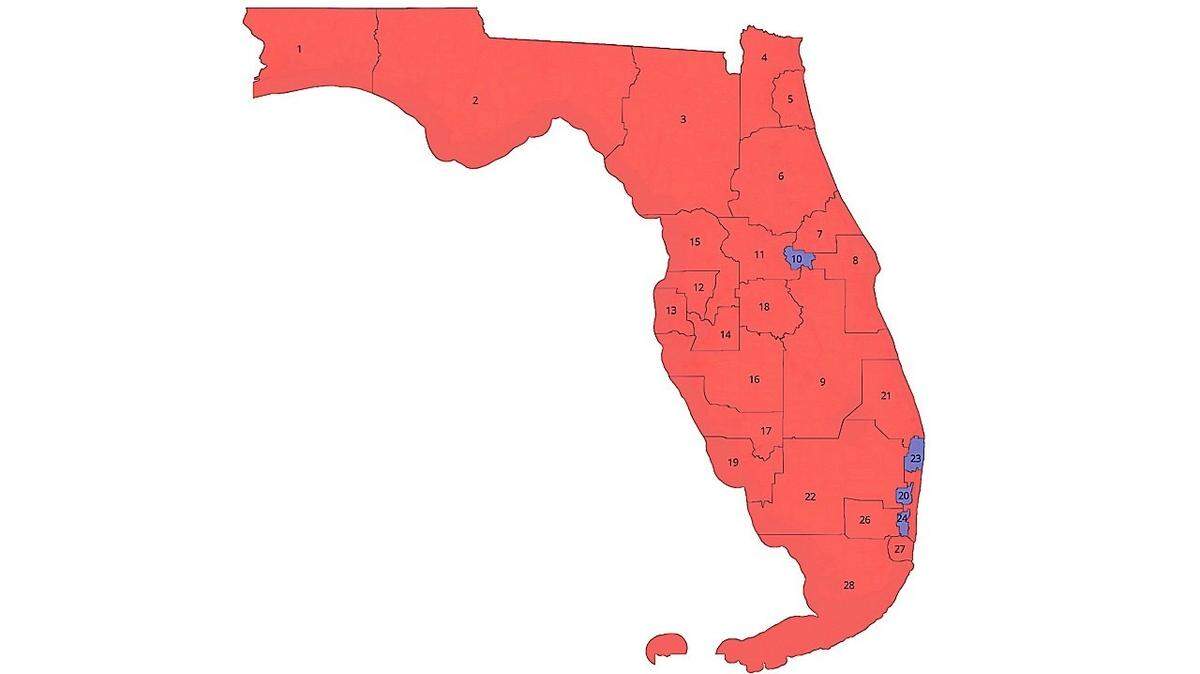
Didn’t Florida voters outlaw gerrymandering? You sure wouldn’t know it by looking at the map Gov. Ron DeSantis released Monday of his proposed new congressional district lines.
The map is an absolute sea of red. There are four blue-leaning districts for Democrats and 24 red-leaning districts — an increase of four — for Republicans. Lawmakers are set to vote on it this week when they return to Tallahassee for a special session called by DeSantis. They didn’t see the map until Monday, and DeSantis shared it with Fox News before Florida legislators.
Is the state really that lopsided politically? No. Voter registration numbers show there are about 5.5 million active Republicans and about 4 million Democrats, according to information from Florida Division of Elections as of March 31. (There are about 3.3 million voters with no party affiliation.) Florida is a red state but not as red as DeSantis wants to paint it.
Florida passed the Fair Districts amendments to the state constitution in 2010 with about 63% of the vote just to address this sort of thing. Those amendments spell out in clear language that no party is supposed to draw voting districts with the intent of favoring or disfavoring one political party or candidate. Voters have said they don’t want gerrymandering; the governor should be bound by that law. And yet he is acting as though that decision by voters is meaningless.
DeSantis has been talking for months about calling a special session for redistricting, saying it’s necessary because of a yet-to-be-issued ruling by the U.S. Supreme Court on the federal Voting Rights Act that could jeopardize congressional districts drawn to protect the voting power of racial minorities.
He also says the state was short-changed in the 2020 Census. Maybe so, but whose fault is that? The state (under DeSantis) dragged its feet helping with the Census, despite warnings that it might lose out on congressional seats if the population was undercounted. Donald Trump, president at the time, also played a part. He politicized the count by attempting to exclude illegal immigrants and ended the national head count in 2020 early, no doubt reducing participation.
There is another political calculation going on here. For DeSantis, a term-limited governor, this is a chance to curry favor with Trump, who has been pushing states to redraw congressional district lines in ways that would help the GOP keep the U.S. House in the November elections. The party in charge at the midterm elections usually loses seats. If that happens to Republicans this year, Trump’s agenda could be in trouble.
If DeSantis has any hope of running for president again in 2028, he’ll need to land somewhere with high visibility when he leaves office in January. Trump recently said DeSantis has been “begging” for an administration job, including attorney general, according to reporting by Axios.
There’s risk for the GOP in this push by DeSantis. Members of his own party have been urging him not to move district lines. That could help Democrats by spreading Republicans too thin in certain districts. Adding to the angst: Two seats recently flipped in the state Legislature from Republican to Democrat, one in Tampa and the other in Palm Beach County, where Trump’s Mar-a-Lago estate is. Democrats have been feeling the wind at their backs.
There are legal complications, too. Any map that’s passed by lawmakers could end up in court because of Florida’s Fair Districts constitutional amendment. But the Florida Supreme Court last year already upheld a congressional map DeSantis’ office drew in 2022, reconfiguring a district in North Florida and erasing Black representation. The governor may be banking on the justices doing that again. He appointed six of the seven.
Redistricting is usually done every 10 years after the new Census numbers come out. Midterm redistricting is rare. But the 2026 election has sparked a coast-to-coast redistricting war after Trump pushed Texas and other GOP-led states to redraw their maps before November. California Democrats responded, and last week, Virginia voters approved redistricting that favored Democrats, though that is being challenged in court.
What happens in Florida this week will be part of the national battle. But Florida lawmakers need to remember who they’ll face when they go home: the same voters who said no to gerrymandering. DeSantis isn’t on the ballot in November, but legislators are.
BEHIND THE STORY
MOREWhat's an editorial?
Editorials are opinion pieces that reflect the views of the Miami Herald Editorial Board, a group of opinion journalists that operates separately from the Miami Herald newsroom. Miami Herald Editorial Board members are: opinion editor Amy Driscoll and editorial writers Isadora Rangel and Mary Anna Mancuso. Read more by clicking the arrow in the upper right.
What's the difference between an op-ed and a column?
How does the Miami Herald Editorial Board decide what to write about?
The Editorial Board, made up of experienced opinion journalists, primarily addresses local and state issues that affect South Florida residents. Each board member has an area of focus, such as education, COVID or local government policy. Board members meet daily and bring up an array of topics for discussion. Once a topic is fully discussed, board members will further report the issue, interviewing stakeholders and others involved and affected, so that the board can present the most informed opinion possible. We strive to provide our community with thought leadership that advocates for policies and priorities that strengthen our communities. Our editorials promote social justice, fairness in economic, educational and social opportunities and an end to systemic racism and inequality. The Editorial Board is separate from the reporters and editors of the Miami Herald newsroom.
How can I contribute to the Miami Herald Opinion section?
The Editorial Board accepts op-ed submissions of 650-700 words from community members who want to argue a specific viewpoint or idea that is relevant to our area. You can email an op-ed submission to oped@miamiherald.com. We also accept 150-word letters to the editor from readers who want to offer their points of view on current issues. For more information on how to submit a letter, go here.