
Florida’s Pam Bondi showed how to weaponize justice — and still lost her job | Opinion
Pam Bondi was loyal, turning the U.S. Department of Justice into a tool for partisan and political retribution, just as President Trump intended. In the end, though, that wasn’t enough to keep her job as U.S. attorney general. Her handling of the Jeffrey Epstein files no doubt played a big part in her departure.
Now Bondi gets to be the latest person to learn that appeasing Trump — as she seems to have tried to do — only goes so far.
Trump announced Bondi was leaving in a social media post Thursday, calling her “a Great American Patriot” and saying she was moving to an “important new job in the private sector.” Todd Blanche, the deputy attorney general, will become acting attorney general, Trump said.
Bondi, a former two-term Florida attorney general, is the second Cabinet official Trump to leave the administration in recent weeks. Previously, former Department of Homeland Security Secretary Kristi Noem was ousted following the botched immigration enforcement actions in Minneapolis, in which two American citizens died.
During her turbulent 14-month tenure, Bondi acted as a staunch foot soldier for Trump. Under her leadership, the DOJ indicted Trump enemies like former FBI Director James Comey and New York Attorney General Letitia James — both cases were dismissed in November — and fired prosecutors who participated in criminal investigations involving the president.
In Miami last year, she fired an assistant U.S. attorney, considered a rising star, for posting critical online comments about Trump during his first term as president. That nearly upended a Medicare fraud trial in which he was the lead prosecutor, the Herald reported.
As the Herald Editorial Board wrote in November: “Where other Trump AGs reached a point where they had to push back on Trump’s worst instincts, Bondi, so far, has faithfully toed the line.”
That didn’t save her job, though. In a since-deleted September social media post, Trump appeared to criticize the DOJ for not pursuing his political enemies enough.
Trump, reportedly, also grew frustrated over the DOJ’s release of the Epstein files, which have a become a political liability for the president. After Trump signed the Epstein Files Transparency Act in November, the agency missed deadlines to release the documents, revealed victims’ names and redacted information that should have been available to the public, the Herald reported.
Perhaps the watershed moment, though, was when Bondi told Fox News last February that she had the Epstein files right on her desk to review, only to say a few months later that the files didn’t exist.
And then there was the time Bondi faced questions from a U.S. House committee in February. She pushed back, at one point calling a member of Congress “a washed up loser” — how classy!
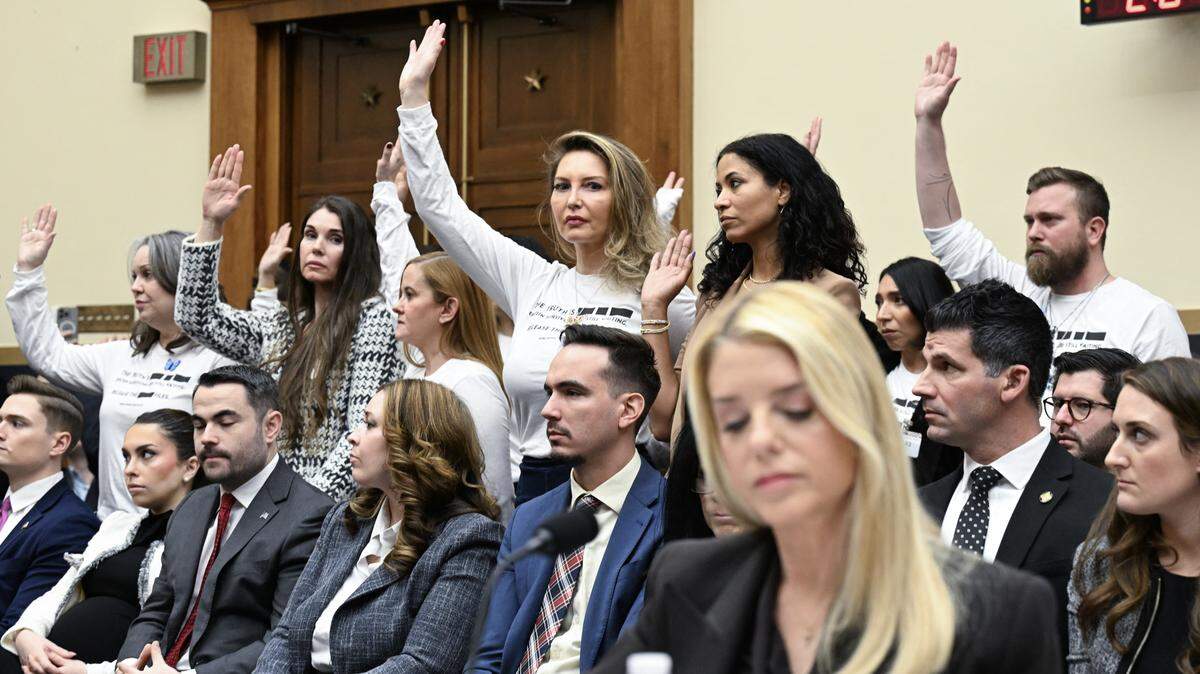
A photo taken during that hearing symbolized the contempt with which Epstein’s victims have been treated by the justice system for years. It showed Bondi sitting in front of a group of more than a dozen victims standing up and raising their hands in response to questions from Democrats on the House Judiciary Committee. Bondi, just a few feet away, looked down at the table in front of her, her back to the women.
Despite her abrupt departure, Bondi may still have to face questions about the Epstein files. The New York Times reported she was scheduled to testify before the House Oversight Committee on April 14 but had not yet committed to appearing. U.S. Rep. Robert Garcia of California, the committee’s top Democrat, said in a statement that Bondi is still “legally obligated to appear before our committee under oath,” the Times reported.
The mishandling of the Epstein files will probably be Bondi’s legacy as America’s top prosecutor. But we cannot forget that she also helped set a precedent for the weaponization of the Justice Department, and that legacy is a dangerous one for American democracy.
BEHIND THE STORY
MOREWho decides the political endorsements?
In advance of local and state elections, Miami Herald Editorial Board members interview political candidates, as well as advocates and opponents of ballot measures. The Editorial Board is composed of experienced opinion journalists and is independent of the Herald’s newsroom. Members of the Miami Herald Editorial Board are: Amy Driscoll, editorial page editor; and editorial writers Isadora Rangel and Mary Anna Mancuso. Read more by clicking the arrow in the upper right.
What does the endorsement process look like?
The Miami Herald Editorial Board interviews political candidates to better understand their views on public policy and how their policies will affect their constituents. Board members do additional reporting and research to learn as much as possible about the candidates before making an endorsement. The Editorial Board then convenes to discuss the candidates in each race. Board members seek to reach a consensus on the endorsements, but not every decision is unanimous. Candidates who decline to be interviewed will not receive an endorsement.
Is the Editorial Board partisan?
No. In making endorsements, members of the Editorial Board consider which candidates are better prepared to represent their constituents — not whether they agree with our editorial stances or belong to a particular political party. We evaluate candidates’ relevant experience, readiness for office, depth of knowledge of key issues and understanding of public policy. We’re seeking candidates who are thoughtful and who offer more than just party-line talking points.