
The 9-building project that a South Florida city can’t stop is a new reality | Opinion
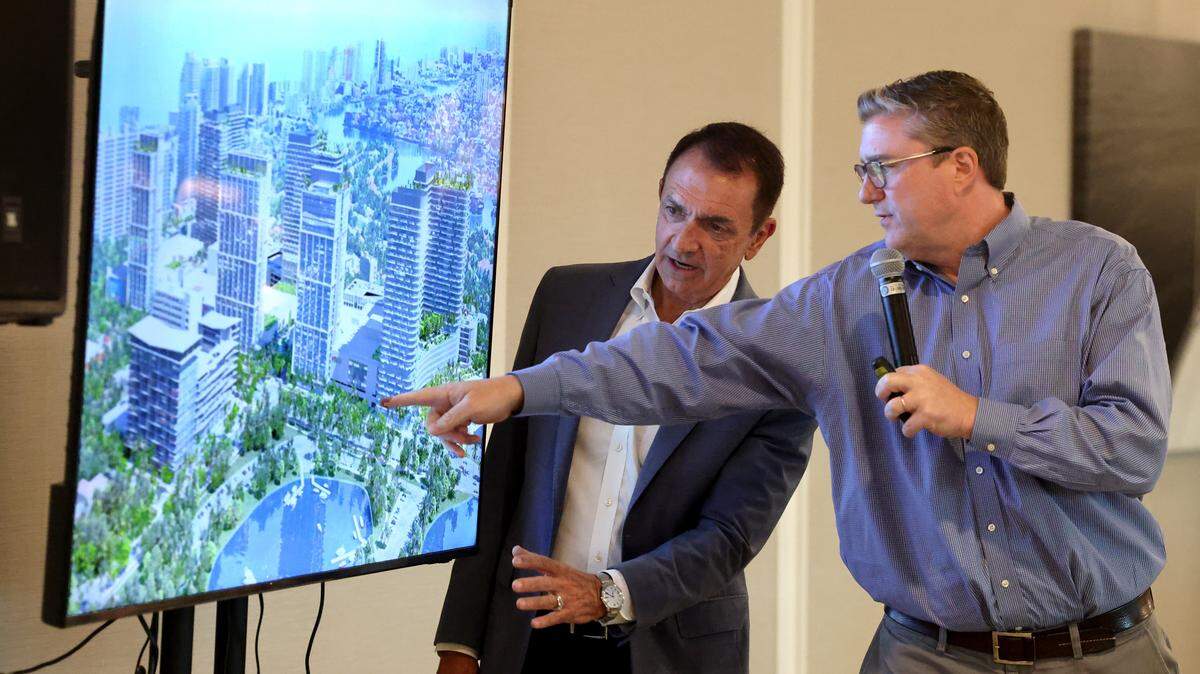
The anger and frustration were palpable during a Tuesday evening town hall the mayor of Fort Lauderdale organized, partly to explain to residents why the city cannot stop a nine-building development — with workforce housing units — that’s planned for the site of a struggling mall.
There’s widespread agreement that the Galleria Mall on Sunrise Boulevard — once a prime shopping destination in Broward County — needs redevelopment. The Galleria’s empty halls and aging infrastructure have become a sore spot in this growing city.
But nine, 30-story buildings, right at the foot of a busy causeway? That’s too much for the people who live in surrounding single-family neighborhoods. Hundreds of them filled up a room at a local yacht club to voice their discontent to local officials, who were equally frustrated.
Their concerns are reasonable; Mayor Dean Trantalis said the project would add 10,000 to 15,000 new car trips per day to Sunrise Boulevard.
“I see no positive side in this development,” Trantalis told residents.
The anger demonstrated in this meeting may become commonplace across South Florida, thanks to a 2023 state law called the Live Local Act. A similar uproar happened last year when plans were unveiled for residential towers at the Bal Harbour Shops, the luxury mall north of Miami Beach. The developers sued the village of Bal Harbour, accusing the municipality of violating the new law in trying to block the project.
The Live Local Act addresses Florida’s historic housing crisis by preempting, in some instances, local height and density restrictions to incentivize the construction of workforce and affordable housing. This isn’t necessarily a bad idea. Cities and counties have historically caved in to “not-in-my-backyard” opposition to zoning changes that could spur more multifamily construction for middle-and-low-income residents. Terms like “affordable housing” often evoke stereotypical and even racist tropes of people living on federal housing vouchers.
That sentiment was certainly present Tuesday in Fort Lauderdale, but there are legitimate questions about whether Live Local goes too far in changing the landscape of communities without any say from the people who live there. The law remains a worthy effort by the Republican-led Legislature. But, as lawmakers continue to tweak it, they should look for a better balance between home rule and the dire need for more housing stock in Florida.
It’s undeniable that there’s a compatibility issue when 30-story buildings are erected too close to single-family homes and the older, two- to three-story buildings that are behind the Galleria.
The law allows developers to build multifamily or mixed-use housing on sites that were designated for commercial or industrial use. They can build to the highest allowed height for a commercial or residential building within a one-mile radius if at least 40% of the units in their project are reserved — for 30 years or more — for residents making up to 120% of the Area Medium Income. In Broward, that’s up to $96,840 annually for one person, according to the Florida Housing Finance Corporation. In Miami-Dade, that’s $104,160.
As we have said before, workforce housing in South Florida isn’t always as affordable as its name would imply.
When such projects are proposed, a city or county commission has no say in approving them. However, the developments must still be consistent with other local regulations that were not preempted by the state law.
The Galleria Mall redevelopment also calls for a 170-room hotel, retail space, restaurants and more than 3,000 housing units, with 1,273 of those qualifying as workforce housing, the Sun Sentinel reported. Fort Lauderdale Vice Mayor John C. Herbst said on Tuesday he expects the redevelopment, which is still in its initial phase, to be downsized, calling it “the starting point of a conversation.”
Local officials had better be cautious and choose negotiations over fighting developers, who can easily go to the Legislature to ask for more laws that preempt local home rule.
The Florida Legislature has been determined in recent years to tie the hands of local governments. In the case of affordable housing, some preemptions may have been necessary. But, in the case of the Live Local Act, lawmakers may have overcorrected.
BEHIND THE STORY
MOREWhat's an editorial?
Editorials are opinion pieces that reflect the views of the Miami Herald Editorial Board, a group of opinion journalists that operates separately from the Miami Herald newsroom. Miami Herald Editorial Board members are: opinion editor Amy Driscoll and editorial writers Isadora Rangel and Mary Anna Mancuso. Read more by clicking the arrow in the upper right.
What's the difference between an op-ed and a column?
How does the Miami Herald Editorial Board decide what to write about?
The Editorial Board, made up of experienced opinion journalists, primarily addresses local and state issues that affect South Florida residents. Each board member has an area of focus, such as education, COVID or local government policy. Board members meet daily and bring up an array of topics for discussion. Once a topic is fully discussed, board members will further report the issue, interviewing stakeholders and others involved and affected, so that the board can present the most informed opinion possible. We strive to provide our community with thought leadership that advocates for policies and priorities that strengthen our communities. Our editorials promote social justice, fairness in economic, educational and social opportunities and an end to systemic racism and inequality. The Editorial Board is separate from the reporters and editors of the Miami Herald newsroom.
How can I contribute to the Miami Herald Opinion section?
The Editorial Board accepts op-ed submissions of 650-700 words from community members who want to argue a specific viewpoint or idea that is relevant to our area. You can email an op-ed submission to oped@miamiherald.com. We also accept 150-word letters to the editor from readers who want to offer their points of view on current issues. For more information on how to submit a letter, go here.