
We got a look at radical Rickenbacker Causeway plan. Here are the pros and cons | Opinion
Miami-Dade County Commissioner Raquel Regalado calls her proposal to re-envision the Rickenbacker Causeway a “beautifully crazy idea.”
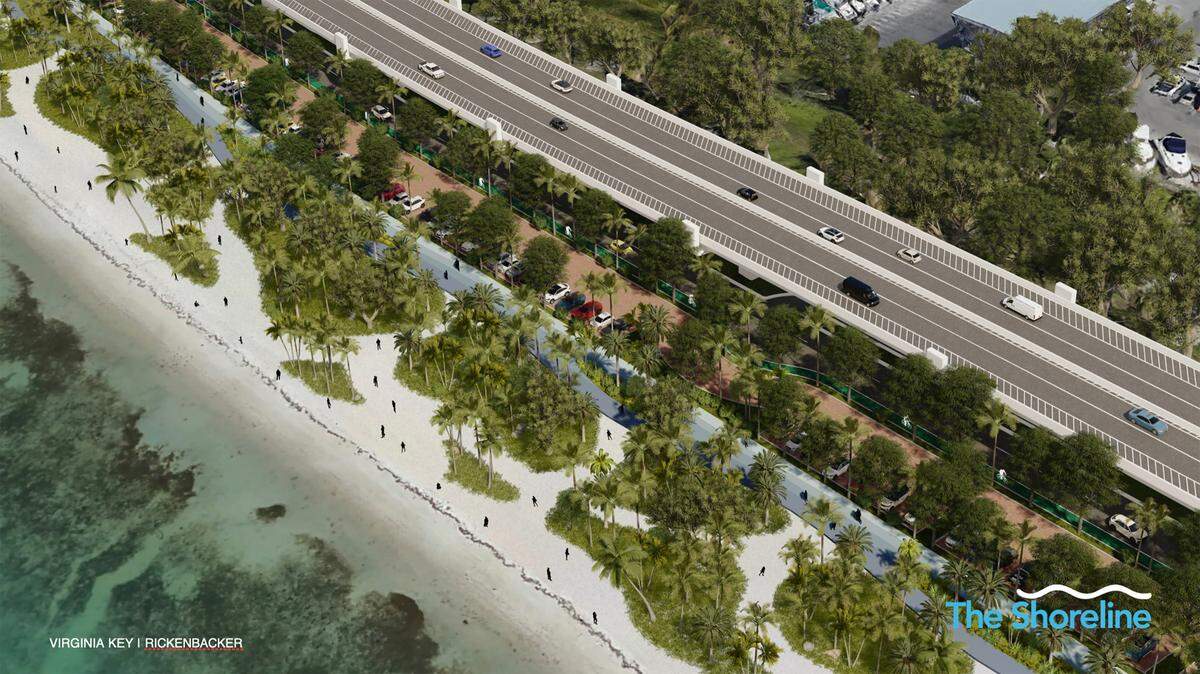
Miami does need outside-the-box thinking to address the traffic congestion and need for more green space that affect our quality of life. “The Shoreline” is Regalado’s plan, designed with help from a developer, to build a 25-foot-tall viaduct to split vehicles traveling to and from Key Biscayne from pedestrians and cars stopping at Virginia Key. Significantly, it would also increase waterfront recreational space.
“Any meeting that you have in Key Biscayne, the No. 1 complaint will be the Rickenbacker,” Regalado told the Herald Editorial Board. “I’ve gotten stuck in it a million times as a county commissioner who has to go out there.”
Her proposal falls somewhere between innovative and pie-in-the-sky. It has been well received by officials and residents in Key Biscayne, and it’s worthy of consideration, if Miami-Dade can pull it off.
That’s a big if. The Shoreline is still in its very early stages — it hasn’t even been presented to the full County Commission — so it’s too soon for the Editorial Board to endorse it or oppose it. We recently met with Regalado and project designers and were left both impressed and with lingering questions.
The project would send roughly 28,000 high-speed vehicles that head daily to and from Key Biscayne and fast bicycle pelotons to the top of the viaduct, which would have two lanes in either direction, plus 10-foot-wide shoulders. The viaduct would begin at the east end of the Powell Bridge and stretch the full length of Virginia Key to Bear Cut Bridge before it comes to ground level at the Crandon Marina entrance.
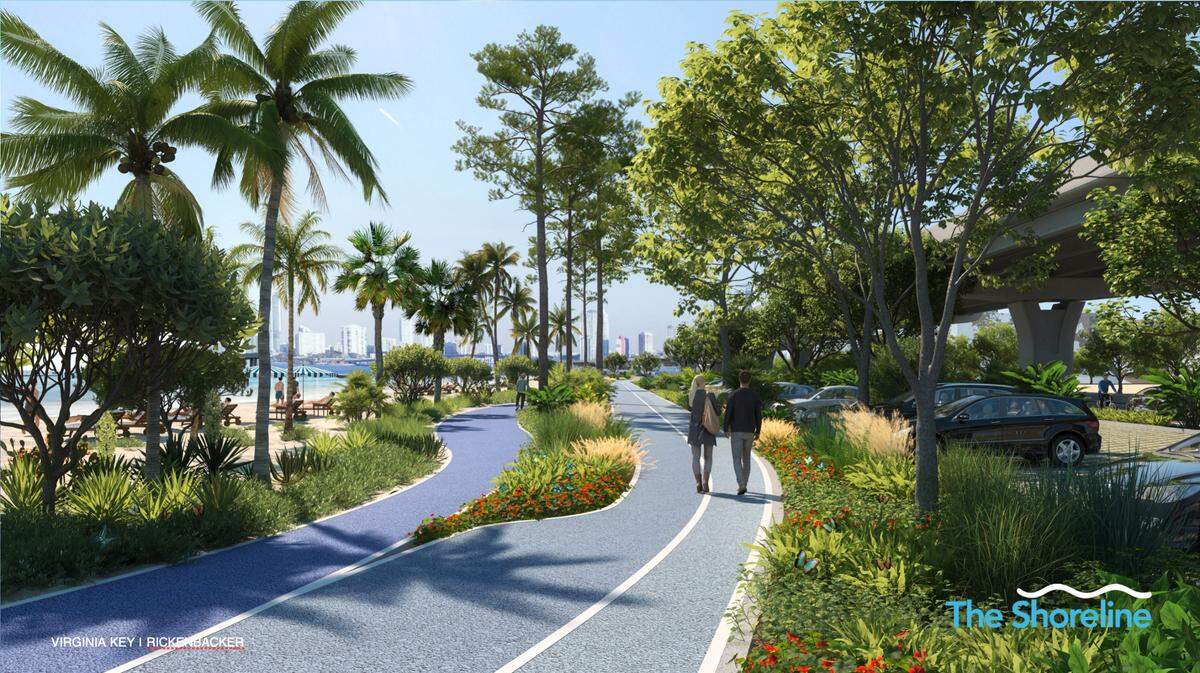
The area below would be used for slower local traffic headed mostly to and from to Virginia Key (roughly 12,000 vehicles per day), bike and pedestrian paths. That would clear space for more beach, park and parking spaces.
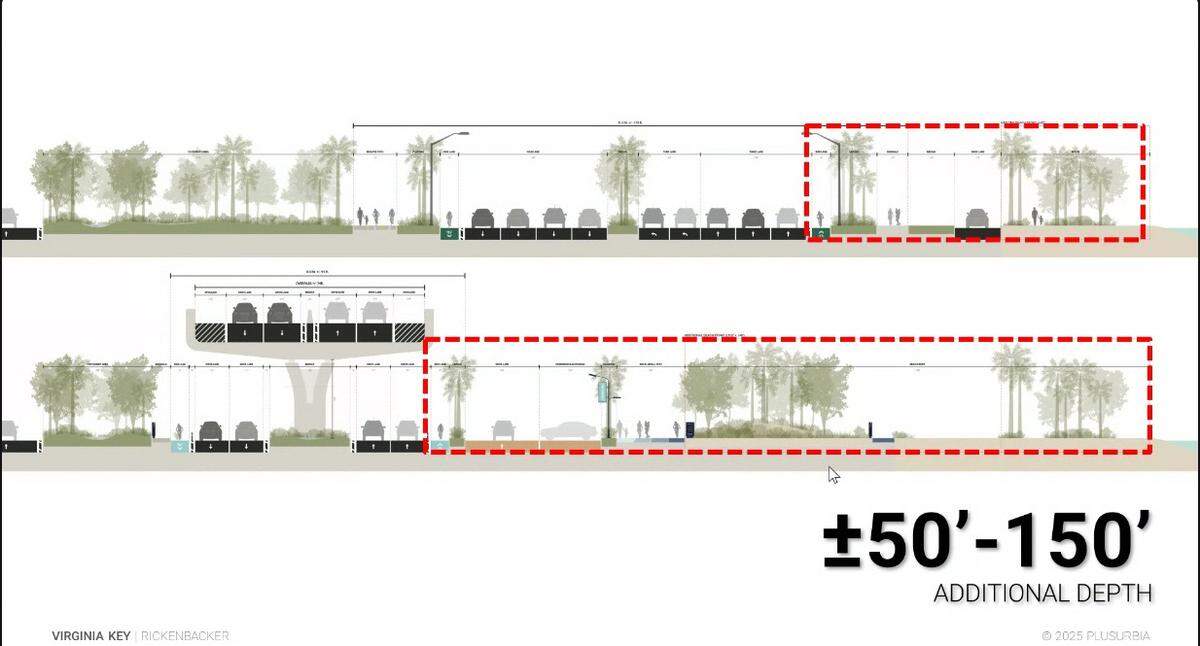
The project’s intentions are noble; it would not only improve traffic but also pedestrian and bike safety, which is sorely needed given how dangerous the causeway currently is to anyone who’s not in a car.
“We’re creating, by elevating this [viaduct], an opportunity for mobility and for the free flow of traffic at higher speeds that do not affect or create a friction with those of us... riding our bikes or walking or just going to the beach,” Shoreline designer Juan Mullerat told the Editorial Board.
The project also calls for traffic circles each at MAST Academy and the Marine Stadium entrance, which has no crosswalk, and vehicles would no longer cross bike lanes to get to the beach area. Regalado also envisions connecting the new recreational area of Rickenbacker to the Underline, a gem of a linear park in Miami, where underutilized space beneath the Metrorail is being transformed into 10 miles of bike and pedestrian paths and recreational areas.
“This vision is exactly what the Underline, we, hoped would happen,” Friends of The Underline founder Meg Daly said of the Shoreline. “This inspirational approach to solving larger problems in having these hybrid projects really makes sense.”
There are questions, though, about how much the Shoreline would cost. The Herald reported a figure of $475 million but a final estimate is not available yet. We suspect the project would cost a lot more than what’s been reported. There’s no direct comparison in terms of scope but the Interstate 395 “Signature Bridge” in downtown Miami is costing $840 million.
And, then, by making it easier to reach Virginia Key and Key Biscayne, would the new Rickenbacker add pressure to increase development on these two environmentally sensitive islands? Developer David Martin, CEO of Terra Group, paid for the Rickenbacker plan design and has a vested interest in it — he recently purchased the old Silver Sands hotel property on Key Biscayne, the Herald reported. Some Rickenbacker users have also wondered whether the viaduct would be aesthetically pleasing.
Another potential hiccup: Miami-Dade County already has been working on a master plan for the causeway that’s not yet public. The county also just started a three-year planning process for a Bear Cut bridge replacement, the Herald reported. How easily could Regalado replace those plans?
The Shoreline could spur a much-needed transformation of the Rickenbacker Causeway and its surroundings. It just has to be feasible.

Click here to send the letter.
BEHIND THE STORY
MOREWhat's an editorial?
Editorials are opinion pieces that reflect the views of the Miami Herald Editorial Board, a group of opinion journalists that operates separately from the Miami Herald newsroom. Miami Herald Editorial Board members are: opinion editor Amy Driscoll and editorial writers Isadora Rangel and Mary Anna Mancuso. Read more by clicking the arrow in the upper right.
What's the difference between an op-ed and a column?
How does the Miami Herald Editorial Board decide what to write about?
The Editorial Board, made up of experienced opinion journalists, primarily addresses local and state issues that affect South Florida residents. Each board member has an area of focus, such as education, COVID or local government policy. Board members meet daily and bring up an array of topics for discussion. Once a topic is fully discussed, board members will further report the issue, interviewing stakeholders and others involved and affected, so that the board can present the most informed opinion possible. We strive to provide our community with thought leadership that advocates for policies and priorities that strengthen our communities. Our editorials promote social justice, fairness in economic, educational and social opportunities and an end to systemic racism and inequality. The Editorial Board is separate from the reporters and editors of the Miami Herald newsroom.
How can I contribute to the Miami Herald Opinion section?
The Editorial Board accepts op-ed submissions of 650-700 words from community members who want to argue a specific viewpoint or idea that is relevant to our area. You can email an op-ed submission to oped@miamiherald.com. We also accept 150-word letters to the editor from readers who want to offer their points of view on current issues. For more information on how to submit a letter, go here.