
Will radical remake of the Rickenbacker fly? Road above, waterfront park below
This is the Rickenbacker Causeway today: As many as nine highway-style lanes of speeding, noisy traffic, bordered on either side by a narrow string of popular beaches, winding paths shared by throngs of cyclists and pedestrians, and perilously unprotected but heavily used on-road bike lanes.
Mixed in are a big public high school, a marina, federal and University of Miami marine-science buildings, restaurants and other attractions.
At times, after a heavy rainstorm that swamps the low-lying roadway or a special event on the grounds of the historic but long-closed Miami Marine Stadium, the causeway — the only way in and out for residents and visitors to paradisial Key Biscayne — becomes a veritable parking lot.
And then there is the ancient and obsolete Bear Cut bridge, which connects the causeway and Virginia Key to Miami-Dade’s massively popular Crandon Park and, beyond it, to the village of Key Biscayne and Bill Baggs Cape Florida State Park and is years overdue for replacement.
For years, frustration among those who use and depend on the Rickenbacker and Bear Cut bridge has been mounting amid inaction and sluggishly progressing plans for improvements by Miami-Dade County, including a failed causeway privatization plan.
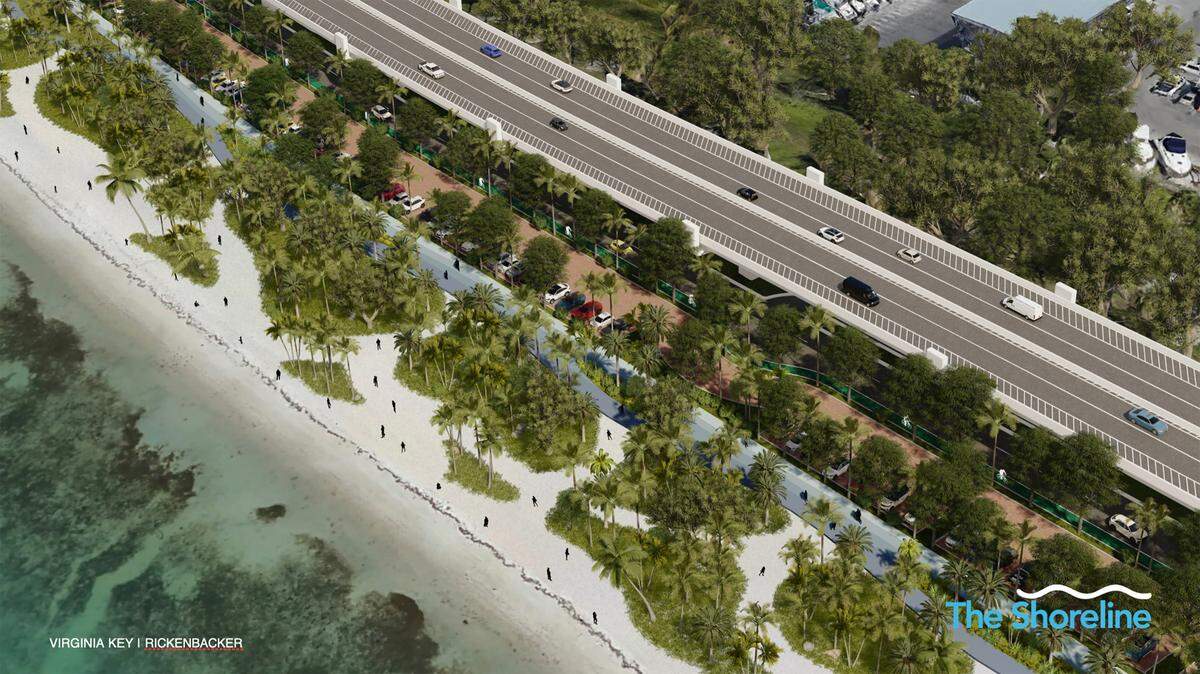
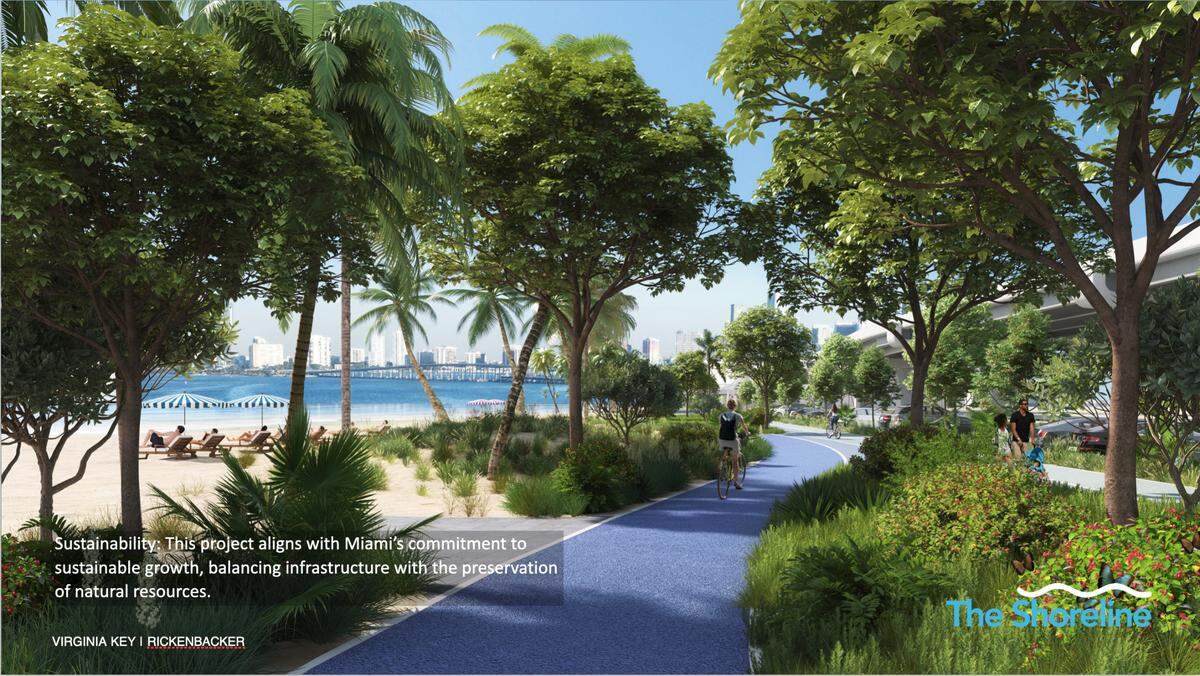
Now, some critics say, it’s time to try something completely different: They are embracing a “rogue” plan backed by a Miami-Dade Commissioner for a radically re-conceived causeway that aims to add acres of beach, dunes and shade trees while solving its safety and traffic problems in one bold stroke — putting most Rickenbacker motorists 25 feet up in the air, on a viaduct, that could take them all the way across Virginia Key to Key Biscayne and back without interruption.
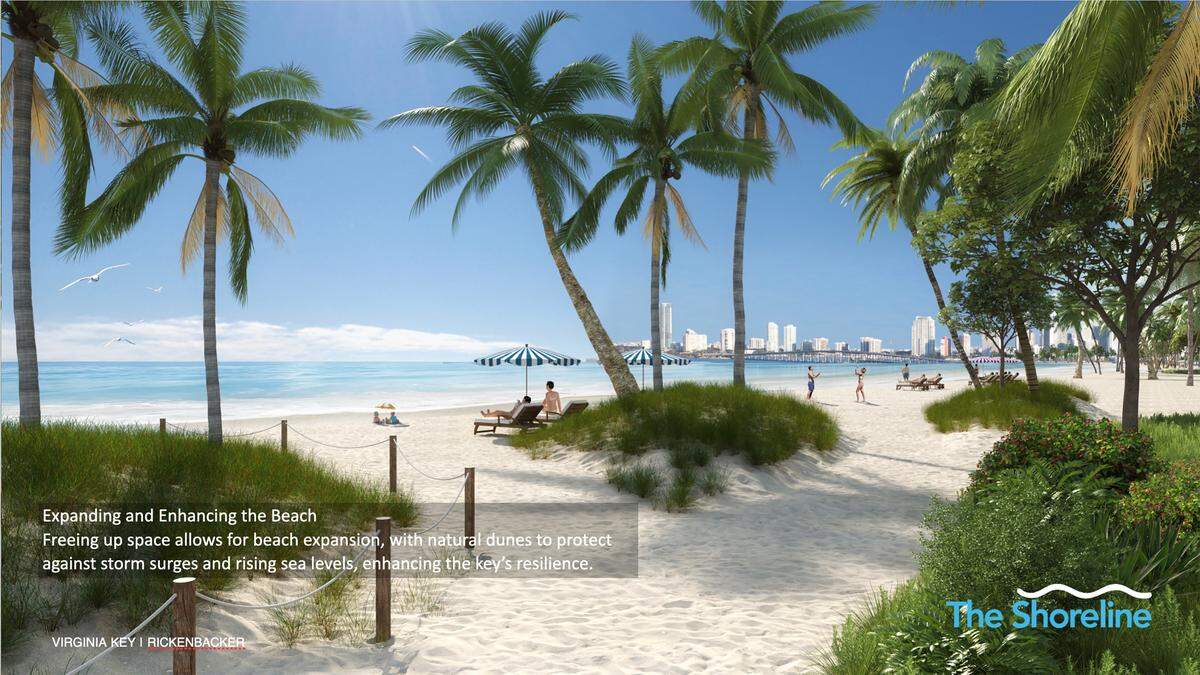
At the same time, on the ground on Virginia Key, the plan would replace road asphalt with significantly wider beaches, lush park space, a paved multi-use path for people on foot, on bikes and on e-devices, plus a protected dedicated bike lane and even some additional beach parking. Slow-speed lanes running below the viaduct would serve motorists visiting Virginia Key while segregating them from cyclists and pedestrians.
Regalado champions proposal
The unorthodox proposal, drawn up by a prize-winning Miami planning firm, paid for by a prominent Miami developer and backed by Key Biscayne residents and public officials, has been embraced in hard-charging fashion by Miami-Dade Commissioner Raquel Regalado.
Regalado says it would be an alternative to official county public works department plans that she dismisses as an unimaginative “more of the same” highway-style approach that would effectively kill the causeway’s potential as a recreational area.
Instead, she says, her admittedly “ambitious” alternative would transform the causeway and Virginia Key into what it should have become long ago — a prime waterfront for people from all across the county. She has dubbed it The Shoreline, in a deliberate echo of the Underline, the highly praised, 10-mile-long pathway and park that’s nearing completion under the elevated Metrorail tracks nearby,
“I asked them to imagine more than a bridge and a road,” Regalado said of the Shoreline’s designers while presenting the plan at a well-attended public Key Biscayne town hall earlier this month. “Reshuffling of the current situation is not enough. We need to rethink this whole thing.”
The presentation was greeted by enthusiastic applause, a notable departure for a community that has been skeptical of past county plans for the causeway.
What exactly the Shoreline plan would replace is not entirely clear. The county has been working on a long-promised new master plan for the causeway that’s not been disseminated publicly. The county also just started a three-year planning process for a Bear Cut bridge replacement that will look at options ranging from improving the existing one to building a completely new design.
But leadership at the county public works department declined a request by the Miami Herald for an interview about the status of the plans, asking instead for written questions. There was no substantive response by publication deadline.
Regalado and Shoreline designer Juan Mullerat, who have seen the county’s plans, say its engineers contemplate installing express lanes to and from Key Biscayne on raised berms along the middle of the Rickenbacker roadway -- something they say would make it virtually impossible to cross from one side to another on Virginia Key without a car while making conditions even sketchier for people on foot and on bikes.
In short, they contend, the county plan might ease the traffic problems for Key Biscyane residents while making things worse for everyone else.
‘Something for everyone’
They say the Shoreline plan by contrast benefits everyone — beachgoers, runners, cyclists, MAST Academy students and others who flock to Virginia Key from across Miami-Dade, as well as people heading to and from Key Biscayne.
“The beauty of this design is there is a little something for everyone,” said Mullerat, founder of Plusurbia Design. “It’s all about alternatives for everybody — cars, bikes and pedestrians — and thinking bold and aiming high.”
But Lee Marks, a Miami attorney and cycling activist who rides his bike on the Rickenbacker several times a week, questioned whether an imposing concrete viaduct would detract from the view of sea and sky that makes the Rickenbacker appealing to its many users.
“I am deeply concerned about the impact on cyclists and other recreational users of the entire area, not to mention the aesthetics and costs of what is really and simply a high-speed overpass slicing through the beauty of Virginia Key,” said Marks, who attended the plan presentation in Key Biscayne. “What are we going to look up and see?”
It’s not the first concept for the Rickenbacker’s transformation to emerge from a private initiative.
In 2021, Miami-Dade Mayor Daniela Levine Cava embraced Plan Z, a blueprint devised by Miami architect Bernard Zyscovich that called for elevating not the roadway but pathways for pedestrians and cyclists. Levine Cava and the county commission pulled the plug in large part because of strong objections from Key Biscayne officials and residents and controversy over a funding plan that called for privatizing the causeway and using toll revenue to finance construction and operation.
Unlike Plan Z, the Shoreline concept originated with a prominent Key Biscayne figure, lawyer and activist Eugene Stearns, and has picked up significant support from village residents and elected officials.
Stearns, who has long floated the idea of a viaduct on the Rickenbacker, said he half-jokingly suggested the idea in a meeting with developer David Martin, CEO of Terra Group, which recently purchased the old Silver Sands hotel property on the island with Fortune International for $205 million. Stearns, who noted he does no lobbying, said it was the first time he had met Martin.
“He says to me, is there anything he can do for Key Biscayne?” said Stearns, a key figure in the incorporation of the village and other Miami-Dade suburbs like Pinecrest. “I said, sort of flippantly, ‘Hire some engineers and design a new causeway.’ ”
To his surprise, Martin took him up on it, Stearns said. The developer hired Mullerat and Plusurbia, who worked for Terra on other projects, along with local engineering firm HDR to develop a proposal.
Their concept won over Regalado, who helped the designers refine the plan and has enlisted support from Key Biscayne’s elected leadership.
“She got on it and worked hard to do it,” Stearns said in an interview. “It’s now her ball. The plan looks pretty good. Lo and behold, it really helps everybody. It helps the cyclists. It helps the pedestrians. It does a masterful job for Virginia Key. It provides far better access and you pick up acres and acres of public land for recreational activities.”
One big hitch is the potential price. A rough estimate by the designers puts the cost of a rebuilt causeway, including viaduct, parks and pathways, at $475 million. That doesn’t include the coast of a new Bear Cut bridge. That is a separate project, though Regalado and her designers say the plans would have to be coordinated because the replacement span would need to be elevated to connect to the viaduct.
Stearns says it’s worth the cost, and residents in Key Biscayne, a wealthy municipality of 14,000 people with a total real estate value he puts at $11 billion, can and are willing to foot a substantial portion of the bill. The city of Miami, the county and the state all benefit as well and should collaborate on paying for it, he said.
Key Biscayne Mayor Joe Rasco applauded Regalado for taking on the project. He said the Shoreline’s balanced approach can solve the congestion problem along the Rickenbacker because it takes into account the unusual traffic patterns on Virginia Key. The usual approach by traffic engineers, he said, is to add road capacity to ease morning and evening rush hours, but that’s not the problem on the Rickenbacker.
The roadway in and out of Key Biscayne backs up bumper-to-bumper, often for hours, on weekends and holidays when special events coincide with the departure of beachgoers late in the afternoon. The fact that it goes beyond simply solving the traffic problem only adds to the plan’s appeal, he said.
“It’s a forward-thinking plan that addresses the needs of many stakeholders,” Rasco said. “This is a good faith effort by Raquel and others to say, ‘Wow we could do something really fantastic.’ “
Rasco said he will call for a workshop for council members to review and comment on the plan soon.
Backers say the plan will also save the county millions of dollars in needed stormwater system improvements. Because the Shoreline would consist mostly of permeable surfaces that allow rainwater to penetrate into the ground, an elaborate system would be unnecessary, Stearns, Mullerat and Regalado say.
The viaduct approach also has one other huge advantage, backers say. The viaduct and a new, elevated Bear Cut bridge could be built while the old ones are still operating, virtually eliminating construction-related traffic headaches.
Bridge vulnerable to hurricanes
Bear Cut is of particular concern. In need of constant and costly shoring up, the low-lying bridge on the edge of the Atlantic Ocean and Biscayne Bay is so fragile that the Shoreline designers say in their presentation it might not survive a hit from a Category 2 hurricane.
Because the new bridge would also be elevated to 25 feet, it would be far more resistant to storm surge. Both the bridge and the viaduct would also be far more resilient in the face of rising seas.
The current bridge, built in 1944 and expanded and rehabbed over recent decades, has a faulty design that makes it vulnerable to lifted off its support pilings by a hurricane, Stearns said. The concrete pilings are exposed to saltwater, crack often and need to be frequently re-jacketed with protective material.
“Don’t look at the total cost. Look at the difference between good and bad,” Stearns said. “Neither is cheap. But we can have a cheap one that won’t be every good and will destroy Virginia Key and have no benefit for recreation. Or we can pay a little more and have a very elegant solution for a very important part of Miami-Dade County.”
The Shoreline plan also comes at a critical juncture for Virginia Key, the 1,000-acre island that’s bisected by the Rickenbacker and split between City of Miami and county jurisdiction.
Beyond the attractions and educational and research facilities that line the road, the island is a mix of public beaches, extensive preserved and restored natural areas, popular mountain biking trails, a toxic former landfill that’s long been slated for conversion into a park, and a sewage treatment plant.
The city of Miami is moving forward on a pair of long-delayed plans. One plan is to renovate the Marine Stadium, an iconic structure that’s been closed since 1992. The city is weighing bids from two major companies to manage the reopened facility, though actual renovation work and financing remain up in the air.
A city consultant is meanwhile workings on designs for athletic fields on the landfill site under a master plan approved in 2010. But a multi-million-dollar county plan to properly cap the landfill has been delayed for years.
When those plans are finally realized, Regalado and Stearns and other Key Biscayne leaders say, the need for a vastly better Rickenbacker will only be more acute.
“Its time we try to get ahead of the game rather than fall behind,” Rasco, the Key Biscayne mayor, said. “It’s an important juncture where we need to work to get this done, even if it takes a long time.”
Regalado, who joked after the Key Biscayne presentation that she had “gone rogue” with the unofficial Rickenbacker plan, said she hopes to persuade the administration of Levine Cava and the county commission to adopt it. She said she’s racing to catch up with the county’s Bear Cut bridge planning since the new span would need to be elevated to the viaduct’s proposed height.
The idea now is to have the village of Key Biscayne pay for partial engineering design work to prove its viability. Rasco said he believes his fellow council members are amenable to the idea.
The problem plaguing Virginia Key, Mullerat noted, is that the island often acts as “a bottleneck” for motorized traffic. Some 40,000 cars and trucks cross use the causeway every day, with a sharp increase on holidays or when special events happen at the stadium or the historic Black beach park. Most of those vehicles, about 28,000, are going to and from Key Biscayne, with the balance stopping somewhere on Virginia Key.
The viaduct would keep those two streams of vehicles out of each other’s way, smoothing the trip for everyone, Mullerat said. It would also keep vehicles pulling boats on trailers and headed to and from Crandon Marina off Virginia Key.
Under the Shoreline plan, the viaduct would begin at the eastern end of the Powell Bridge, the tall span that links Virginia Key to the causeway section leading to mainland Miami, and extend the full length of Virginia Key to Bear Cut. There it would meet the new bridge, which would come to ground level at the Crandon Marina entrance.
A long “stacking” lane, still to be designed, would be created for trailered boats, which must often wait for space to open at the marina when it fills up on weekends on the grassy median on Crandon Boulevard. Further design work is also needed for figure out how the connection between the Powell and the viaduct would work, Mullerat said.
The viaduct would have two lanes in either direction, plus 10-foot-wide shoulders that could accommodate emergency vehicles, express buses and the early-morning packs of fast cyclists that frequent the causeway. Below the viaduct would be a pair of lanes in both directions with a slow speed limit of perhaps 35 mph.
The plan also calls for park-like traffic circles at ground level at MAST and at the Marine Stadium entrance -- which now has no crosswalk and no signal -- and improvements at the two other intersections on the causeway road two on Virginia Key. Those would provide safe and appealing crossings both for people in cars and on foot or bikes in spots where getting across now is onerous and dangerous.
The viaduct would be built along the northern edge of the existing roadway. Once the old causeway surface asphalt is removed, the beach fronts along the southern edge would expand from between 50 to 150 feet -- enough space to add dunes and a dunewalk, a multi-use path, a segregated two-way bike lane, beach parking and thousands of shade trees and plants.
Cars and trucks would no longer cross the dedicated bike lane to get in and out of beach areas. Several cyclists have been killed over the years along the causeway when motorists crossed into the bike lanes.
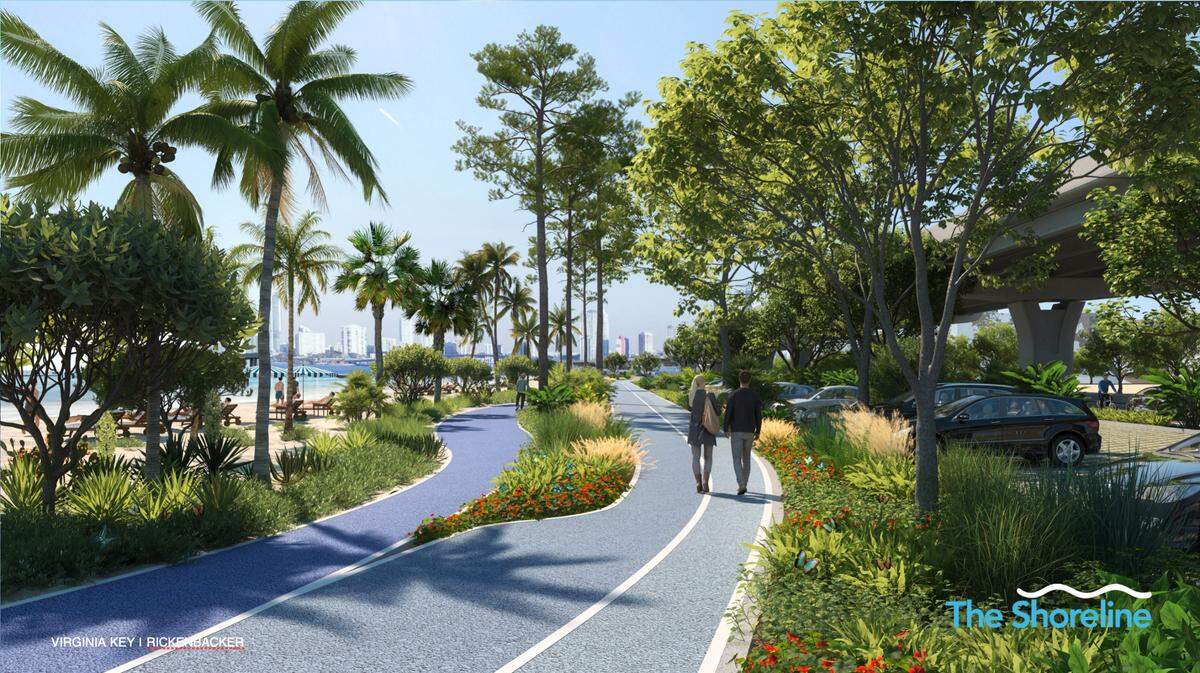
Regalado said the Underline, which will have separate paths for people on foot and cyclists for much of its length, set amid lush landscaping, gardens and recreational areas, has been a model for the Shoreline’s beach side designs. She plans to take Key Biscayne council members on a site visit to an open section of the Underline this month.
She is also pushing for a new connection between the Underline and the entrance to the Rickenbacker. The two are separated by an Interstate 95 overpass and the complex intersection of South Miami Avenue, South Dixie Highway, Brickell Avenue and Southwest 26th Road. The county had promised to redo that hazardous intersection to make it more bike and pedestrian friendly years ago as part of a series of safety improvements to the Rickenbacker, but never got around to implementing that.
In the meantime, Regalado said she is also working on some short-term measures to help ease the causeway’s traffic woes, including better planning for concerts, festivals and other special events.
This story was originally published May 23, 2025 at 5:30 AM.