
Progressives in Congress and campuses flirt too closely with antisemitism | Opinion
If Republicans like Gov. Ron DeSantis have a problem calling out neo-Nazis as they march in American towns, some Democrats and progressives, too, have come dangerously close to antisemitic rhetoric.
They are, of course, a small minority, but one that has a high profile, like the group of student organizations at Harvard that wrote a letter blaming Israel for Hamas’ terrorist attacks on Oct. 7, the nine Democrats in Congress who voted against a resolution supporting Israel and condemning the attacks, or some pro-Palestinian protests that turned into apparent support for Hamas with people shouting “Resistance is justified when people are occupied” in New York City.
Antisemitism is on the rise, according to the Anti-Defamation League. Jewish students don’t feel safe on some college campuses and, in South Beach, a woman shouted “Hitler should’ve f---ing finished the job” in broad daylight. It’s important that free speech and people’s legitimate right to advocate for Palestinians doesn’t turn into an excuse for anti-Jewish hate.
Tlaib censured
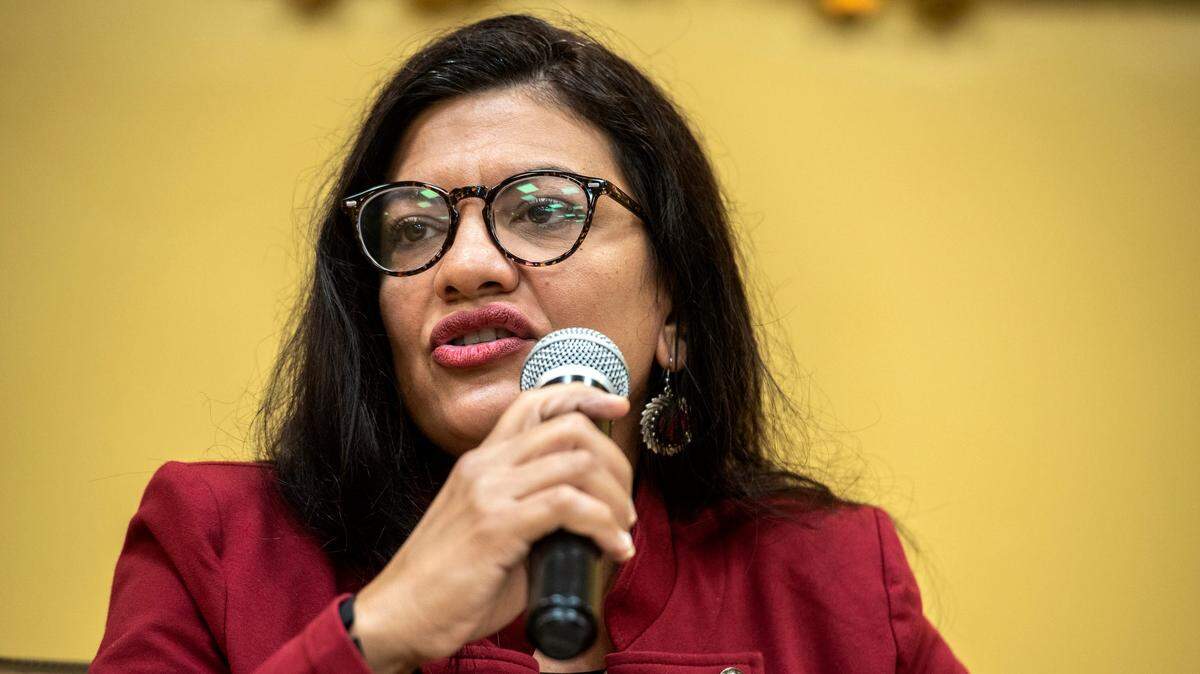
The U.S. House of Representatives voted last week to censure Democratic U.S. Rep. Rashida Tlaib, the only Palestinian-American in Congress, over her defense of a phrase widely considered as a call for Israel’s extinction. Twenty-two Democrats joined Republicans in that vote. Among them were five Florida Democrats, four of them from South Florida, home to one of America’s largest Jewish populations: Frederica Wilson of Miami and Debbie Wasserman Schultz, Jared Moskowitz and Lois Frankel representing Broward and Palm Beach counties.
In a social media post in which she criticized the Biden administration’s response to the Israeli invasion of Gaza, Tlaib defended the slogan “From the river to the sea.” The chant “From the river to the sea, Palestine will be free” is a reference to the area between the Jordan River and the Mediterranean Sea, which covers the state of Israel. A Palestine “free from the river to the sea” is often understood as the elimination of Israel.
“It is an antisemitic charge denying the Jewish right to self-determination, including through the removal of Jews from their ancestral homeland,” according to the Anti-Defamation League.
The phrase was coined in the early 1960s and became popular as a call for the return of the borders established under British control of Palestine, where Jews and Arabs coexisted before Israel was created in 1948, the New York Times reported. Tlaib wrote on social media, “From the river to the sea is an aspirational call for freedom, human rights, and peaceful coexistence, not death, destruction, or hate.”
The slogan over the years was adopted by Hamas, which slaughtered about 1,200 people in Israel on Oct. 7, including entire families, and women who, based on evidence and witness testimony, were raped before being shot. Hamas is clear that it wants to annihilate Israel.
Sharing slogans with terrorist organizations should be a nonstarter, especially for members of Congress. Tlaib’s words shouldn’t be measured only by her intentions, but by their impact.
The phrase has also appeared during pro-Palestinian protests on college campuses and across American cities. Do those demonstrators truly understand the weight of those words, or do they believe it is only a call for social justice?
“There are a lot of people — I am absolutely confident in this because we’ve seen the data — who don’t know or don’t understand most of what they’re chanting,” American Committee Jewish CEO Ted Deutch told the Herald Editorial Board.
“But they’ve been taught that this is a position they need to take to fit within some community on their campus.”
Campus protests
To many young Americans, it’s easy to look at complex Israel-Palestinian relations as a “binary choice” where “you are either an oppressor or you are oppressed,” said Deutch, a former Democratic congressman who represented Broward and Palm Beach counties. That view makes it easy to dehumanize the other side.
There’s grave danger when legitimate support for Palestinians — more than 11,000 of whom have died in Gaza, according to local health officials — flirts with anti-Jewish rhetoric. Likewise, there’s also danger in equating support for Palestinians or criticism of Israel’s government as antisemitic. Labeling Israel critics as hateful or discriminatory is a disingenuous method to quash dissenting opinions and free speech.
Americans must condemn antisemitic and anti-Israel rhetoric, especially when it comes from their political side of the aisle, as Florida’s congressional Democrats did.
Americans should also be wary of efforts to pit Jews and Muslims against each other. Calling Palestinians “all antisemitic,” as DeSantis did recently, stokes the flames of division even further. Islamophobia, too, has reared its ugly face over the past month. A 6-year-old Palestinian-American boy was stabbed to death in Chicago by his landlord because he was Muslim, police said. In Fort Lauderdale, a U.S. Postal Service worker was attacked while wearing a hijab last week. Her alleged attacker is facing hate crime charges, the Herald reported.
Religion-based bigotry of all kinds is abhorrent.
Click here to send the letter.
BEHIND THE STORY
MOREWhat's an editorial?
Editorials are opinion pieces that reflect the views of the Miami Herald Editorial Board, a group of opinion journalists that operates separately from the Miami Herald newsroom. Miami Herald Editorial Board members are: opinion editor Amy Driscoll and editorial writers Isadora Rangel and Mary Anna Mancuso. Read more by clicking the arrow in the upper right.
What's the difference between an op-ed and a column?
How does the Miami Herald Editorial Board decide what to write about?
The Editorial Board, made up of experienced opinion journalists, primarily addresses local and state issues that affect South Florida residents. Each board member has an area of focus, such as education, COVID or local government policy. Board members meet daily and bring up an array of topics for discussion. Once a topic is fully discussed, board members will further report the issue, interviewing stakeholders and others involved and affected, so that the board can present the most informed opinion possible. We strive to provide our community with thought leadership that advocates for policies and priorities that strengthen our communities. Our editorials promote social justice, fairness in economic, educational and social opportunities and an end to systemic racism and inequality. The Editorial Board is separate from the reporters and editors of the Miami Herald newsroom.
How can I contribute to the Miami Herald Opinion section?
The Editorial Board accepts op-ed submissions of 650-700 words from community members who want to argue a specific viewpoint or idea that is relevant to our area. You can email an op-ed submission to oped@miamiherald.com. We also accept 150-word letters to the editor from readers who want to offer their points of view on current issues. For more information on how to submit a letter, go here.