
Broward Schools says, ‘Enough!’ to DeSantis’ reckless COVID policies. Others should follow | Editorial
Cruise lines, schools and businesses in Florida have been Gov. DeSantis’ political pawns in his offensive against public-health measures that would contain the spread of the highly transmissible delta variant of the coronavirus.
And, at least some of them have said: “Enough!” Many more should join them.
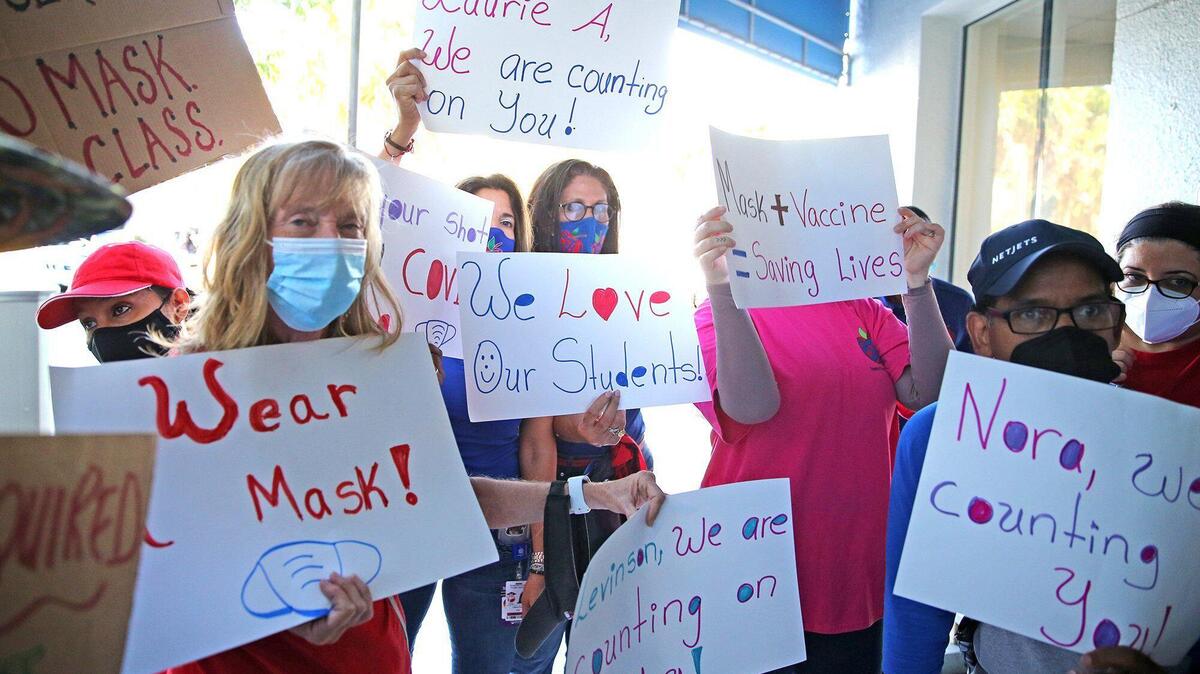
On Tuesday, the Broward County School Board defied DeSantis and voted 8-1 to keep its mask mandate for students, staff and visitors in the 2021-22 school year, risking the salaries of its members and superintendent, which the bullying governor has threatened to withhold. The Board also authorized the district to evaluate and legally challenge the state Department of Health’s new rules, which say districts must allow parents to opt out of mandates.
In doing so, the School Board went against its own legal counsel’s advice that it comply with a late-July executive order signed by DeSantis and the DOH rules, which have the same effect as laws, the Sun Sentinel reported.
Will Miami-Dade County Public Schools do the same?
‘Consulting experts’
The state’s largest district has the advantage of school starting on Aug. 23, later than Broward and other districts. That gives Superintendent Alberto Carvalho time to look at the political landscape and make the calculus: Whom would he rather follow: the whims of a vengeful governor or the guidance of the Centers for Disease Control and Prevention, the American Academy of Pediatrics and others who call for universal masking at schools?
It looks like Carvalho might balk at the governor’s edicts and follow wiser voices. He vowed to stick with a process that requires “consultation with experts in the areas of public health and medicine,” he wrote in a statement to CBS4.
“At no point shall I allow my decision to be influenced by a threat to my paycheck; a small price to pay considering the gravity of this issue and the potential impact to the health and well-being of our students and dedicated employees,” Carvalho wrote. Good to hear.
A medical task force that advises Miami-Dade Schools will meet before the School Board votes on the issue of masks next week. We find it unlikely that task force members will endorse anything other than the efficacy of masks in preventing the virus’ spread. One of them, infectious-disease expert Dr. Aileen Marty, from Florida International University, told the Herald Editorial Board last week that masks protect children and adults at schools.
Assuming our prediction is correct, how could the School Board then go against medical guidance, especially when Carvalho has consistently said that he will follow the experts?
Political fallout
But things are not that simple. Carvalho must also weigh the ramifications of going against a powerful governor with backing from Republicans who control the state Legislature and can inflict harm on rogue school district leaders. Sensing public disgust, however, DeSantis’ office on Tuesday indicated budget cuts that affect students are not his objective and that the goal is to “narrowly tailor any financial consequences to the offense committed” — whatever that means.
A decision to defy DeSantis could be dangerous — as is allowing children to return to school unmasked. But what should school districts do when a governor, bound by ideology and his own political aspirations, issues edicts that are so reckless with the lives of children, teachers and staff — and the rest of us? This new phase of the pandemic is driven by a virus so contagious that even vaccinated people can transmit it.
It’s time for DeSantis to realize that his Trump-backed actions may thrill his base, but, going forward, he’ll need more than true believers to win higher office. Does he really want to be cast as the governor who not only risked children’s lives, but was so relentless that he initially didn’t care one whit about crippling Florida’s ability to education them? Who prohibited local officials from imposing tough COVID safety mandates? Who meddled in private business at the risk of cruise passengers’ lives? Who hides COVID data?
It’s not a good look.
Stand up to a bully
Unless local communities and businesses stand up to the governor, the bullying will continue. More should follow Norwegian Cruise Line Holdings’ example. Sunday, a federal judge allowed the company to require passengers to provide proof of COVID-19 vaccination. A new law, championed by DeSantis and challenged in court by Norwegian, prohibited businesses from asking for so-called COVID passports. He’s vowed to appeal the judge’s preliminary injunction.
Norwegian isn’t simply acting out of principle. It’s acting to preserve its ability to conduct business in the industry that was the most affected by COVID-19’s economic ramifications — not to mention the deadly outbreaks on cruise ships early in the pandemic.
The judge’s decision might embolden other cruise lines, which are assessing what the ruling means to them, to take a stand. They should.
The members of the Miami-Dade County School Board should take a stand, too. Broward’s already has shown them the way.
BEHIND THE STORY
MOREWhat's an editorial?
Editorials are opinion pieces that reflect the views of the Miami Herald Editorial Board, a group of opinion journalists that operates separately from the Miami Herald newsroom. Miami Herald Editorial Board members are: opinion editor Amy Driscoll and editorial writers Isadora Rangel and Mary Anna Mancuso. Read more by clicking the arrow in the upper right.
What's the difference between an op-ed and a column?
How does the Miami Herald Editorial Board decide what to write about?
The Editorial Board, made up of experienced opinion journalists, primarily addresses local and state issues that affect South Florida residents. Each board member has an area of focus, such as education, COVID or local government policy. Board members meet daily and bring up an array of topics for discussion. Once a topic is fully discussed, board members will further report the issue, interviewing stakeholders and others involved and affected, so that the board can present the most informed opinion possible. We strive to provide our community with thought leadership that advocates for policies and priorities that strengthen our communities. Our editorials promote social justice, fairness in economic, educational and social opportunities and an end to systemic racism and inequality. The Editorial Board is separate from the reporters and editors of the Miami Herald newsroom.
How can I contribute to the Miami Herald Opinion section?
The Editorial Board accepts op-ed submissions of 650-700 words from community members who want to argue a specific viewpoint or idea that is relevant to our area. You can email an op-ed submission to oped@miamiherald.com. We also accept 150-word letters to the editor from readers who want to offer their points of view on current issues. For more information on how to submit a letter, go here.
This story was originally published August 10, 2021 at 6:09 PM.