Hurricane Fiona strengthens to Category 3 as it heads toward Turks and Caicos
UPDATE: Fiona is the first major hurricane of the 2022 Atlantic season. Where is it going now?
-
Hurricane Fiona, now a Category 3 storm with 115 mph winds, was back over open water Tuesday morning after battering the Dominican Republic with wind and heavy rain.
Much of Puerto Rico continued to see rain bands from the storm, which caused “catastrophic flooding,” according to the National Hurricane Center. The forecast shows Fiona staying away from Florida, but the U.S. East Coast may see ocean swells this week.
What type of hazards is Fiona causing? How much stronger will it get? And where is it going?
Here’s a forecast breakdown:
Where is Hurricane Fiona now?
Hurricane Fiona was about 130 miles southeast of Grand Turk Island as of the National Hurricane Center’s 8 p.m. advisory Monday.
The hurricane strengthened to Cat 3 early Tuesday, with maximum sustained winds reaching 115 mph with higher gusts. It’s forecast to get even stronger over the next few days once it emerges over the southwestern Atlantic, and is now expected to be a major Category 4 hurricane by Wednesday, with 130 mph winds.
Its hurricane-force winds extended up to 30 miles from the center, with tropical storm-force winds extending up to 140 miles, according to the hurricane center.
READ MORE: Hurricane Fiona causes ‘catastrophic’ damage, island-wide power outage in Puerto Rico
Where is Fiona going?
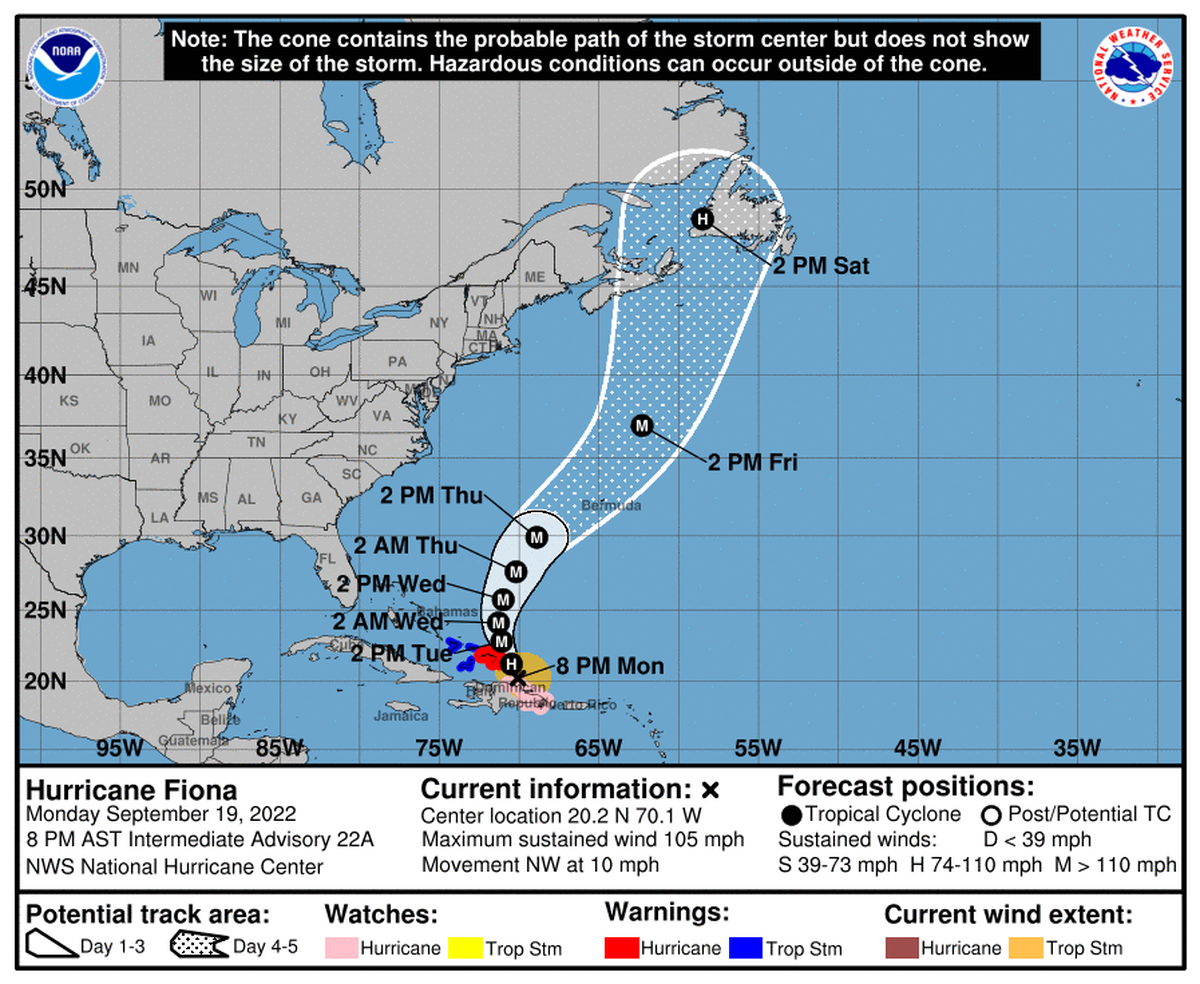
Fiona was moving Monday night toward the northwest very slowly at about 10 mph, according to the hurricane center. This motion is expected to continue overnight, followed by a turn toward the north-northwest on Tuesday and to the north on Wednesday. The center of Fiona will pass near or just east of the Turks and Caicos on Tuesday.
Hurricane Fiona’s watches/warnings
Here are the hurricane center’s watches and warnings for Fiona:
▪ Hurricane Warning in effect for: Turks and Caicos.
▪ Hurricane Watch in effect for: Coast of the Dominican Republic from Cabo Caucedo to Puerto Plata.
▪ Tropical Storm Warning in effect for: Southeastern Bahamas, including the Acklins, Crooked Island, Long Cay, the Inaguas, Mayaguana and the Ragged Islands.
Hurricane Fiona hazards
Fiona’s hurricane-strength winds whipped the Dominican Republic most of the morning. Puerto Rico saw at least an additional ten inches of rain, on top of up to 25 inches in some spots, from Fiona’s rain bands.
“These rainfall amounts will continue to produce life-threatening and catastrophic flooding along with mudslides and landslides across Puerto Rico. Life-threatening flash and urban flooding is likely for easterly portions of the Dominican Republic,” the hurricane center said.
The northern and eastern Dominican Republic was forecast to see an additional four to eight inches of rain, with the eastern section of the island seeing up to a total of 20 inches. The rest of the Dominican Republic and Haiti could see three to six inches of rain.
Turks and Caicos could see four to eight inches of rain, with the southeast Bahamas seeing one to three inches, according to the hurricane center.
The combination of storm surge and the tide will cause normally dry areas near the coast to be flooded by rising waters moving inland from the shoreline.
Storm surge could raise water levels by as much as 3 to 5 feet above normal tide levels along the immediate coast in areas of onshore winds in the Turks and Caicos into Tuesday. It will also raise water levels by as much as 1 to 3 feet in the Dominican Republic.
Localized coastal flooding is possible for the Southeastern Bahamas into Tuesday.
Swells generated by Fiona were affecting the Virgin Islands, Puerto Rico, the northern coast of Hispaniola, the Turks and Caicos Islands and southeastern Bahamas on Monday night. These swells will continue to spread westward across the southwestern Atlantic toward the central and northwestern Bahamas and the east coast of the United States through midweek.
“The swells could cause life-threatening surf and rip current conditions,” the hurricane center said.
Miami Herald staff writer Omar Rodríguez Ortiz contributed to this report.
This story was originally published September 19, 2022 at 7:00 AM.