Elsa now a Category 1 hurricane with Florida in its forecast. Hurricane watch for Cuba
Tropical Storm Elsa strengthened into a hurricane early Friday, and it still has Florida in its sights for early next week, although the National Hurricane Center stressed that the forecast is uncertain that far out.
The still-forming northern eyewall of the hurricane passed over Barbados Friday morning, causing widespread damage and road closures. The latest forecast calls for Elsa to continue to strengthen over the next day but weaken to a tropical storm while crossing Cuba.
In South Florida, officials overseeing the search-and-rescue effort at Champlain Towers South are keeping an eye on Elsa as a possible disruption. At a Thursday evening news conference, Miami-Dade Fire Rescue Division Director Charles Cyrille urged residents to check their hurricane supplies
“Contingency plans for this incident are in place should this system become a threat to Miami-Dade County,” he said. “Now is the time to prepare.”
How strong is Elsa? Where is it going?
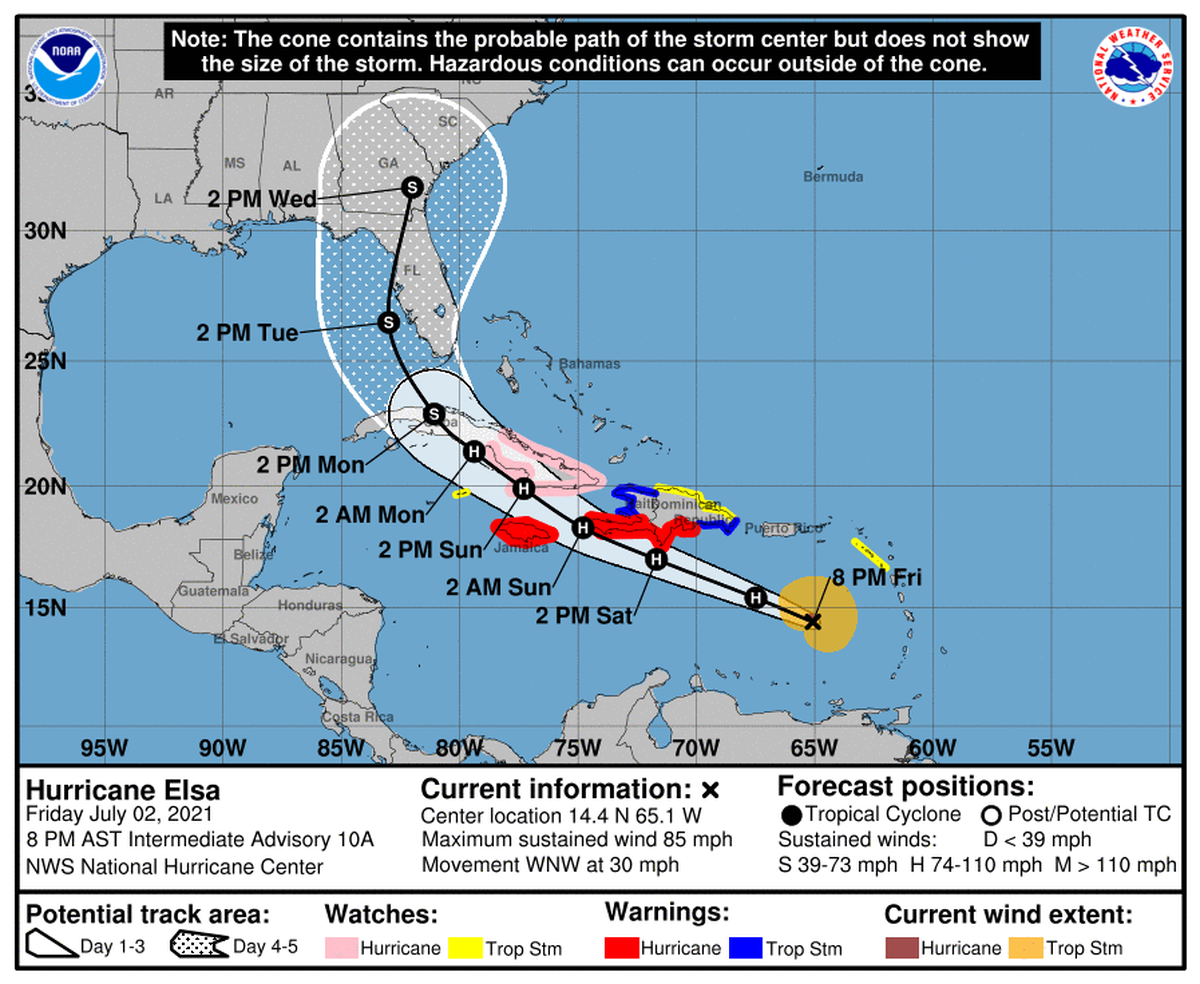
As of the 8 p.m. Friday update, Elsa had maximum sustained winds of 85 mph and higher gusts that stretch up to 140 miles from the center, mainly to the north. Hurricane-force winds extended 25 miles from the center. Elsa was about 475 miles east-southeast of Isla Beata, Dominican Republic.
The latest forecast shows potential devastation for Haiti, the Dominican Republic and parts of Cuba, where heavy rains and category 1 winds could lead to flash flooding and mudslides. But the prognosis looks better for Florida, where Elsa is expected to near as a tropical storm with 65 mph winds.
As of Friday evening, Key West had about a 47% chance of sustained tropical-storm-force winds of 39 mph and about a 16% chance of seeing sustained winds around 58 mph on Monday and Tuesday. Chances for similar winds in mainland Miami-Dade and Broward were much lower, in the high teens and low twenties for tropical-storm-force winds and in the single digits for anything stronger.
Elsa was still moving west quickly. Forecasters said its rapid pace — 30 mph — could destabilize the storm and stop it from strengthening even further in the days to come.
By Friday evening, Hurricane Elsa has passed through the Lesser Antilles. The latest projected track has Elsa shooting the gap between Jamaica and Haiti early Sunday before crossing through the center of Cuba.
In the 5 p.m. update, the hurricane center revised its forecast to show Elsa holding onto hurricane strength a bit longer, but to still weaken back to a tropical storm by the time it reaches Cuba’s north end. It’s forecast to near Florida by Monday or Tuesday.
“There is a risk of storm surge, wind, and rainfall impacts in the Florida Keys and portions of the Florida Peninsula early next week. However, the forecast uncertainty remains larger than usual due to Elsa’s potential interaction with the Greater Antilles this weekend. Interests in Florida should monitor Elsa’s progress and updates to the forecast,” the hurricane center said.
The next 24 hours — on the runway to Haiti, the Dominican Republic and Jamaica — Elsa is set to travel over some storm-friendly conditions: warm sea surface temperatures, high humidity and low shear.
In that time, the hurricane center predicted Elsa’s maximum sustained winds could reach remain around 85 mph.
Hurricane models still show some disagreement about what happens after Elsa passes Jamaica and Haiti. Some show it headed east toward the Bahamas and the southeast Atlantic coast and others show it headed west into the Gulf of Mexico. Those models started to converge a bit Friday afternoon, and the projected track from the hurricane center remained mostly the same — with a bet that the storm will cruise by Florida’s west coast.
“The track guidance is a little less divergent than earlier, but there is still enough spread in the potential tracks that this part of the forecast remains low confidence,” the hurricane center said Friday at 5 p.m.
Watches, warnings and preparations
The South Florida Water Management District is lowering canal levels in anticipation of heavy rainfall from Elsa, said spokesman Randy Smith.
“The district flood control system was already in operation from the heavy rains this week so we will just keep the pumps running and discharging from the coastal structures to bring the flood control system down to a pre-storm level,” he said.
Lake Okeechobee is currently at 12.82 feet, compared with 12.28 feet last year and 11.25 feet two years ago.
A hurricane warning is in effect for Jamaica, the southern portion of Haiti, from Port Au Prince to the southern border with the Dominican Republic as well as the southern coast of Dominican Republic from Punta Palenque to the border with Haiti.
The coast of Haiti north of Port Au Prince and the southern coast of Dominican Republic from Cabo Engano to the border with Haiti remain under a tropical storm warning. A hurricane watch was issued for the provinces of Camaguey, Granma, Guantanamo, Holguin, Las Tunas, and Santiago de Cuba.
A tropical storm watch is in effect for Saba and Sint Eustatius and the north coast of the Dominican Republic from Cabo Engano to Bahia de Manzanillo as well as Cayman Brac and Little Cayman.
Parts of Hispaniola could see 4 to 8 inches of rain this weekend with isolated totals of 15 inches, the hurricane center said. That’s enough to cause flooding and mudslides. An additional two to four feet of storm surge is also expected.
Cuba could see 5 to 10 inches of rain, with isolated maximums of 15 inches, as well as four to six feet along its southern shore, according to the hurricane center.
Breaking records
Tropical Storm Elsa is the earliest ‘E’ named storm on record, beating out Edouard in 2020. Normally, according to NOAA data, the average fifth named storm forms on August 31. The only storm that’s formed farther east this early in the season was a tropical storm in 1933, an infamously active season, according to University of Miami Research Professor Brian McNoldy.
It also became the first hurricane of the season, something that NOAA data show usually occurs on August 10. It’s the earliest first hurricane of the season since 2021, McNoldy tweeted.
NOAA predicted 2021 would be another above-average hurricane season but nowhere near 2020’s record-breaking status.
Miami Herald staff writers Jacqueline Charles and Adriana Brasileiro contributed to this article.
This story was originally published July 2, 2021 at 7:08 AM with the headline "Elsa now a Category 1 hurricane with Florida in its forecast. Hurricane watch for Cuba."