After refusing for weeks, Florida releases nursing home records, showing flurry of deaths
Florida health administrators Friday released detailed information about coronavirus fatalities at long-term care facilities in the state after more than a month of refusing to discuss the virus’ toll. But as has been the case throughout the pandemic, the new numbers raise questions about their reliability.
The administration of Gov. Ron DeSantis disclosed the fatality numbers after several news organizations, including the Miami Herald, filed suit under the state’s public records law to force the data’s release. The release came in the wake of withering pressure from elder advocates and the families of long-term care residents who have been isolated in nursing homes and assisted living facilities for over a month.
The data show that nursing homes and assisted living facilities have accounted for one in three coronavirus deaths in the state.
Problems immediately emerged with what was released. For example, more than a month ago, administrators at the 180-bed Atria Willow Wood ALF in Fort Lauderdale confirmed that at least six residents had died of COVID-19, the illness caused by the virus. But the chart released Friday includes only three resident deaths as confirmed, while three remained “under investigation.”
Other elements of the data raised eyebrows. One nursing home in the Panhandle, the 210-bed Southern Oaks Care Center, was reported to have had three resident deaths — though recent data from health administrators showed 94 residents of the Pensacola home had been infected. That would mean that 3 percent of the home’s residents who contracted the disease succumbed to it. Based on previous data, 40 percent to 50 percent of long-term care residents infected with the virus die.
Another anomaly: Among the 152 nursing homes and ALFs that have reported at least one death from COVID-19, four were not listed on the state’s most recent list of positive cases at long-term care facilities. Three deaths were associated with an unknown facility.
One nursing home, the Coquina Center in Ormond Beach, has nine resident deaths listed. The home did not appear on the most recent list, released by the state, of facilities with positive tests. But a prior list of coronavirus cases in long-term care facilities said 15 residents had COVID-19, 11 others with positive tests had been transferred out, and that nine staffers were infected. Those numbers were supposed to be current as of this past Monday
Spokespeople for DeSantis and his two health agencies — the Department of Health and the Agency for Health Care Administration — declined to discuss discrepancies in the data with the Miami Herald Friday afternoon. When asked by a reporter to discuss the numbers, a DOH spokesman wrote: “Questions received. We are looking into this.”
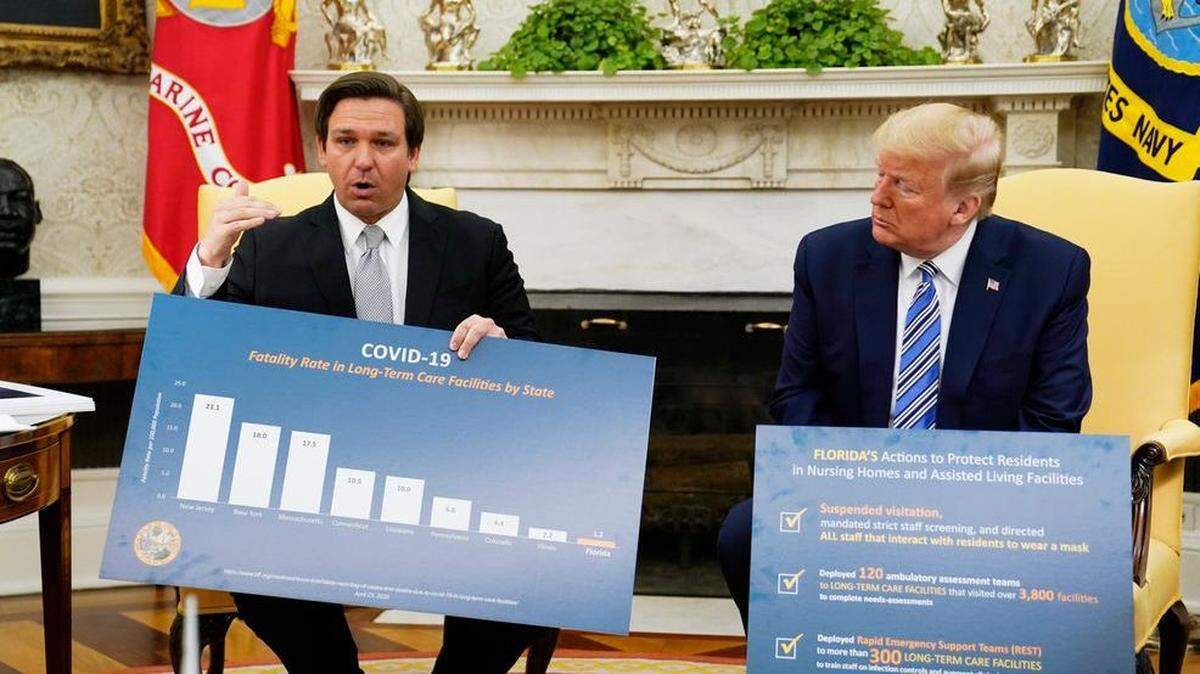
This past Tuesday during a meeting with President Donald Trump at the White House, DeSantis brandished a poster board that compared Florida’s coronavirus mortality rate in nursing homes and ALFs favorably to the rates in some other states. Since then, deaths of staff and residents have accelerated in Florida long-term care facilities, reaching 444.
According to Friday’s release, three nursing homes have suffered the greatest losses: Braden River Rehabilitation Center in Bradenton, Suwannee Health and Rehabilitation Center in Live Oak and Seminole Pavilion Rehabilitation and Nursing Services in Seminole all have reported 13 resident deaths and one death among staff members.
Miami Jewish Health Systems, which operates an enormous elder-care facility with 438 beds at 5200 NE Second Ave., has reported more deaths from COVID-19 than any other facility in South Florida. According to the state, eight residents have died there.
South Florida, which has been the epicenter of COVID-19 infections in the state, accounted for nearly half of all deaths at elder-care facilities. Miami-Dade County, with 95 verified deaths, topped the list, followed by Broward County, at 53, and Palm Beach at 52.
The Fountain Manor Health & Rehabilitation Center, a 146-bed nursing home in North Miami, reported seven resident deaths. Unity Health And Rehabilitation, a 270-bed nursing home in Miami, also reported seven resident deaths.
The data released late Friday — reflecting “the current available information for nursing homes and assisted living facilities that have had a death that can be linked to the facility” — suggest that some of the elder-care homes with the largest number of COVID-19-related fatalities also have struggled in recent years to satisfy state health regulators.
Unity Health and Braden River both are on the state’s Watch List of nursing homes that failed to meet minimum standards during an inspection. So is Signature Healthcare Center of Waterford, a 214-bed nursing home in Hialeah Gardens with six reported resident deaths — as well as another unspecified “confirmed” death — from the coronavirus.
Boulevard Rehabilitation of Boynton Beach reported five resident deaths from the coronavirus. It had been placed on the state’s Watch List three times in 2018 and 2019. The home has been disciplined by AHCA 12 times since 2008, including four fines totaling $22,250.
Boulevard was first placed on the Watch List in March of 2018, after a frail 87-year-old resident was sent to the hospital in respiratory distress, and later died from what was ruled an accident resulting in five broken ribs, a collapsed right lung, a “bruise along the side of her torso” and pooling of blood in her chest.
It is unclear why the other homes are on the Watch List, as AHCA appears to have recently scrubbed all Watch List details from its website.
Editor’s note: The chart has been updated to reflect the fact that some facilities with the same name operate in multiple counties. The state did not indicate in which county the deaths occurred.
This story was originally published May 1, 2020 at 5:40 PM.