
2 nursing homes become COVID-19 death traps. Why are they more dangerous than ALFs?
Late last year, the DeSoto Health and Rehabilitation Center had a flu problem: Forty-three residents requested a flu shot, but only 10 of them got one in time to prevent an outbreak. When it erupted, at least three residents were hospitalized.
State inspectors said the failure to vaccinate residents before flu season left them at “immediate jeopardy.” “The administrator said a resident not being offered or receiving a flu vaccine when the vaccine was available... was considered neglect,” a report said.
DeSoto, whose overall rating on a federal database of elder-care facilities was listed as “much below average,” now is on Florida’s “Watch List” of nursing homes that failed to meet “minimum standards” at the time of inspection.
This past week it made yet another list: Florida elder-care facilities with at least one resident or staff member infected with COVID-19, the illness caused by the deadly coronavirus.
The coronavirus list, produced Saturday after weeks of demands by activists and news organizations led by the Miami Herald, fails to distinguish between homes with one coronavirus case and those that have been overrun with the virus.
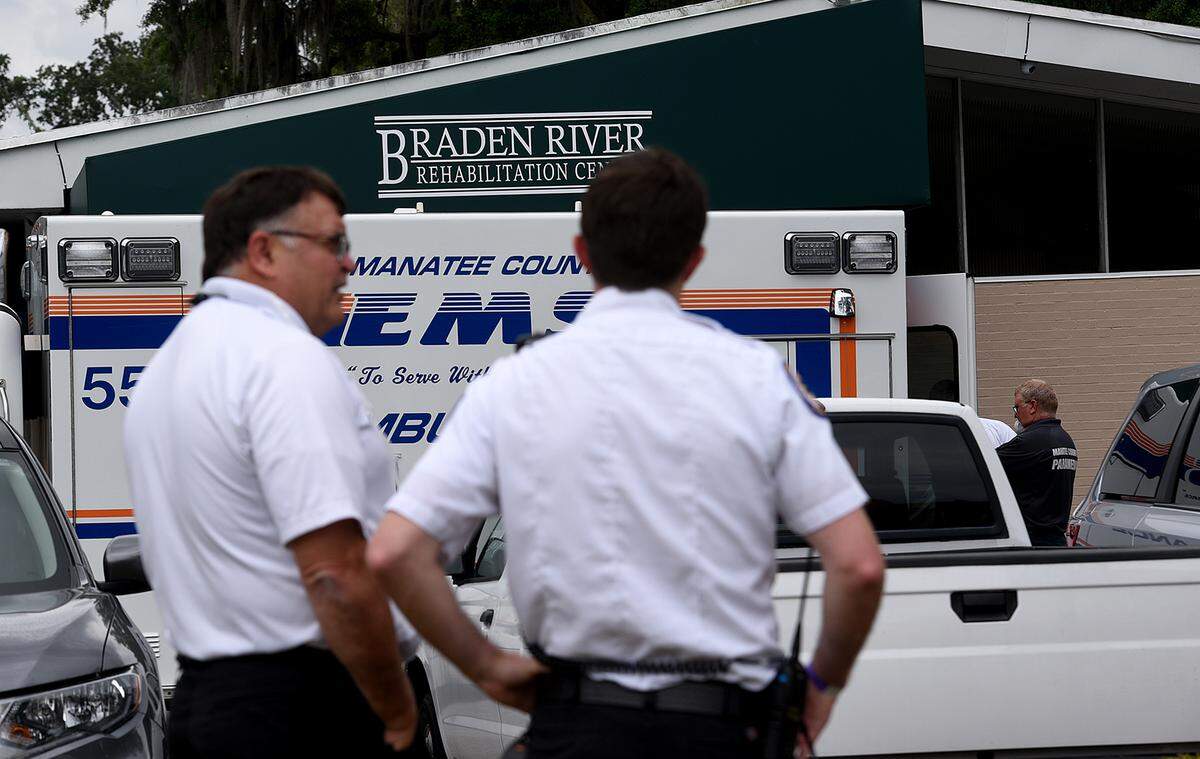
Examples of the latter would include Braden River Rehabilitation Center and the Riviera Palms Rehabilitation Center, both in Manatee County, which between them reported 23 COVID-19 deaths, vaulting them to the upper ranks of Florida hot spots. The death toll is known only because their common owner, Southern Healthcare Management, LLC, acknowledged it Thursday.
Braden River was on the “Watch List.” Riviera Palms was not.
In theory, nursing homes should be among the safest places to be during a public health crisis: They generally employ doctors, nurses, respiratory therapists and nutritionists. Their residents’ health status is measured regularly. They are required by law to develop and maintain infection-control and emergency-management plans; state regulators are required to enforce them. And residents by and large don’t come and go.
Yet, in what is likely to be the worst public health crisis in a century, the industry, as a whole, has often failed to keep residents safe.
One in four of Florida’s 700 nursing homes is listed as having at least one resident or employee test positive for COVID since March 2.
In contrast, fewer than one in 25 of Florida’s 3,100 ALFs — also congregate facilities, but whose residents are generally less frail — are listed as having at least one positive COVID-19 test. (That is true even omitting the 14 assisted living facilities considered “small,” by state statute.)
“If there was any type of senior-care facility that should have been most equipped to manage the COVID crisis, it should have been skilled nursing facilities,” said Brian Lee, a former Florida long-term care ombudsman who currently heads a group called Families for Better Care.
“Despite requirements that nursing homes maintain a robust infection-control program, develop a comprehensive emergency management plan and drill repetitively in preparation for this type of crisis, the coronavirus was seemingly able to slip past these fail-safes and wreak havoc in nursing homes — among residents and staff.”
He added: “Couple that with the state’s too-often lax enforcement, and now our loved ones are suffering the consequences.”
Nursing homes are doing their best to protect residents while under enormous strain, said Kristen Knapp, spokeswoman for the Florida Health Care Association. And most of them, she said, are doing well.
“We’re not hospitals,” Knapp said. “So we don’t have the isolation rooms like a hospital would. In terms of the [personal protective equipment], the N95 masks, we wouldn’t typically have that kind of equipment like masks and, ventilators on hand.”
“We care for a very frail and vulnerable population. And people age 65 and up and more susceptible to COVID.”
As of Wednesday, Florida health administrators reported 312 elder-care homes had at least one confirmed case of coronavirus, 177 of them nursing homes, 135 ALFs. The COVID-19 cases in long-term care totaled 2,386 on Thursday. Of those, the state reported 258 deaths.
Except anecdotally, it is impossible to say which Florida elder-care facilities are battling severe outbreaks of COVID, and which have faced only one case or two. Gov. Ron DeSantis and the leaders of two of his state agencies — the Department of Health and the Agency for Health Care Administration — have refused to provide more than a list of homes.
Other states, including California, Illinois, Nevada and New Jersey, are maintaining online data banks of long-term care facilities. The lists include the number of infections, and the number of residents who have died as a result.
And Florida’s numbers are not reliable: On Thursday, the state reported a total of 16 COVID-related deaths in Manatee County long-term care facilities — at the same time Braden River and Riviera Palms were reporting 23 from their facilities alone.
Dr. Magdi Younan, a Royal Palm Beach anesthesiologist, said the state’s veil of secrecy around elder-care homes had made it difficult to make informed decisions on behalf of loved ones.
Younan’s 92-year-old mother is living in a Greenacres ALF where, he said, at least one resident contracted the illness. “The number of cases in a facility on a daily basis should be reported in a timely fashion,” he said. “I, and others, may choose to withdraw our families and try to make alternative arrangements.”
“The lack of information is disconcerting, and is not helping anyone in making an informed decision,” he added.
Even with threadbare information, it appears that homes that were struggling before the pandemic are having a hard time coping with the rigors of fighting an often-invisible enemy.
“None of this is surprising, “ said Larry Polivka, executive director of the Claude Pepper Center at Florida State University and a researcher on aging issues. “It was going to be especially problematic in nursing homes, because they have such a vulnerable population. We were concerned they did not have the kind of infection-control capacity to respond to the magnitude of this challenge.”
“If you have facilities that have been placed on the Watch List, especially those that have been identified as having infection-control deficiencies, they should be our first concern,” Polivka said. “How can we expect them to be as prepared as other facilities to deal with COVID-19?
There’s no reason to believe they would be prepared to manage this,” he added. “I suspect they are not.”
Knapp, the nursing home spokeswoman, said federal health administrators have made it more difficult for nursing homes to maintain a clean slate with regulators: Last year, for example, the Centers for Medicare and Medicaid Services added a host of new regulations.
“With more regulations,” Knapp said, “there are more opportunities for citations. In 2019, those citations were mostly isolated instances that did not cause resident harm.”
“It’s also important to note that these citations all had to be corrected, which means that facilities learned from their mistakes, and were able to make improvements prior to this pandemic,” Knapp said.
She added: “This virus is spreading in nursing homes with citations, and without citations.”
DeSoto Health and Rehab in Arcadia was a home with citations — for fire safety and emergency management lapses — when inspectors from the Agency for Health Care Administration investigated a flu outbreak there last fall.
Among the violations: the 118-bed home was not properly maintaining nor regularly inspecting its automatic fire-protection sprinkler system, a report said. The home had improperly installed and maintained commercial cooking equipment, which “could result in fires.” A maintenance director said he’d submitted an emergency management plan to the county, but none could be found, the report said.
Then, on Jan. 10, 2020, DeSoto was cited for leaving its residents in “immediate jeopardy,” and placed on the Watch List. Records show DeSoto had enough flu vaccines to immunize 80 residents at least two months before the flu season was expected to begin in October, as procedures require.
But of the 43 residents who requested vaccination, 33 did not get a shot in a timely fashion, the report said.
DeSoto also “failed to implement measures to protect the residents who cannot receive the flu vaccine,” the report said.
“The residents,” the report said, “did not receive the care they needed.”
Since most of DeSoto’s residents were not protected, the home “experienced a flu outbreak” sometime before early December; the exact onset was redacted from a report.
“The medical director said the facility has no excuses for not administering the vaccine to the residents when it was available,” the report said.
DeSoto’s administrator, Lumé Badenhorst, said Thursday that “the care and safety of our residents are our priority. Immediate action was taken to correct the identified deficiency.”
Badenhorst said a prospective employee came into DeSoto in March for training and lied during her screening. The next day, the would-be employee called and told Badenhorst she had tested positive for the coronavirus.
“I was shocked,” Badenhorst said. “She could have started working here. Luckily she did not.”
The facility began screening residents and staff in early March for infection with the virus, but the prospective employee squeaked by the written quiz and wasn’t showing symptoms, Badenhorst said.
“Finding out a person that was dishonest...It’s a blow. They put a whole nursing home in jeopardy.”
Badenhorst said the facility immediately informed the local health department office. Shortly thereafter, AHCA inspectors began an investigation, which, she said, concluded the job applicant only had contact with the facility’s receptionist.
“They were extremely happy to see that we are taking all of the precautions that we do,” she said. “They found them to be more than adequate.”
The facility was told by the health department to revise its screening, she said. So they added a question: have you been tested for COVID, or are you awaiting results?
And so far, it’s worked. None of the residents have come down with symptoms of the virus.
Another home that is on both the state’s Watch List and the COVID-19 list, Avante at Ormond Beach, was cited in 2018 for failing to “implement an infection prevention and control program.”
During an April 2018 visit, inspectors noted that all three licensed practical nurses doing blood glucose monitoring weren’t bothering to clean and disinfect their glucometers. “This failure,” a report said, “placed the residents at risk for transmission of potentially infectious blood-borne pathogens.”
Records say an inspector watched as an unidentified nurse placed a glucose monitor on her medication cart after using it on a resident — “but did not clean it.” She then walked over to another resident sitting at a dining room table. “She proceeded to clean the resident’s finger and obtain a blood glucose reading without first cleaning/disinfecting the blood glucose meter.”
At first, the nurse told the inspector she only cleaned the glucose monitor “if it touches a resident’s bed.” When asked again, she replied: “Yes, I should clean it after every use, and I just forgot.”
On April 24, 2018, the home was cited for placing residents in “immediate jeopardy,” records show. The next day, administrators presented AHCA with a “credible” plan for complying with infection-control rules, and on April 27 of that year the immediate jeopardy was removed.
Kimberly Biegasiewicz, vice president for clinical services at Avante Group, Inc., said the home is in compliance with all state and federal infection-control regulations. “Two representatives from the Department of Health and Agency for Health Care Administration came to the facility on [April 10] and voiced no concerns related to the infection-control processes of the facility, and did not issue any citations related to non-compliance,” she said.
Biegasiewicz said no Avante residents have tested positive for the coronavirus since the pandemic’s onset. One staff member became ill on March 26, but had not been in the home for four days prior. The other employee also has had no resident contact since testing positive. Both employees will not be allowed to re-enter until testing negative twice.
Avante has taken all available precautions to protect residents, Biegasiewicz said, and adhered to all guidelines from the Centers for Disease Control and the state.
“Visitation has been stopped since early March, and only essential medical professionals are allowed in, and are screened each time they enter the facility. The screening includes a temperature check of the staff,” she said.
“Unfortunately,” Biegasiewicz added, “the list provided by [DOH] at the direction of the governor does not give all of the necessary information to portray an accurate picture of the facility, and [its] efforts to successfully mitigate any spread of COVID-19.”
Boulevard Rehabilitation in Boynton Beach, which also is among the 312 homes listed as having some kind of COVID-19 infection, had been placed on the state’s Watch List three times in 2018 and 2019. The home has been disciplined by the state 12 times since 2008, including four fines totaling $22,250.
Boulevard’s was first placed on the Watch List in March of 2018, after a frail, 87-year-old resident was sent to the hospital in respiratory distress.
Records of the incident described “Resident 1” as “extremely” cognitively impaired and unable to care for herself. She was at risk of falls, had overly stiff muscles and was taking blood thinners, meaning any serious injury could become fatal.
At the hospital, Resident 1 was discovered to have five broken ribs and “a bruise along the side of her torso,” inspection records show. Resident 1 also suffered a collapsed right lung and x-rays showed pooling of blood in her chest cavity. At the time, a critical care doctor said Resident 1 was “actively dying, and most likely was in an irreversible state.”
Because the woman had earlier signed a “do not resuscitate order,” she was placed in hospice care until she died on July 18, 2017, records say.
The nursing home’s social service director later reported the incident to the state’s abuse hotline, and an investigation into Resident 1’s injury was commenced.
“All staff involved in the care of Resident 1 were interviewed,” a report said. “All stated they had no knowledge of any incidents.
An autopsy concluded Resident 1’s death resulted from an accident. “They were not able to identify a perpetrator, as the facility denied any knowledge of any incident occurring to Resident 1,” a report said.
Boulevard was added to the Watch List a second time, in September of 2018, when an unannounced survey found the facility did not have a current emergency management plan.
The 167-bed home made its third appearance on the Watch List in July of 2019, when a resident developed a severe pressure sore on her hip bone, leading to sepsis. “The resident’s mental status worsened,” a report said. She stopped eating, then developed pneumonia. “After discussions with the resident and family members, the resident was admitted to hospice, where she subsequently expired.”
Cause of death: gangrene.
Boulevard management won’t say whether any of its residents or staff have come down with the coronavirus. But the rehabilitation facility, with help from the health department, has been testing residents and staff for COVID-19, said Susan Kaar, vice president of Compliance & Quality Management for Southern Healthcare Management.
The protocols aim to catch asymptomatic cases before they infect others, Kaar wrote in an email. The results are then shared with the local health department and the resident.
“We understand the interest in knowing the test results; however, the privacy rights of the residents prohibit their disclosure,” Kaar said. “The Department of Health continues to be the source to provide updates regarding cases in the local community.”
Inspectors from both the health department and the Agency for Health Care Administration had been at Boulevard Thursday, Kaar said, “and exited with no concerns noted.”
This story was originally published April 23, 2020 at 5:18 PM.