Frederica Wilson is leaving Congress. She explains why in an exclusive interview
Congresswoman Frederica Wilson will not seek a ninth term in Congress, she confirmed to the Miami Herald Thursday in a wide-ranging interview explaining why she obfuscated her plan to give up her seat, why she’s not “retiring” and why the political luminary isn’t ready just yet to get behind a successor.
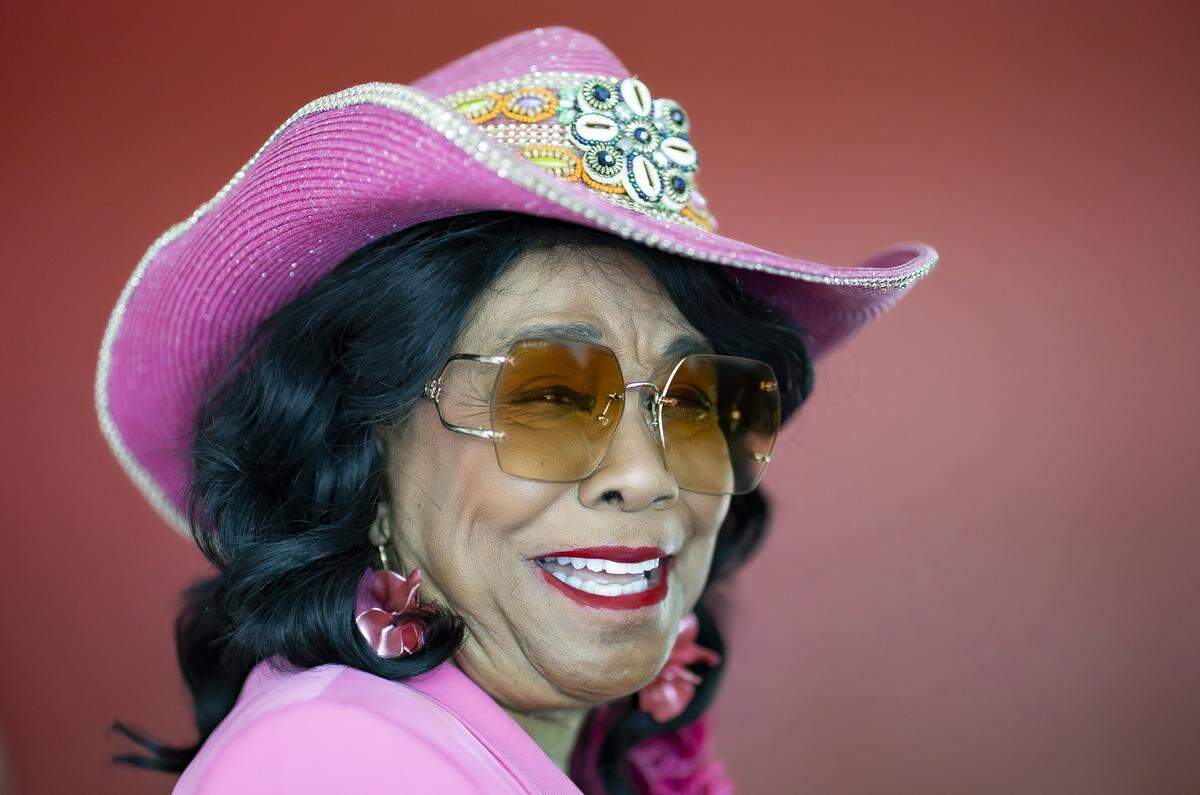
Dressed in a pink two-piece suit topped with one of her signature hats (pink, of course), Wilson, 83, spoke with the Herald about why she decided not to run, her legacy in South Florida and in Washington, and what it will take to run District 24, a Miami district created to concentrate Black voting power that she has represented since 2011, following in the footsteps of Rep. Carrie Meek.
“I think it’s time, and I think I really held on as long as I did because of the 5000 Role Models program, and my concern about the future of it,” the Democratic lawmaker said about the mentorship program she created for Black and brown boys more than 30 years ago.
Wilson, who sat down with the Herald at the 5000 Role Models of Excellence office at Andover Middle School in Miami Gardens, just days earlier called a report about her impending retirement a “crazy rumor.” She said she made her decision a while ago, but needed to be “politically strategic” about how she went about it considering Florida’s recent redrawing of congressional maps, which the governor signed into law on May 4.
“I figured if I announced that I was retiring, what would the Legislature and the governor do? What would they say? Would District 24 be an easy target because Frederica is no longer there? I’m a strong candidate,” she said. “With me not here, would that weaken the survival of District 24?”
Wilson’s concerns were exacerbated by a recent Supreme Court ruling that limits how states can use race when drawing political boundaries — even if it’s done to avoid racially discriminatory maps that diminish Black voters’ power. That ruling came the same week the Florida Legislature voted on a new congressional map that altered the amount of Black constituents in her district and in nearby District 20, both of them drawn to protect Black representation in Congress. Under the new map, Wilson’s is even more concentrated with Black voters.
READ: ‘Not race neutral’: How Florida’s new voting maps favor white voters
“God said to me, ‘Frederica, stay put and trust the process, and when it’s time, you will know,’” she said.
‘This is Carrie Meek’s seat’
Wilson’s career began with her effort to close a landfill near the elementary school where she was principal, which led her to a seat on the Miami-Dade County School Board, Florida Legislature and eventually Congress.
During her political career, Wilson has worked to require that Black history be taught in Miami-Dade schools and eventually statewide, created prison reform that allows incarcerated mothers to be closer to their children, and established and expanded 5000 Role Models, a program to decrease the school to prison pipeline. During her 15 years in Congress, she worked to deliver significant sums of money for projects in South Florida.
But for all her accomplishments, she firmly asserts that the needs of the district are her priority, and that she stands on the shoulders of her predecessor Carrie Meek, a trailblazing politician who set the standard for Black leadership in Miami before retiring in 2002.
“This is Carrie Meek’s seat,” she said. “This is not my seat, and I watched her as she went through the fire and brimstone to get this seat and I didn’t want to gamble on this seat being taken away from us.” Meek, along with the late Alcee Hastings in District 20 and Corrine Brown of District 5, were the first Black U.S. representatives from Florida since Reconstruction.
As the speculation about Wilson retiring from Congress spread, rumors about who might take her place emerged. Two names that arose were Florida state Sen. Shevrin Jones and Miami-Dade County Commissioner Oliver Gilbert.
Rudy Moise, a Miami physician who twice ran against Wilson for her congressional seat, has already thrown his hat into the ring, citing her recent absence and missed votes due to an eye surgery. “Every vote is important and you cannot fight for your constituents if you don’t vote. And now, in District 20 since the congresswoman resigned they don’t have a voice over there either,” he said, referencing Rep. Sheila Cherfilus-McCormick’s resignation last month.
Wilson took umbrage with Moise framing her as unable to run her district — and balked at the idea that a congressional member should resign from their role if they’re considered too ill or too old.
READ: Potential successors are lining up as Frederica Wilson weighs exit
“I’ve had colleagues who have been out for one year because they had a stroke,” she said, adding she’s considered Moise a friend. “These are human beings. So, the way he said that, it didn’t sound like the Rudy I know.”
She said she wasn’t ready to endorse anyone yet. “All of this rests on my shoulders. So I carried a lot, and it’s time to find someone who I can trust,” she said. “I’m going to vet all these candidates to see who I can trust to carry this mission forward.”
‘Congress is hard’
There are plenty of projects Wilson wants to see completed in District 24: building homes for women veterans; a memorial for COVID-19 victims; a Bahamian museum in Coconut Grove and a park in Liberty City, to name a few. She also wants her successor to be a strong advocate for Medicaid expansion and fight to protect the Affordable Care Act.
“It’s one thing to have something on paper, but you have to work. Congress is hard. It’s not easy. It’s not a joke. It’s not fun. It’s hard work, and the people need a strong, strong advocate for District 24,” she said.
Wilson had thoughts on nearby District 20, where Congresswoman Debbie Wasserman Schultz, whose district was completely redrawn on the new maps, has entered a race in an already crowded field with Black candidates seeking to represent what’s left of the historically Black district. Though she didn’t say Wasserman Schultz shouldn’t run, Wilson said that the race would be an uphill battle as Black residents and candidates have emphasized the need for someone who shares their lived experience.
“She might not win if people vote their conscience,” she said, adding Wasserman Schultz has considerable support from Black voters and some elected officials. “I hear people saying lived experiences, so if she wins, she’s got to hire a whole new staff with lived experiences.”
While redistricting has been a point of contention for South Florida, Wilson said voters have to get to the ballot box if they want to see change.
Wilson emphasized that while she isn’t seeking reelection, she’s not retiring. She is working on her memoir and plans to stay politically engaged, likely working to register voters.
“I might just run for Governor,” she joked.
This story was originally published May 29, 2026 at 10:00 AM.