‘Passing the baton:’ Frederica Wilson reflects on her political career
The fumes from the Agripost landfill near the Skyway Elementary School were so bad that the children couldn’t go outside for gym class and their desks were covered in mold. Then-principal Frederica Wilson organized a student letter writing campaign to the county commissioners, asking them to close the plant.
It was 1990 and she held firm. After outcry from the students, parents and community leaders, the commission voted to close the landfill.
The valiant effort was the impetus to a viable political career and is but one in a long line of accomplishments from the esteemed congresswoman, whose political career is now coming to a close.
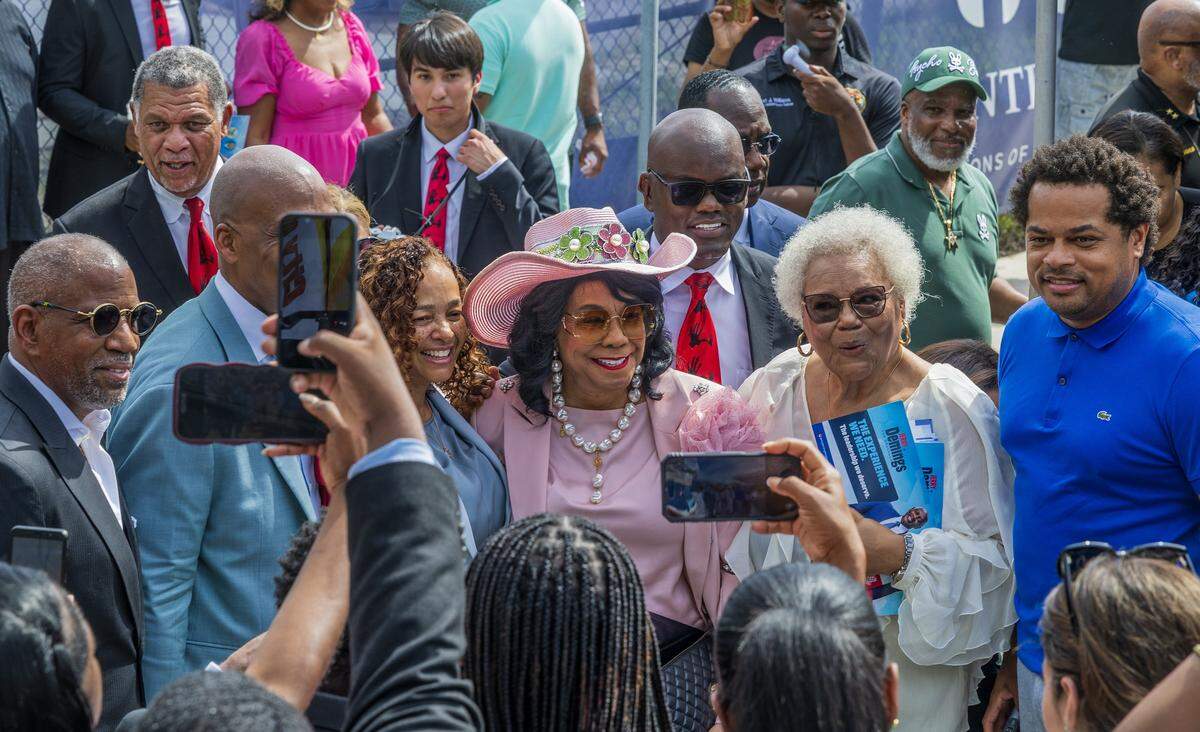
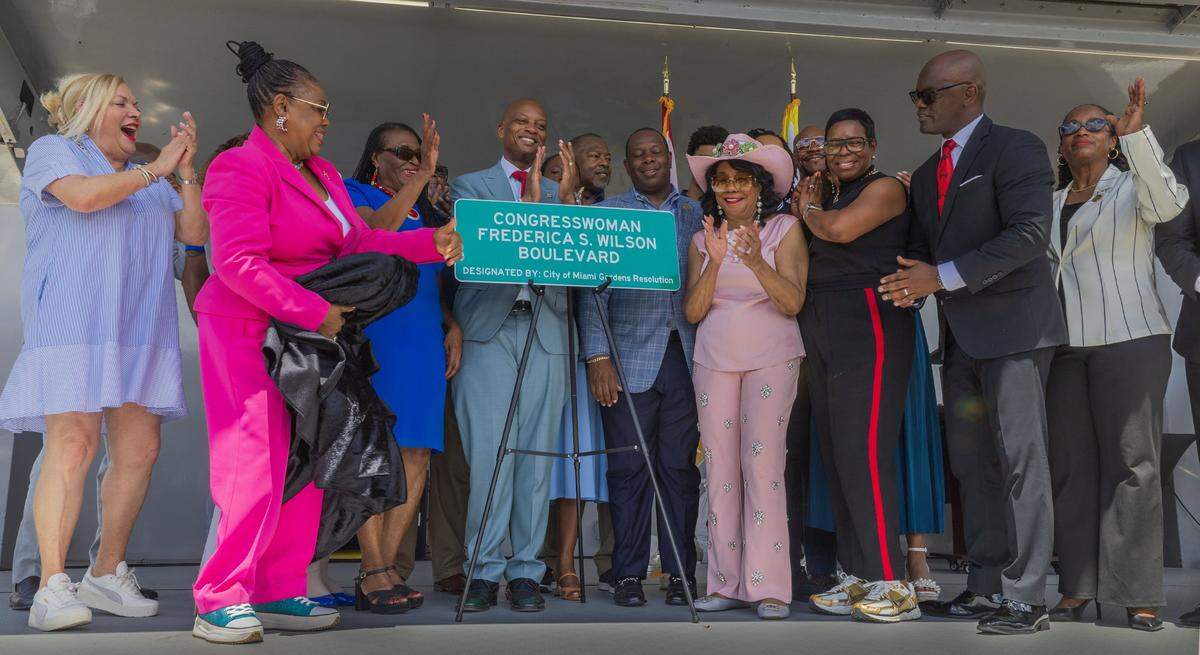
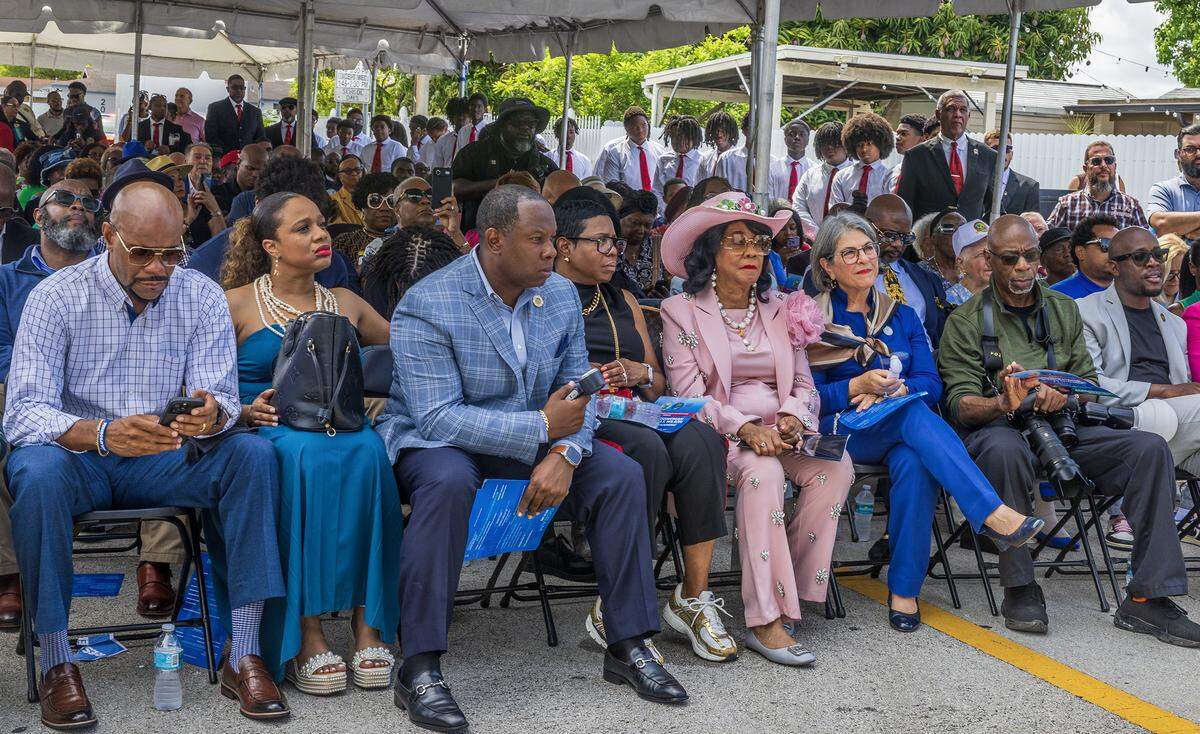
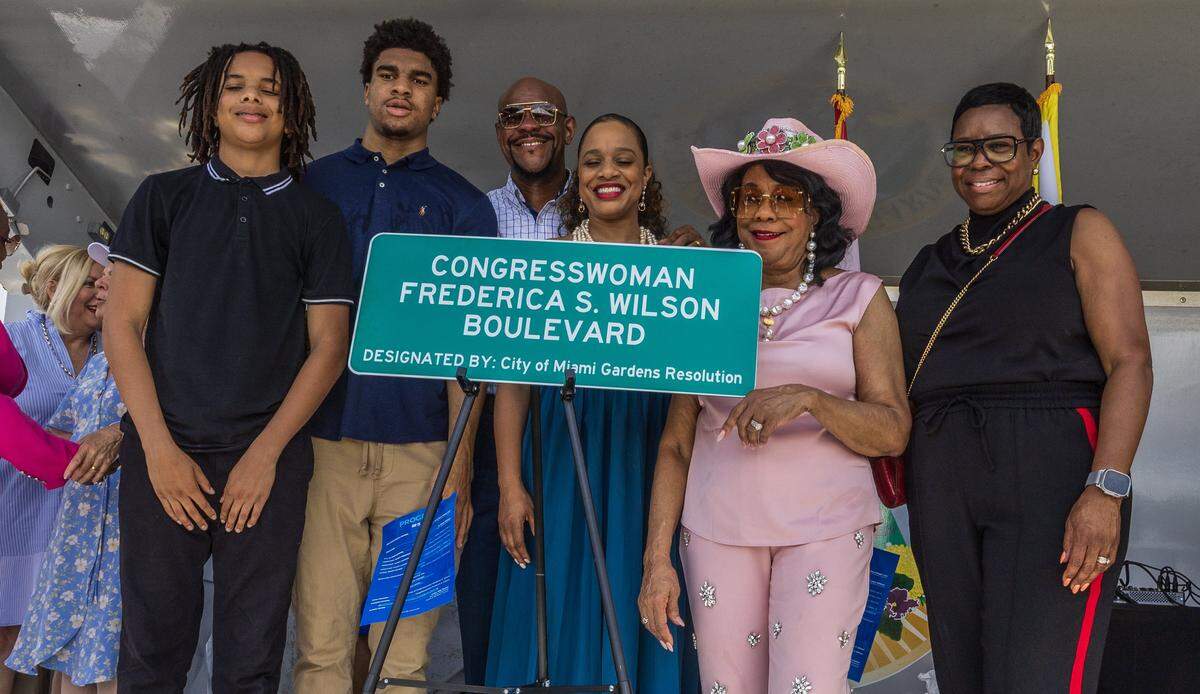
On Friday, it culminated with a street renaming ceremony just outside the same elementary school that now bears her name where she announced she would be retiring from politics, and opening the door to new leadership from the predominantly Black district, which has long been a Democratic hold.
“Even leather wears,” she said to a crowd of at least 100 people outside the construction site of the new Dr. Frederica Wilson/Skyway Elementary School in Miami Gardens. She called the event a bookend for her career, capping more than 30 years in politics that included forming one of the foremost nonprofits for young Black and brown men, creating a council for on the social status of Black men and boys, helping imprisoned Haitian refugees, and has touted delivering $3.1 billion in funds to her district, including for transportation and health-related projects.
But even with a bevy of accolades, Wilson said her work is not done. She will focus on expanding her cornerstone nonprofit 5000 Role Models across the United States and squeeze in time for her memoir.
“I’ve been trying to leave for a while,” she told the Herald ahead of her street renaming ceremony. “If it was just me, Frederica Wilson, I probably would have been gone, but I carry so much. My district means so much, and it’s a historic district.”
Miami Gardens Councilman Reggie Leon, who sponsored Wilson’s street renaming ceremony, said her decision to leave is a reflection of her leadership.
“This isn’t a person waiting until they’re sick or waiting until there’s no hope,” he said. “She is passing the baton in her right mind, knowing what she’s accomplished, knowing what she still has on the table, but also making sure that the mentorship program that she started [continues to succeed]. She’s being a prime example.”
READ: Frederica Wilson is leaving Congress. She explains why in an exclusive interview
Early beginnings
Before she threw her hat in the ring for politics, Wilson was an educator first in Dade County Schools where she initially began working at an Earlington Heights Elementary School, then a predominantly white school in Liberty City. She lasted one day after the white principal threatened to fire her for asking too many questions.
“I went home and told my daddy. He called the superintendent, and he said, ‘Frederica Wilson will not be reporting to Earlington Heights tomorrow. So you have to find another school,’” she said.
She’d go on to work at Lillie C. Evans Elementary, where she worked under her former principal at Liberty City Elementary and alongside some of her former teachers.
The political fire in her belly grew during her time as principal of Skyway Elementary School in what is now Miami Gardens, where she was thrust into the spotlight after she and her students took on Agripost. Wilson said her battle against the landfill “gave me the confidence that I could change things.”
“My daddy was a civil rights activist, and so I watched him change things, so I always wanted to change things for the better for people,” she said.
Miami-Dade County School Board Member Steve Gallon said he’s seen Wilson’s fervent spirit in how she chose to lead as a principal. “She provided an example of a principal who steps outside of the status quo, who challenges the status quo, who leads with a degree of fearlessness, and puts their career and their reputations on the line for children, and that’s something that I’ve always appreciated and respected,” he said.
Wilson won her school board seat in a runoff election, and at the time, she was the only Black person on the school board. She developed and launched what was then called 500 Role Models, a program that would partner young Black male students with established Black men in the community with the hopes it would steer them away from drugs and violent crime and on the path toward education.
It has since ballooned into the 5000 Role Models and services children in Broward and Miami-Dade as well as affiliate chapters in Los Angeles, Detroit and the Bahamas. In many regards the nonprofit is her heartbeat, producing more than 7,000 mentees, including Florida state Sen. Shevrin Jones, who was one of the first graduates of the program and attended Skyway when Wilson was principal. He described her as no-nonsense, but approachable.
“She was serious, not just about children, but she was serious about us learning,” said Jones, who is expected to campaign for her seat. “She had a rapport with the community, and she had a rapport with the parents, but she loved her boys, and I was one.”
A champion for criminal justice, black education
In many respects, Wilson was ahead of her time: She helped pass legislation ensuring Black history was effectively taught in Miami-Dade County during her time on the school board and expanded that statewide when she was a part of the state Legislature.
In recent years the Legislature has limited how Black history can be taught in schools. But Wilson had the foresight to pass on the task of ensuring it would be taught effectively, and passed the task onto another Black Florida senator when she left office.
“I said, I need you to preserve this, I need you to work with everybody, this has to work,” she said, adding there was a task force and an advocate in every school at the time. “They didn’t do nothing. When I say I’m carrying this on my back, there’s Role Models and everything else that I’m carrying, because people don’t transition well.”
Other accomplishments of Wilson’s include the creation of the Florida Council on the Social Status of Black Men and Boys and prison reform that allows incarcerated mothers to be closer to their children.
When Wilson reflects on her own legacy, names sit with her such as Rilya Wilson, the 4-year-old girl who went missing while in foster care and whose absence wasn’t noticed due to case worker neglect. “You’re not getting ready to hide this, because somebody’s going to jail,” Wilson said she told the state attorney at the time. Wilson would later introduce and help pass the Rilya Wilson Act when she was a state representative.
Another name is La David T. Johnson, a 5000 Role Models alum and soldier killed in Niger in 2017. Wilson went toe-to-toe with President Donald Trump about his comments to Johnson’s widow.
Martin Lee Anderson is another person seared in her memory. Anderson collapsed and died while being forced to complete a run during his first day at a boot-camp style detention center in 2006. Wilson worked to close the boot camp and others like it.
“They said he died from sickle cell, and I made them exhume his body,” she said.
Her work has been touted nationally, but behind those accomplishments are sacrifices no one sees, said her son Paul Wilson. He recalled a time when he had to escort a young lady who was debutant and his mother was supposed to pick up his tux, but forgot. “There were times where she was supposed to be at events to support me or support my sisters and there was another event that she needed to be at, but we understood because we understood the mission,” he said.
And then there was the misogyny he witnessed his mother receive during her time as an elected official and the death threats aimed at her and her family when she fought against the landfill.
“These are the things that people don’t understand,” he said as tears streamed down his face. “When I say it’s personal for me, this isn’t politics for me. This isn’t just some lady that was voted in, and now we’re gonna move on to the next person. This is my mother.”
‘Somebody who’s not scared’
Paul Wilson, also an educator, is again following in his mothers footsteps and is running for office, seeking a seat on the Miami Gardens City Council – and emphasized he has no plans to run for his mom’s seat. Still she imparted this bit of wisdom on him: “Keep the people front and center. Don’t worry about anything else. Don’t worry about being liked. Keep the people and what the people need front and center.”
It’s that mindset that’s won her over with constituents, along with her strict sense of accountability for those in the Black community. “There was a time where communities and families and neighbors, everybody leaned into the raising of children, and she kind of brought that same spirit…during her time on the school board.”
And then, there are the moments where she’s mothering those in the community. “I lost my mom seven years ago, and even on holidays, she’s making sure that I’m OK, asking if I want to come to dinner, and things like that,” Leon said. “She just has a real mother spirit about her, and she does that with all the kids that are in her program.”
The congresswoman has been described as relentless in her work and uncompromising in her values, but also ingrained in mentoring youth. Jones said he’s made lifelong friends through 5000 Role Models and has created a ripple effect in mentorship in Black and brown communities.
“When we look at some of our Black leaders now, who are in my age bracket you see many of them who are involved in the community, that’s because of people of the likes of Frederica Wilson and Carrie Meeks, and so many others.”
For Gallon, Wilson’s accessibility has been one of her more powerful attributes. Gallon said last week Wilson called him to gain more insight into Schools of Hope framework. “She is always in tune, and she is able to go directly to us, and we likewise are able to go directly to her around particular issues,” he said.
Wilson said whoever fills her shoes will need to be a fighter.
“I want somebody who’s not scared. I want somebody who is not dependent on lobbyists to give them campaign money,” she said. “I want somebody who is accountable to the people and who has a heart and can feel the needs.”
This story was originally published May 29, 2026 at 8:15 PM.