FPL supports customers paying subsidies but not when it comes to rooftop solar
By Mary Ellen KlasHerald/Times Tallahassee Bureau
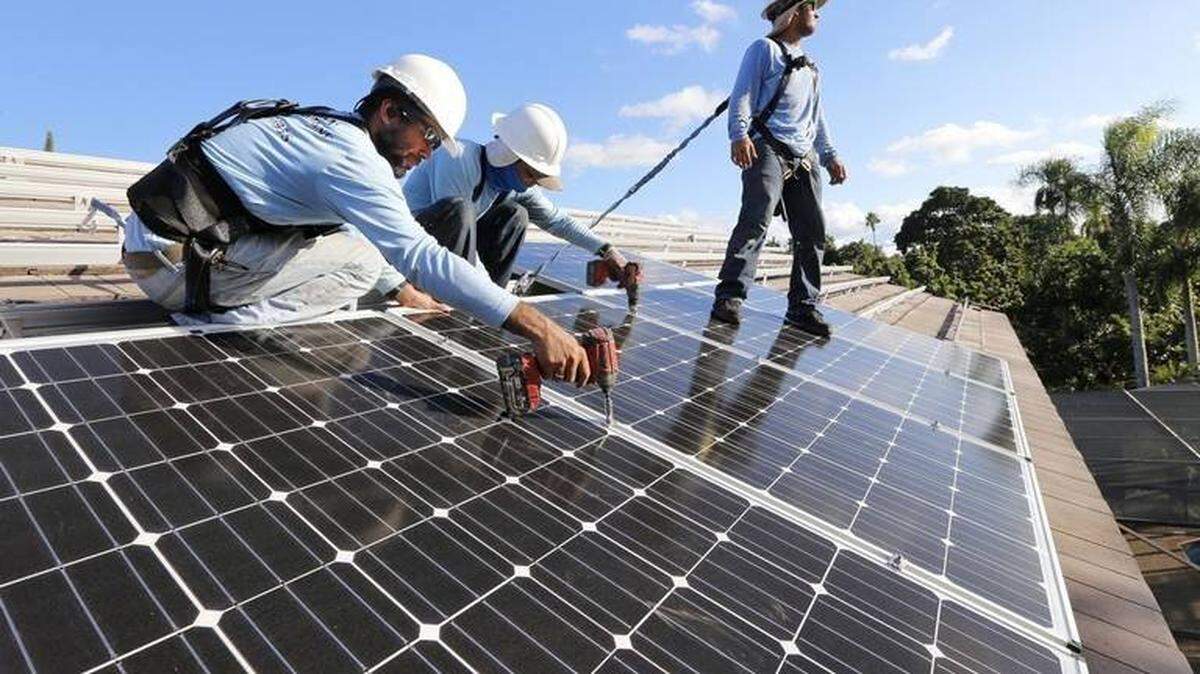
Workers install solar panels at a home in South Miami-Dade County in 2015.
Miami Herald
Tallahassee
In a new television ad, Florida Power & Light argues that “outdated Florida laws are forcing FPL customers who don’t have rooftop solar to pay extra every month for the few who do.”
The argument — that some customers subsidize other customers — is at the heart of the utility industry’s push to change the “net metering” financial terms that have helped expand the solar power industry. The bill, written by FPL for two legislative sponsors, would slash financial incentives for rooftop solar installation and impose new fees on users.
Opponents argue that there is no data to justify the claim that non-solar customers subsidize solar users, and they argue instead that rooftop solar provides a net benefit, not a net cost. But they also point to another reason to oppose the net metering legislation in Florida: the utility industry’s own contradictions over subsidies.
In addition, the utility companies asked for and received the right to impose another $2 billion in subsidies from non-participants to participants in its utility-scale solar program called “SolarTogether.” And, for the first time, regulators allowed them to recover about $32 million in costs from customers with little to no monthly electricity usage, including solar users, by charging a monthly minimum fee.
Critics say those programs contradict the industry’s intense lobbying and advertising campaign to change the rules for private solar users — an estimated 90,000 customers who use “net metering” to sell excess power back to the grid and offset some of their investment for their solar equipment.
On Monday, the House’s State Administration & Technology Appropriations Subcommittee voted 10-5 in favor of HB 741, sponsored by Rep. Lawrence McClure, R-Dover. The bill will be heard in the House Commerce Committee on Wednesday. The companion measure in the Senate, SB 1024, must be heard by the Rules Committee.
Schools fear impact of bill
Rooftop solar makes up less than 1% of the 10.5 million electricity customers in the state but it is one of the fastest growing industries in the nation and threatens to cut into the utility industry’s revenue stream. Critics say if the anti-net-metering legislation becomes law in Florida, it will stifle solar’s commercial potential in the state and allow the utility industry to dominate the market with large-scale solar farms, which all customers will finance.
FPL, however, is fiercely determined to install 30 million solar panels in the state by 2030, and considers its solar investment “greener” for Florida than allowing homeowners to install and finance their own systems. Passing the bill is the company’s top priority, and it has the support of GOP leaders in the Legislature, who have been the biggest recipients of the $3.2 million in campaign contributions spent by FPL and its parent company, NextEra, this election cycle.
FPL argues that its 5.6million customers spent $30 million last year on “subsidies” associated with providing services to its 90,000 solar customers, and net metering must be changed because it predicts that amount will triple by 2025 as solar use grows.
But rooftop solar installers and clean energy advocates call those numbers “a myth.” They note that regulators have never accurately measured the real costs of installing solar, and no data has been provided to legislators to defend the utility’s numbers.
Michele Drucker, left, the environmental chair of the Miami-Dade PTA, traveled to Tallahassee Feb. 21, 2022, with students Thomas Brulay of MAST Academy and Marcel Borges, a student from G.W. Carver Middle School, along with Borges’ mother, Jacquelina Henriquez-Reyes. They came to testify before a House committee against HB 741, which reduces the financial benefits for rooftop solar users in Florida. Courtesy of Michele Drucker
Michele Drucker, the environmental chair of the Miami-Dade Parent Teacher Association, told the subcommittee Monday the school district passed a resolution to move to 100% clean energy by 2030 by investing in rooftop solar. Florida schools spend over a half-billion dollars each year on electricity, and in Miami-Dade, energy costs are the biggest expense for schools after teacher salaries.
With the increased costs from the recent rate case, and rising fuel costs driven by natural gas prices, FPL is raising its costs 21%, Drucker said after the meeting.
But because the bill could undermine that investment, Drucker urged the committee to reject it or “carve out an exception for schools.”
“They’re not worried about the less than 1% solar,’’ she said, referring to FPL. “They’re worried about schools catching on, using the rooftops to generate clean energy.”
Thomas Brulay, a senior at MAST Academy in Miami, told the committee that last year he circulated a petition to allow for power purchase agreements on school rooftops.
“With no upfront costs or costs to taxpayers, schools could lease the rooftops to solar installers to generate power for schools,’’ he said. “Please do not pass this bill which will prevent our school district from saving $100 million by 2030 and deny our students the opportunity to see clean technology working in their school sites.”
Marcel Borges, a student from G.W. Carver Middle School in Miami, spoke in opposition to HB 741, which slashes financial incentives for solar users. ‘My teacher tells me that the climate crisis will be our problem, so I ask you to help me today,’ he said. ‘Please stop this bill.’ Screenshot The Florida Channel
Marcel Borges, a student from G.W. Carver Middle School in Miami, said he traveled to Tallahassee to testify on behalf of his brother, a student at Palmetto Elementary in Pinecrest who couldn’t come because “he broke his arm on Saturday.”
“I’m doing this alone but I’m speaking for the both of us,’’ he said. “My teacher tells me that the climate crisis will be our problem, so I ask you to help me today. Please stop this bill.”
Here’s how the FPL settlement agreement has baked subsidies into the rate base:
▪ Under the rate settlement, regulators allowed for lower cost increases for commercial accounts than residential accounts. Residential customers will pay $1 billion, or 18% more, over the next four years than the state’s largest businesses, according to FPL testimony and documents submitted as part of the rate case.
▪ Requiring all users to pay a “minimum bill” of $25 a month, including solar users who use little or no energy.
▪ Allowing over $2 billion in subsidies from non-participants to participants in its utility-scale solar program called “SolarTogether.”
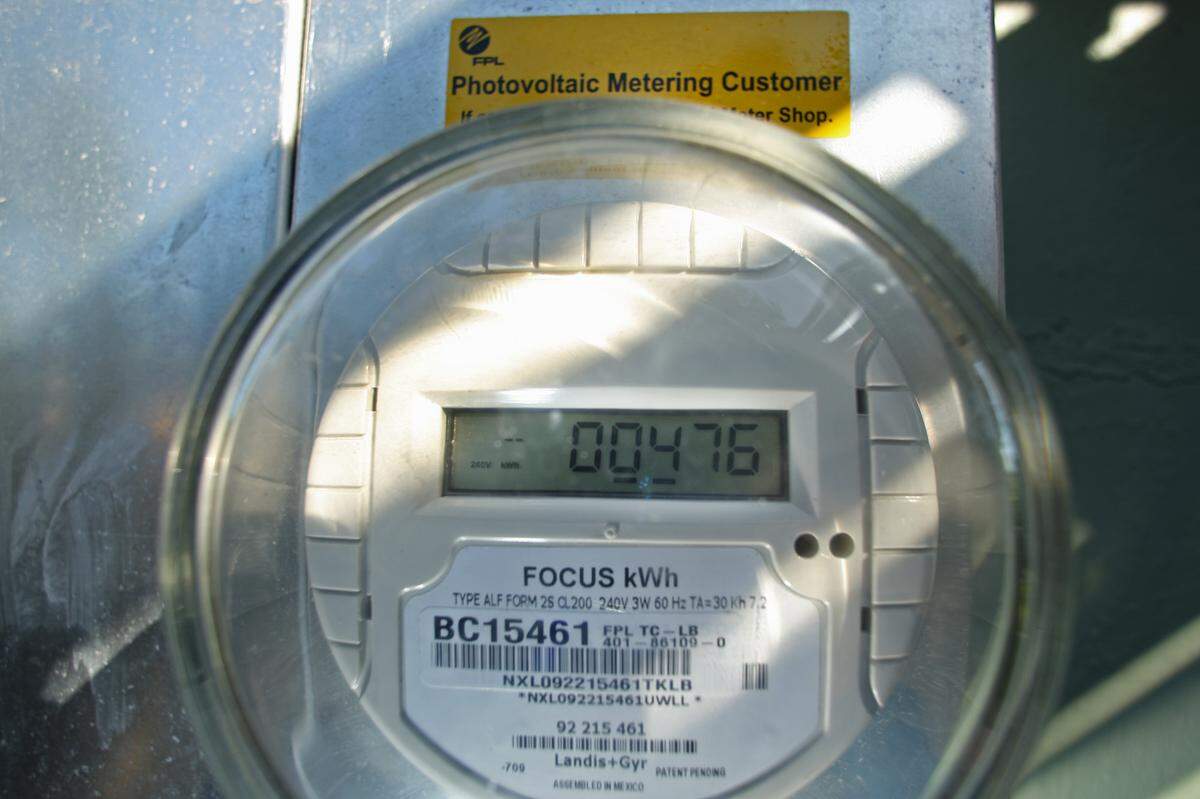
FPL meter on a house in Broward County shows usage and amount generated by solar panels. Miami Herald file photo
‘Minimum bill’ payments
Although the FPL ad suggests that the company supports “bills that are fair for everyone,” critics say that the company used the settlement agreement in its rate case to insert a new “minimum bill” program that would offset some of the subsidy that the company claims non-solar users pay to maintain the electricity grid.
Under the minimum bill, all users who use would be charged at least $25 by FPL. Regulators allowed Duke Energy Florida to charge a minimum bill of $30.
“FPL submits that adding a proposed minimum bill will ensure that customers with little to no usage fairly and reasonably contribute to the fixed costs incurred to serve them and will reduce the potential for subsidization by other customers,’’ said FPL witness Tiffany Cohen during the rate case last fall.
FPL argued in its documents that the “minimum base bill only applies to customers who have extremely low or zero usage, such as a seasonal resident,” and it estimates about 14,000 net metering customers would qualify for the minimum bill.
Cohen said the company expects to collect $32 million in revenue from the minimum bill, which will “offset the amount of revenue that’s been recovered from the general body of customers.”
“The intent is to ensure that all customers contribute towards their fair share of fixed system costs,’’ she said.
George Cavros, an attorney with the Southern Alliance for Clean Energy, told a House committee earlier this month that the FPL testimony was evidence that the utility considers “any revenue loss from rooftop solar is negligible, and that the minimum bill provision ensures that low-use customers, like net-metered customers, are reasonably and fairly contributing to its fixed cost.”
“It begs the question, if FPL says that the minimum bill ensures that low-use energy customers, like solar rooftop customers, are paying their fair share, why are we going after them again?” he asked.
Solar Together concerns
FPL also won regulatory approval to give $2 billion in credits to participants in its utility-scale solar program called “SolarTogether.” Under the program, customers voluntarily pay more on their electric bills to finance solar projects and then receive credits that are expected to result in them getting a “payback” in about seven years.
Despite the criticism, the PSC approved the Solar Together subsidy, which will benefit commercial accounts more than residential users. The decision had the support of some environmental groups.
Subsidy or savings?
Raul Vergara, CEO of Cutler Bay Solar Solutions in Miami, is among many solar suppliers who argue that homeowners in Florida are providing a net savings to other utility users by investing more than $750 million into the energy infrastructure of the state and offsetting the need for utility-financed energy generation.
He said his South Florida customers aloneproduce 75 megawatts of power a day. “That is the equivalent of what FPL produces out of the solar farms they have at Krome [Avenue Solar Center],” he said. “Except my customers pay for those panels and nobody has to pay them back.”
Kim Ross of the Rethink Energy Action Fund urged legislators to reject the utility argument that solar customers are a burden on other ratepayers. She cited the Senate staff analysis that notes that one-third of FPL’s solar customers make less than $50,000 a year in revenue and two-thirds make less than $100,000.
“Rather than harming low-income customers, net metering is actually how low to moderate income customers get access,’’ Ross told the House’s State Administration & Technology Appropriations Subcommittee on Monday. She added that because “there’s nothing in this bill that guarantees lower rates for anyone,’’ eliminating net metering may also not save ratepayers money.
Lisa Edgar, a former PSC commissioner who was on the commission in 2008 when it adopted the net metering rule, agreed with the investor-owned utility (IOU) industry that the rule is outdated and unfair.
“We have 1% of residential rate payers in IOU territory that have rooftop solar,’’ she told the House subcommittee. “That means that the 99% of the others are subsidizing those costs, many of whom are elderly and not in a position to make a 20-year investment into their home.”
Cavros countered that “the PSC has not made any determination about the costs and benefits of solar.”
In the face of heavy opposition from clean energy advocates and the solar industry, the House sponsor of the bill, McClure, said on Monday that he was working on an amendment that gradually slashes the financial incentives for solar users, instead of imposing them all at once. The amendment was released on Tuesday morning and will be heard in the House Commerce Committee on Wednesday.
Mary Ellen Klas can be reached at meklas@miamiherald.com and @MaryEllenKlas
This story was originally published February 22, 2022 at 12:08 PM.