FPL admits its rate increase will cost residential customers more than big businesses
Florida Power & Light witnesses admitted to state regulators this week that its proposed $1.53 billion increase in rates over the next four years will cost residential customers disproportionately more than the rate increase imposed on the state’s largest commercial and industrial businesses.
The statements from FPL witnesses came during a one-day hearing Monday to review a proposed four-year settlement between the state’s largest utility and other interested groups.
Under cross examination from opponents, more than one FPL executive acknowledged that the company’s data show that residential customers will pay $1 billion more in increases than industrial customers under the proposed settlement, which if approved will be the largest rate increase in history for the state’s largest utility.
“That’s a lot of money,’’ said Bradley Marshall, the lead lawyer for Earthjustice and other opponents before his questions prompted FPL’s experts to acknowledge elements of the agreement that were not included in the company’s promotional materials.
“That’s hundreds of dollars per residential customer that they shouldn’t be paying in order to subsidize the rates of a few large companies,’’ he said.
But Robert E. Barrett, vice president of finance at FPL, called it a “comprehensive deal” that balanced the interests of all customers. He said that the settlement includes components approved in the last three FPL settlements, and, because industry metrics show the company is high performing, regulators should continue a successful strategy.
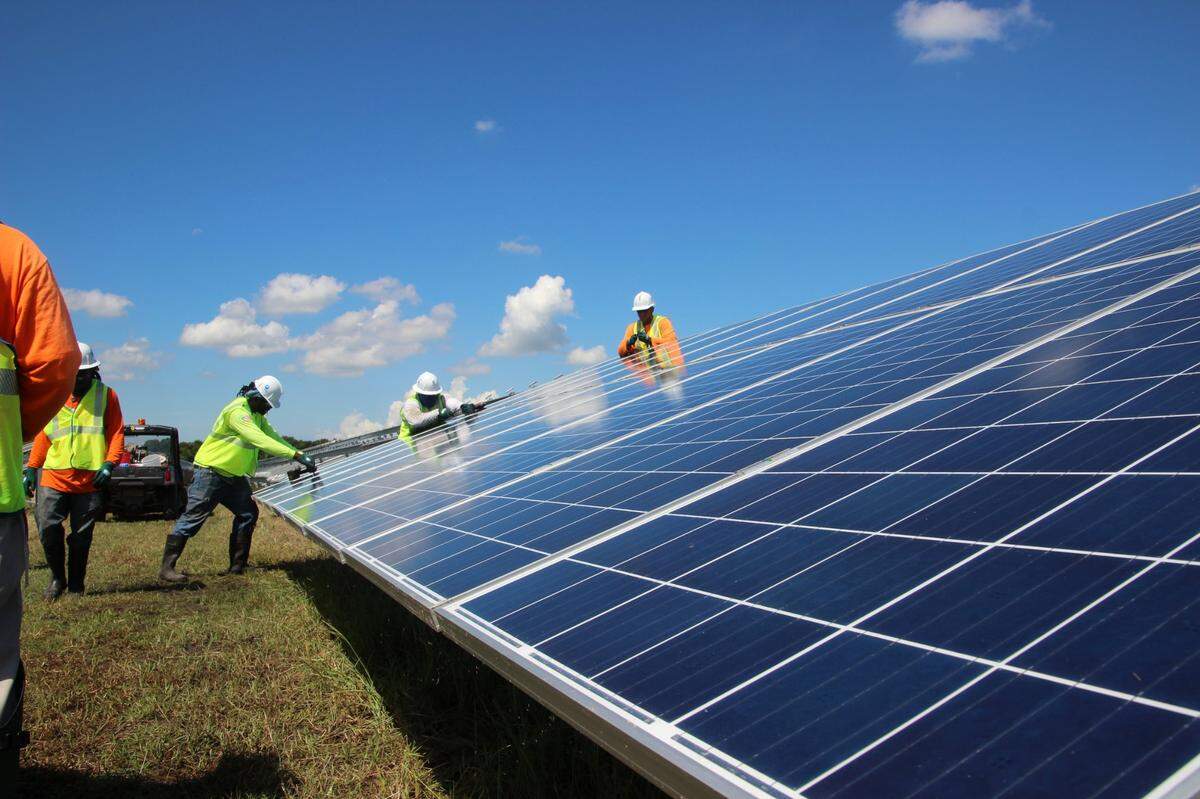
In response to questioning, FPL also said that participants in the SolarTogether program will receive $2 billion in savings and acknowledged that those savings are subsidized by other customers.
The SolarTogether program allows subscribers to voluntarily pay more on their electric bills to finance solar projects and in return receive credits over seven years. The settlement dedicates 40% of the solar expansion to residential and small business customers and 60% to commercial, industrial and governmental customers.
If approved, the proposed settlement would raise base rates $692 million in January and another $560 million in 2023, with additional increases in 2024 and 2025 to pay for solar projects.
The settlement agreement was reached in August between FPL and the Florida Office of Public Counsel, which represents consumers in rate cases, the Florida Retail Federation, the Florida Industrial Power Users Group and the Southern Alliance for Clean Energy.
Vote Solar and CLEO Institute signed the settlement in August after some of their requests were met. The Federal Executive Agencies, which represents the military and other federal programs in Florida, also said Monday they support the deal.
“While the agreement is not a perfect outcome for our interest, we believe it is fair and reasonable,” said Thomas A. Jernigan, attorney for the Federal Executive Agencies, which includes the U.S. military facilities in Florida.
He said the settlement “will result in unique programs that will encourage investment in innovative programs” and “although there will be some increases, we believe these are palatable. The rates are fair and won’t result in any rate shock to customers.”
Third four-year settlement
This is the third time since 2012 that the Florida Public Service Commission is being asked to approve a take-it-or-leave-it settlement agreement sought by FPL. The proposal uses a series of accounting strategies to provide the company with revenue flexibility as well as increased profits.
Proponents include the state’s largest industrial users, who will have smaller rate increases than residential customers, and solar advocates who embrace the plan because it expands solar production and electric vehicle charging programs and lowers fossil fuel usage. In return, the settlement gives FPL one of the highest guaranteed rates of return in the nation.
Opponents representing residential customers — Earthjustice, Florida Rising, League of United Latin American Citizens and the Environmental Confederation of Southwest Florida and Floridians Against Increased Rates — say the settlement is a bad deal for most of FPL’s customers because it requires general customers to subsidize the solar program and disproportionately increases rates on residential customers.
They also argue that FPL’s original proposal was better for residential customers than the settlement regulators are now being asked to approve.
Excluded from negotiations
Under data reviewed by the PSC on Monday, large commercial customers would pay 20% less than what FPL originally proposed when it filed its rate case in March, while residential customers see a decrease of only 2%.
“Residential customers were not at that table, and that’s why they didn’t get the savings,” Marshall said. “It was not a balancing of residential interests, and that’s why the settlement violates the public interest because for it to be in the public interest, it needs to be in everyone’s interest, not just the interests of the largest corporations.”
The company also admitted that its Solar Together program, which pays subscribers credits, will not expand for low-income customers while the greatest beneficiaries will be large commercial users, many of whom are on a wait list to join the favorable program.
Scott R. Bores, senior director of financial planning & analysis for FPL testified that the company calculates savings from the Solar Together program by assuming that without it no solar power would be built and the company would be paying a federal carbon tax that does not yet exist.
“Understanding what’s going on in Washington, DC., I think it’s very hard to fathom that there won’t be some kind of carbon compliance cost over the future,’’ Bores said.
Marshall called that “an absurd scenario to make Solar Together look good.’’
He said instead of paying businesses to take solar credits so they can advertise that they use clean energy, a better approach would be for FPL to eliminate Solar Together and build an efficient solar system that benefits all customers.
“FPL doesn’t want Walmart and other big customers defecting and installing a lot of its own solar,’’ he said. “And so this is a way of paying them to be an FPL customer and charging other customers, including low-income customers, to do it.”
Few questions asked
During more than seven hours of testimony from witnesses for both opponents and FPL on Monday, Florida’s five-member Public Service Commission asked only a handful of questions. The PSC staff asked no questions, and the Office of Public Counsel, which represents all ratepayers and signed onto the settlement, asked no questions.
The PSC is comprised of members who have never presided over a fully litigated rate case for the state’s largest utility.
Commissioner Gabriella Passidomo, a former PSC staff lawyer, was appointed this year. Commissioner Mike LaRosa, a former Realtor, began his term in January. Commissioner Art Graham, the veteran on the panel is a former chemical engineer who was appointed to a fourth term this year. Commission Chair Gary Clark was first appointed in 2017 and reappointed once. And Commissioner Andrew Giles Fay was appointed in 2018 and reappointed this month.
Passidomo, Graham and Fay honed in on some of the accounting provisions in the settlement.
For example, the settlement guarantees FPL a return on equity of 10.6%, with a range of 9.7% to 11.7%.
Under a special arrangement the PSC gave the company in 2012, if FPL earns more than is allowed in earnings, it can credit the surplus funds against its amortization expense and thereby increase its total expenses enough to keep excess earnings.
Tim Devlin, a former PSC executive director who was hired by the opponents to provide his analysis of the rate case, testified that instead of keeping the surplus collected from customers because FPL collects too much for depreciation costs, the surplus should be given back to customers in the form of lower rates.
“FPL has a reserve surplus of just under $1.5 billion, which was paid for by its customers,’’ he said.
Plan to keep surplus
By allowing FPL to keep the money through depreciation credits, the PSC “would effectively deprive FPL customers of the value of those overpayments and transfer this huge amount of wealth and purchasing power to FPL and its shareholder, NextEra Energy,’’ Devlin said. “This is not fair and contrary to public interest.”
But FPL argued the policy, known as reserve surplus amortization mechanism, or RSAM, “has been instrumental in providing the rate certainty and regulatory stability to enable FPL to significantly improve the value that we deliver to our customers,’’ Barrett said.
He said by allowing this flexibility, FPL will avoid general base rate increases in 2024 and 2025 and can better “manage volatility and uncertainty throughout the entire four-year period.”
Barrett also argued that the accounting flexibility that allows the company to make high earnings is a reward for FPL’s “superior performance.”
“The proposed incentive provides a strong message from this commission to us that will be noticed by all companies,’’ he said.
Although the PSC staff has the expertise to analyze the settlement and decide what is in the public interest, it will not be making a staff recommendation on whether or not the PSC should approve the settlement, said Cynthia Muir, PSC spokesperson.
“If, however, the commissioners reject the settlement and take up the rate case at a later date, then there would be a staff recommendation,’’ she said.
The parties next will file briefs on whether the settlement should be approved and the commission is expected to make a final decision on the proposal Oct. 26.
This story was originally published September 23, 2021 at 6:00 AM.