War in Venezuela? How a U.S. military attack against Maduro would play out
At a military base in eastern Venezuela’s Caribbean coast, radar screens sit mostly dark. Generators hum sporadically, parts are stripped from grounded aircraft, and officers communicate on personal cellphones because the army’s radios no longer work.
Just a few hundred miles north, the Caribbean Sea is bristling with U.S. warships, stealth jets and high-tech drones in what analysts describe as the region’s largest show of force in half a century.
The contrast is startling. Washington has deployed one of the most powerful naval forces the region has seen in decades — an aircraft carrier, several destroyers, a submarine, F-35 fighter jets and swarms of armed drones. On the other side, Nicolás Maduro’s military struggles to keep its war machine alive, undermined by corruption, neglect and fear.
If armed conflict broke out between the two nations, retired Venezuelan officers warn that it would most likely be decided in a matter of hours, while the battlefield would soon echo with only one sound — the blast of American weapons.
“This is the lowest operational level in the history of Venezuela’s armed forces,” said a retired Venezuelan general familiar with conditions inside the barracks.
The Miami Herald spoke with U.S. and Venezuelan military experts, including six former high-ranking Venezuelan officers who fled the country after breaking with the Nicolás Maduro regime, who analyzed the readiness of the South American country’s forces. From exile, the former officers remain in contact with colleagues still inside the armed forces and have tracked the military’s internal decay for years.
Figures shared with the Herald suggest the real operational capacity of the Venezuelan army stands between 33% and 35%. By contrast, the U.S. presence in the region represents the full weight of the world’s dominant military power.
“Any attempt to resist an American attack would be suicide,” warned a high-ranking Venezuelan officer now in exile. “They wouldn’t even be able to get their planes off the ground, much less sustain a prolonged engagement.”
The assessment comes amid a sharp escalation of measures ordered by President Donald Trump since returning to the White House in January 2025. One of his first directives was to instruct the State Department to classify drug cartels as terrorist and transnational criminal organizations — including Venezuela’s Tren de Aragua and, later, the Venezuelan Cartel of the Suns, which Washington says is led by Maduro and other top government figures.
Soon after, the Justice Department doubled the reward for information leading to Maduro’s arrest, raising it to $50 million, while the Pentagon was authorized to use military force against certain drug cartels in Latin America.
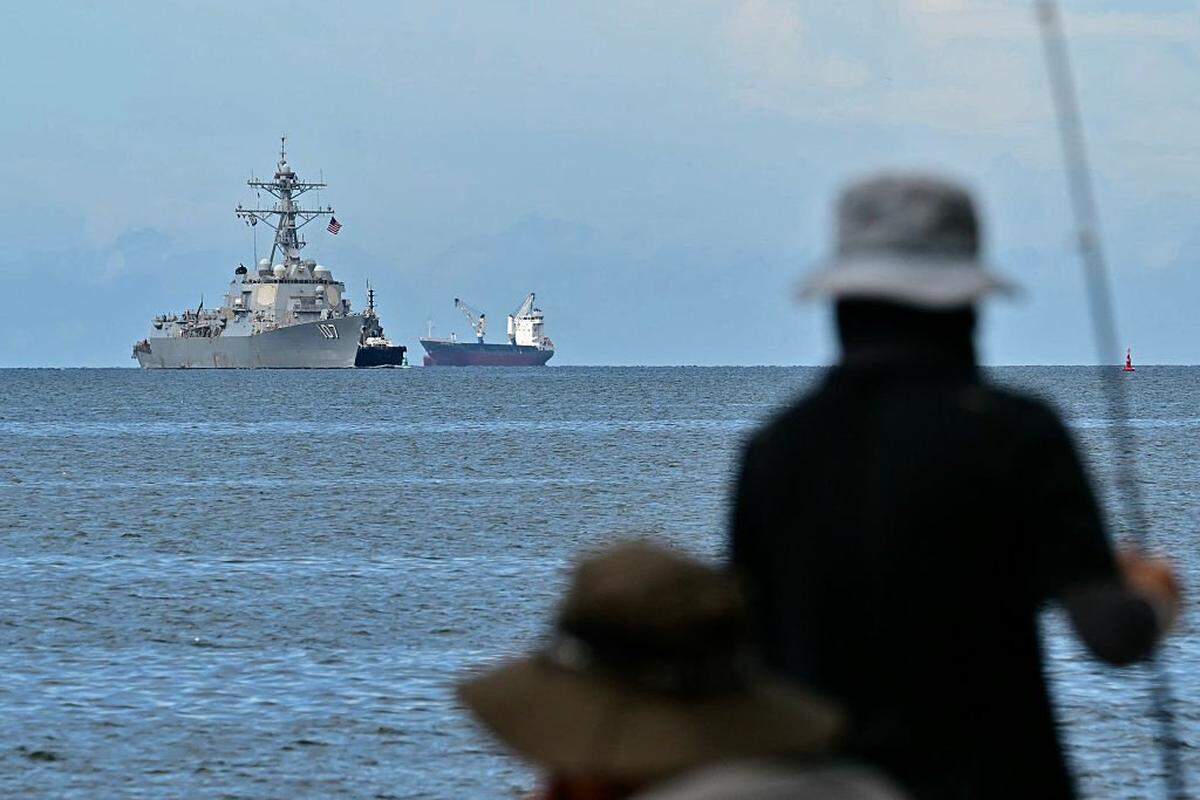
In the following months, the Trump administration launched a large-scale deployment across the southern Caribbean Sea near northern Venezuela, forming a Joint Task Force that includes three destroyers — equipped for air, anti-submarine, and missile defense — and an amphibious group of about 4,500 troops. The mission includes maritime patrols with P-8 aircraft and long-range surveillance flights to track drug trafficking routes.
In September, the deployment was reinforced with 10 F-35B fighters stationed at Ceiba Air Base in Puerto Rico and MQ-9 Reaper drones armed with Hellfire missiles at Rafael Hernández Airport. Those aircraft can conduct precision strikes on labs, clandestine runways, vehicles or vessels tied to drug operations.
On Oct. 24, Defense Secretary Pete Hegseth ordered the aircraft carrier USS Gerald R. Ford to the Caribbean along with its accompanying strike group, including the cruiser USS Normandy and destroyers USS Thomas Hudner, USS Ramage, USS Carney, and USS Roosevelt. The fleet — with more than 4,000 personnel and roughly 90 combat aircraft — would form the centerpiece of the operation’s “final phase,” aimed at neutralizing the leaders of the Cartel of the Suns and Tren de Aragua and striking fixed and mobile targets inside Venezuela, according to retired Venezuelan officers who spoke to the Herald.
As of this week, the massive U.S. military force amassed in the Caribbean has so far been used mainly to carry out lethal strikes against fast boats the administration says were transporting drugs — most of them intercepted off Venezuela’s coast. The attacks have left 57 suspected traffickers dead.
But Trump has signaled that operations could soon shift ashore, arguing that the task force is finding it harder to locate vessels willing to venture out now that the risk of detection means almost certain death.
U.S. officials have offered few details about any planned actions inside Venezuela, but the sheer scale of the deployment has prompted many analysts to conclude the mission has a single, overarching objective: the end of the long-surviving Maduro regime.
A hollowed-out force
Experts portray Venezuela’s armed forces as a broken institution, short on resources, maintenance and training. Operational readiness across the Army, Navy, Air Force, National Guard and Air Defense is estimated between 25% and 40%.
A closer look at the different branches reveals major shortcomings, according to a report prepared by one of the officers at the Herald’s request.
Army: T-72 tanks and BTR-80 armored vehicles suffer severe electrical and mechanical failures, with spare parts and skilled technicians in short supply.
Navy: Just three ocean patrol vessels remain operational, armed with low-effectiveness Iranian missiles; six missile frigates have been sold for scrap, and the country no longer has functioning submarines.
Air Force: Of 22 Soviet-era Sukhoi Su-30 fighter jets, only four are believed operational; another four U.S.-made F-16s can still fly but lack working missile systems. Most helicopters and transport planes have expired inspections and obsolete equipment.
Air Defense: The Comprehensive Aerospace Defense Command is operating at roughly 20%. Although it possesses S-300VM, BUK-M2E, and PECHORA-2M surface-to-air and anti-ballistic missile systems, many have gone over a decade without proper maintenance. “The armed forces have lost the ability to operate these systems effectively,” the experts who spoke to the Herald said.
The regime also claims to have around 5,000 Russian portable infrared-homing surface-to-air missiles, which it says would be devastating against U.S. aircraft. Experts counter that these would not have the reach to significantly threaten U.S. fighter planes and could mostly serve as a deterrent for U.S. helicopters.
Venezuela does have an advanced unmanned aircraft program, developed with Iranian assistance and partly controlled by Iranian personnel. Some drones are capable of carrying explosives and could be used as suicide air units against ground forces.
Training levels are estimated between 25% and 30%, with poorly qualified troops and pilots and a communications network described as “practically collapsed.” In many cases, officers reportedly rely on personal cellphones to coordinate maneuvers.
Most experts believe the Trump administration has no plans for a protracted military intervention in Venezuela, a promise Trump made during while running for his second term.
“He campaigned on ending occasions when 30,000 or 50,000 U.S. troops were sent abroad,” Elliott Abrams, who served as U.S. Special Representative for Venezuela during Trump’s first term, told Herald columnist Andrés Oppenheimer. “What he favors are targeted operations, like the assassination of Iranian General Qasem Soleimani, or attacks on Iran’s nuclear installations earlier this year. I don’t think he wants something that could drag on.”
Even the 1989 U.S. invasion of Panama, a much smaller country easier to dominate militarily than Venezuela, required about 30,000 troops, Abrams noted. A similar operation in Venezuela would generate U.S. casualties, and although probably limited, would still present political challenges.
The forces currently concentrated in the Caribbean, while substantial, are not quite large enough for an invasion, said Mark F. Cancian, a retired U.S. Marine Corps Reserve colonel and senior adviser at the Center for Strategic and International Studies in Washington.
“But as the military buildup continues, the focus on intimidating the Maduro regime and building capabilities to strike it has increased,” he said. “The carrier is the most recent example. There isn’t enough combat power for an invasion, but there is plenty for air or missile strikes against the cartels or the Maduro regime.”
How an initial phase might unfold
Professor Evan Ellis, an educator at the U.S. Army War College’s Strategic Studies Institute, offered a more granular forecast of how the U.S. campaign could progress and why strikes might accelerate soon. Ellis underscored that, on paper, Venezuela still fields large numbers of troops — over 100,000 traditional army personnel and roughly 300,000 formal reserves, plus militias of dubious reliability — but argued that does not translate to combat effectiveness.
Ellis said three factors could trigger escalating strikes: a planned meeting between President Trump and China’s President Xi in South Korea, under the theory that swift, dramatic military action in Venezuela would project U.S. strength and bolster Trump’s position ahead of the talks; the departure of Hurricane Melissa from the region, and the arrival of additional U.S. military assets — aircraft carriers, destroyers, submarines, and Marine reinforcements. Together, he suggested, the conditions would offer political cover, safer weather and increased military options.
He predicted initial operations would focus on counter-drug missions in both the Pacific and Atlantic, using maritime patrols, strike aircraft and drones to degrade trafficking networks. Those missions, he said, could transition into limited land strikes against drug labs or groups near the Colombian border if commanders judged that doing so would not trigger an uncontrollable escalation.
Ellis described the likely tactical mix: Tomahawk cruise missiles from surface ships, precision munitions delivered by MQ-9 drones, electronic warfare to blind Venezuelan sensors, and special operations teams on the ground — a playbook he likened to the opening phases of the 1991 Gulf War. He emphasized that many weapons in the U.S. inventory and deployed forces are chosen specifically to avoid — and defeat — Venezuela’s degraded air defenses.
“I don’t see any question that you basically take out the majority of the radar sites, the command-and-control sites, the Sukhoi-30s,” Ellis said, noting that some jets might survive by dispersal but would be overwhelmed by F-35s operating from Puerto Rico. He added that U.S. destroyers and cruisers already in the region bring hundreds of vertical-launch system missile tubes to bear — and the arrival of the aircraft carrier group would likely add still more — giving planners substantial long-range strike capacity.
The limits of Venezuelan defenses
Ellis drew a clear distinction between a campaign of limited precision strikes and a broader effort that could materialize later. He doubts the administration would pursue a sustained U.S. ground occupation, but predicted that an operation in late November or December could aim to remove the leadership of the Cartel of the Suns — about 10 to 20 key figures — through a combination of long-range strikes, electronic warfare and special-operations actions.
Early operations, Ellis said, would concentrate on capturing or eliminating key Venezuelan leaders — Vice President Delcy Rodríguez, National Assembly President Jorge Rodriguez, Interior Minister Diosdado Cabello and other top regime figures — coordinated with members of the local police or military services incentivized by reward money and working in concert with U.S. intelligence agencies. Such efforts, he indicated, would try to minimize civilian casualties by focusing on command-and-control centers, radar and air-defense nodes, and aircraft parked on the ground.
Ellis dismissed fears that Venezuelan’s portable air-defense systems pose a serious threat to U.S. fighters, calling that concern “pure fantasy.” He noted their effective ceiling is roughly 10,000 feet, well below the altitude and reach of modern U.S. fighters and long-range missiles; more at risk, he said, would be to helicopters.
“The main risk would be to helicopters bringing in special forces if they encounter [anti-aircraft missile] operators who get lucky shots, potentially losing a couple of helicopters,” he said. But against high-altitude fixed-wing aircraft and standoff strikes, he judged those missiles would be largely irrelevant.
Four potential outcomes
Venezuelan military officers in exile outlined four possible outcomes given the growing U.S. military presence: capture or extraction of cartel leaders; elimination of fixed or mobile drug and logistics targets; sustained harassment operations to pressure the regime, or an internal uprising supported by police or military factions.
Ellis’s analysis refines those options with likely methods and timings: an opening counter-drug phase using sea and air assets; limited precision strikes against labs and air defenses; a possible late-year “decapitation” campaign aimed at cartel/regime leadership using electronic warfare, Tomahawks, and special forces. Additionally, depending on the growing doubts inside the regime about its outlook, there could be opportunistic support for anti-regime groups. This intervention could be an uprising backed by police or military factions.
Retired officers and analysts say any operation would target criminal networks tied to the regime rather than the broader civilian population. Still, they warn that Venezuela’s institutional collapse would make it difficult for the government to mount an effective defense — increasing the risk of political chaos and humanitarian fallout if democratic forces fail to fill the power vacuum left by the regime’s sudden removal.
One former general, reflecting on the imbalance of power between a high-tech superpower and a military hollowed by years of corruption, sanctions and neglect, summed up the outcome of any confrontation.
Venezuela’s military, he said, “would not last more than a few hours.”
This story was originally published October 30, 2025 at 5:30 AM.