
Clarifying administration policy on Venezuela, Rubio calls Maduro a ‘horrible dictator’
Secretary of State Marco Rubio doubled down on his tough stance on Venezuela on Wednesday, calling strongman Nicolas Maduro “a horrible dictator” and a “threat” that must be dealt with, indicating the Trump administration still supports a transition to democracy in the South American nation.
Asked by Fox News’ Brian Kilmeade if he wants Maduro to leave the country, Rubio said the administration is “going to work on that policy,” according to a transcript of the interview the State Department released Wednesday.
“I continue to believe that he is a horrible dictator who is instilling all kinds of instability,” Rubio said.
Just minutes later, President Trump said on his Truth Social website that he is reversing concessions given by the Biden administration to Maduro, indicating that a license granted to Chevron in November 2022 to bring more oil from Venezuela to the United States will not be renewed.
Maduro is widely believed to have stolen the latest presidential election, held last July, and is not recognized by the United States as the country’s legitimate leader. Rubio accused him of letting U.S. adversaries and competitors like Iran and China operate out of the country, according to a State Department transcript of the interview.
“He’s threatening his neighbors in the region. He has flooded us with gang members – flooded with these Tren de Aragua gang members that are in this country doing terrible things. Why would we want someone like that to be there?” Rubio said. “We’re not going to discuss publicly what our work is going to be in that regard, but he remains the same threat today that he was two years ago, three years ago, four years ago. That’s going to have to be dealt with.”
Rubio’s strong words and the cancellation of the Chevron license cap a month of uncertainty about the future of Venezuela policy under Trump, and made for a quick turnaround by the White House, which has come under criticism for alienating Venezuelan voters in South Florida who had enthusiastically embraced the president.
Just last weekend, Trump’s special envoy, Richard Grenell, created controversy by suggesting the Trump administration was not interested in Maduro leaving power in the South American nation. The White House had already been criticized for sending Grenell to meet Maduro to secure the release of American hostages and work out a deal for Caracas to accept more Venezuelan deportees.
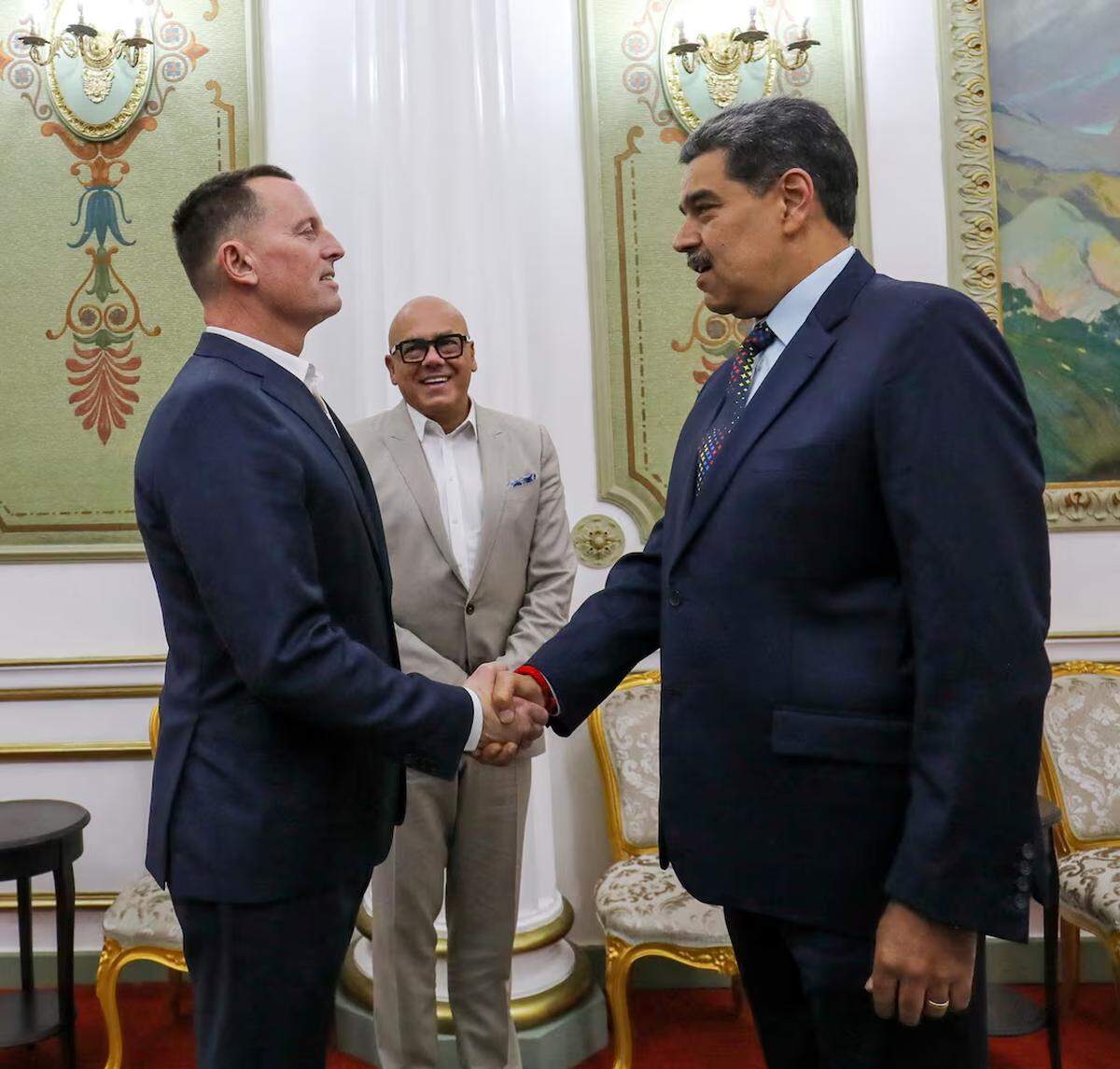
After his trip to Venezuela, Grenell was appointed interim executive director of the Kennedy Center, a move some foreign policy observers believed was a sign the White House was pulling him from discussing Venezuela in the media, at least for a while.
But Grenell delivered another surprise at the Conservative Political Action Conference on Saturday, telling the Epoch Times that “we’re very clear-eyed about the Venezuelan government and Maduro, but Donald Trump is somebody who doesn’t want to do regime change.”
Grenell said his presence in Venezuela had been a “gift” to Maduro, something he said he expressed to the Venezuelan leader himself, saying out loud something that had many foreign policy experts worried.
“He had a long list of asks and I said, ‘Look, we’re not here to give you anything,’” Grenell said. “I came here to Caracas. I’m now sitting in your palace. I’m sitting here, asking you to do things, and you have cameras all around. You’re going to use this moment; you’re going to tell people that I’m here. That alone is a gift; that alone is me showing you that we need to talk about a different relationship.”
When announcing a deportation agreement early this month, Trump said that Maduro had agreed to receive “all Venezuela illegal aliens who were encamped in the U.S., including gang members of Tren de Aragua” gang. But on Wednesday, he said the Maduro regime was not taking them back fast enough.
Grenell’s trip had put Rubio, who, as a senator had built a strong record of opposing Maduro and supporting the Venezuelan opposition, in a tough spot. Just a week before, one of Rubio’s first actions as secretary of state was to call opposition leaders María Corina Machado and Edmundo Gonzalez, the candidate believed to have won the presidential election last year, and treated Gonzalez as Venezuela’s rightful president.
The suspension of the Chevron oil license gives Rubio an early win.
In his interview with Fox, Rubio denied that by sending Grenell to Venezuela the Trump administration was legitimizing Maduro, a criticism heard among Venezuelan exiles in South Florida.
Fears that Trump would give up on efforts to dethrone Maduro, despite a federal $25 million bounty for tips leading to his arrest, had grown after the Department of Homeland Security canceled deportation protections for hundreds of thousands of Venezuelans and singled out Venezuelan migrants by sending close to 200 to a military prison in the U.S. Navy base in Guantanamo Bay, Cuba, before they were finally deported.
But while the fate of thousands of Venezuelans in the United States is still in limbo, it is clear that there has been a concerted effort to show the Trump administration is still committed to opposing Maduro.
On Wednesday afternoon, Trump’s son, Donald Trump Jr., announced a special guest on his podcast, Triggered:
“The undisputed leader of the opposition party in Venezuela, María Corina Machado.”
This story was originally published February 26, 2025 at 4:47 PM.