Venezuela’s top opposition leader downplays fears that Trump is siding with Maduro regime
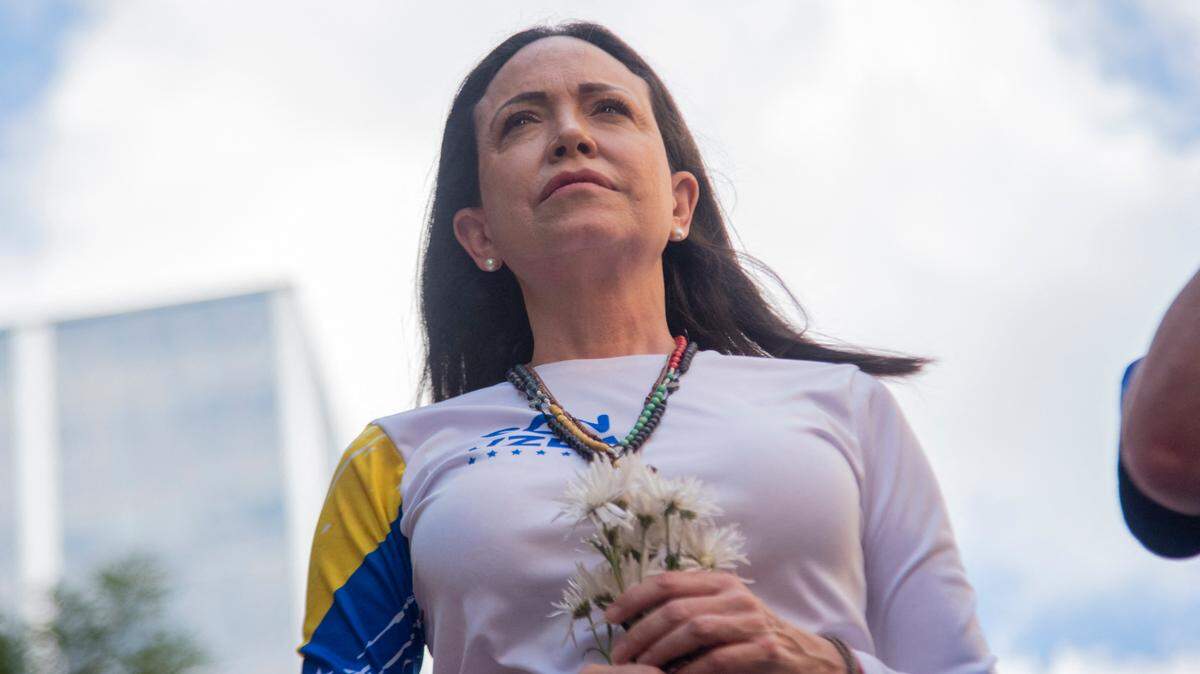
Venezuelan opposition leader Maria Corina Machado on Monday downplayed fears that President Donald Trump had reached an understanding of coexistence with strongman Nicolás Maduro following a deal reached last week in Caracas in which the socialist regime agreed to receive thousands of her countrymen deported from the United States.
In a video conference with reporters, Machado said she is concerned about the thousands of Venezuelans who will be at risk of being deported from the U.S. But she does not agree with the notion circulating in some opposition circles and among international observers that Trump’s decision to end their Temporary Protection Status signals that the president has decided he can live with Maduro in power just as long as he allows the deportation flights into Venezuela.
Trump’s decision to move against Venezuelan migrants present appears based on the concept that a large number of criminals are among them, sent by Maduro to disrupt American cities. Most experts, however, disagree and believe that the criminal presence among Venezuelan migrants is proportionally very small.
Machado is considered to be the top leader of the Venezuelan opposition and her support was crucial for the election bid of former diplomat Edmundo Gonzalez, whom Washington and a growing number of nations believe was the real winner of last July’s presidential election.
In her conversation with reporters, Machado said she has been in contact with top members of the Trump administration and that she is convinced that Trump is fully aware of the dangers that Madurl represents to the region.
“Is it possible that anyone could really believe that Trump does not know that Nicolás Maduro is the actual leader of the Tren de Aragua?” Machado said, referring to the Venezuelan criminal gang that has gone international. “To believe that the United States has any doubt about the threat to the safety of the hemisphere that this regime represents is really naive.”
Machado said she aware beforehand of the meeting that took place on Friday between Maduro and Trump’s special envoy, Richard Grenell, and that she spoke with the White House representative during his visit to Caracas.
“I was aware of this visit before it took place, I was informed, and I also spoke with the special envoy of the President of the United States during his visit. He also informed me of the result of it,” she said, adding that the new administration made no concessions to the Venezuelan leader. “President Donald Trump himself has been very clear that there is no negotiation here. Maduro can say whatever he wants for his own people.”
The Maduro regime released six American citizens imprisoned in Venezuela after the strongman met with Grenell on Friday. The following day, Trump announced that Maduro had agreed to take back undocumented Venezuelan immigrants deported from the United States, including Tren de Aragua members.
“Venezuela has agreed to receive, back into their Country, all Venezuela illegal aliens who were encamped in the U.S., including gang members of Tren de Aragua,” Trump wrote on the social media platform Truth Social on Saturday, adding that Caracas has agreed “to supply the transportation back.”
Machado said during the press conference that she is working to find “effective protection” for Venezuelans living in the United States, following the administration’s announcement that it will be revoking the temporary protection status for immigrants granted by the previous administration.
“It is a heartbreaking issue that greatly concerns us and on which we have been focused for many days,” she said. “Personally, in the last few hours, I have been talking with several representatives from South Florida and other states, because we are going to address this together.”
Hundreds of thousands of Venezuelans were left vulnerable to being deported by the decision when it expires in April. The ending of TPS is based on the concept that conditions have improved in the South American country to the point that its citizens no longer need to be safeguarded.
Experts, however, claim not only that there has been any improvement in the South American country, but that conditions are much worse today than they were when Venezuelans in the U.S. were first granted TPS.
This story was originally published February 3, 2025 at 3:36 PM.