
Trump administration ends deportation protections for hundreds of thousands of Venezuelans
The Trump administration has eliminated deportation protections for hundreds of thousands of Venezuelans in the United States, making them vulnerable to be sent back to the South American country in 60 days when the protection expires.
The development, confirmed to the Miami Herald by the Department of Homeland Security, comes days after department Secretary Kristi Noem announced last week that the administration would eliminate a Biden-era extension that allowed over half-a-million Venezuelans to maintain the protections through October 2026. Noem said she had revoked the measure because former Homeland Security Secretary Alejandro Mayorkas had improperly made the extension and that it was up to the Trump administration to make that decision.
It also comes days after President Donald Trump special envoy Richard Grenell met Venezuelan strongman Nicolas Maduro in Caracas, and Trump said that Venezuela had agreed to take back people deported from the U.S. The New York Times first reported Sunday the end of the Temporary Protected Status for Venezuela.
READ MORE: Trump’s special envoy met Maduro ahead of Rubio’s first trip to Latin America
The revocation of TPS is certain to have profound effects on Florida, which has the largest number of TPS beneficiaries out of any state with over 357,985 beneficiaries. Nearly 60% of them are Venezuelan. Some experts note that besides causing family separations if Venezuelans are deported back to their home country, the revocation could also lead to job loss and business disruptions.
The Biden administration first designated Venezuela for Temporary Protection in March 2021, a decision that was widely celebrated in South Florida. In October 2023, it created a new designation for Venezuela that protected people who had arrived after the 2021 TPS measure was in place.. In documents announcing the designation, the Biden administration said that Venezuela faced a “severe humanitarian crisis.
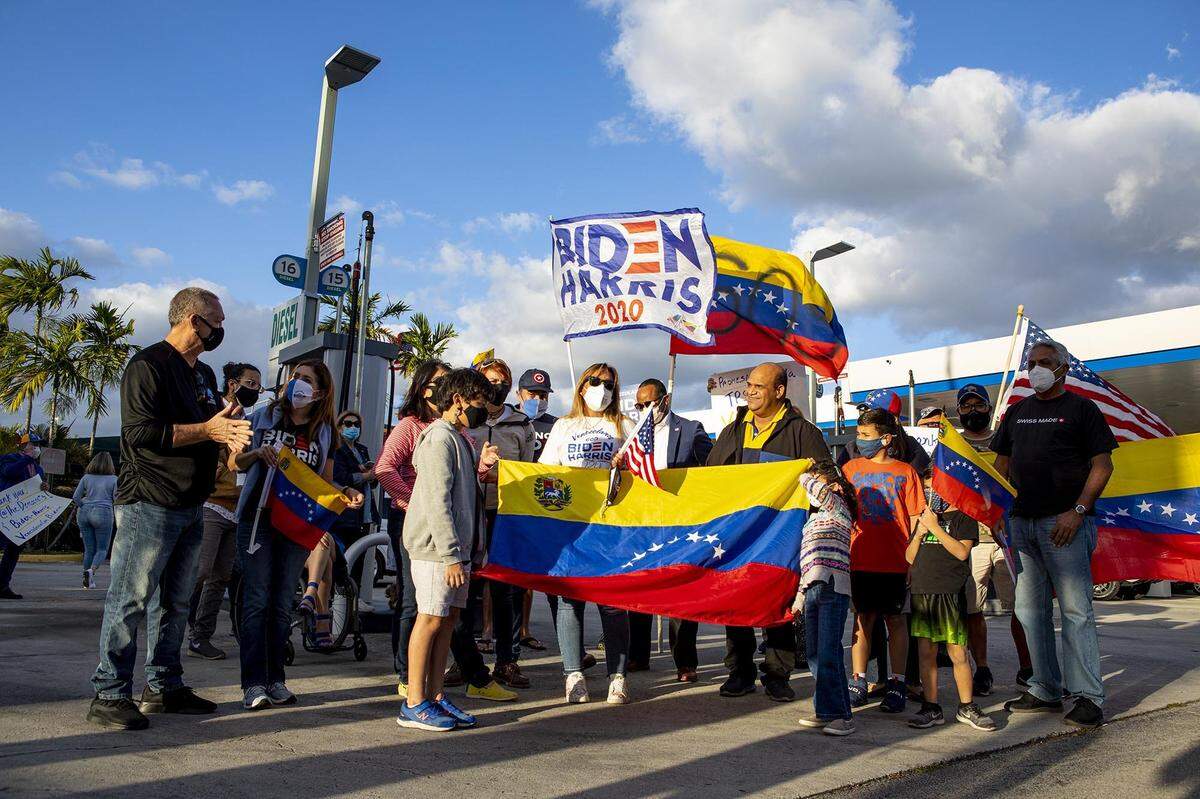
There were 505,400 Venezuelans protected by TPS under both designations as of December 2024, according to the Congressional Research Service. Venezuelans make up the largest group of migrants protected by TPS in the U.S
On Sunday, Noem eliminated the 2023 designation, which covers over 248,000 people, saying that Venezuela no longer meets conditions to have the designation. The move makes it likely that the Venezuelans under the 2021 designation, whose protections are set to expire in September, are also at risk of losing their TPS.
“After reviewing country conditions and considering whether permitting Venezuelan nationals covered by the 2023 designation is contrary to the national interest of the United States, in consultation with the appropriate U.S. government agencies, the secretary of homeland security has determined that Venezuela no longer continues to meet the conditions for the 2023 designation,” the notice reads, according to the New York Times.
More than 7.8 million Venezuelans have fled their country in recent years to escape what at one point was characterized as the worst humanitarian crises in the region. And now, following Maduro’s failure to recognize that he lost the presidential election in July, millions more are considering leaving the country, according to recent polls.
The country’s oil industry, which once made Venezuela one of the richest countries in the region, has been steadily gutted as experts fled, inexperienced leaders were appointed and production crashed, falling from more than three million barrels a day, when former President Hugo Chávez took office and launched his socialist revolution in 1999, to less than 700,000 barrels a day produced today.
In addition, the country suffers from severe fuel shortages. The country’s refineries have seen a dramatic fall, producing only a very small fraction of their 1.3 million barrels-per-day capacity.
While Venezuela still boasts of having the largest oil reserves on the planet, and the migration exodus means that there are significantly fewer mouths to feed, some five million Venezuelans are still going hungry in the country today.
According to the most recent report from the U.N. Food and Agriculture Organization, hunger afflicts 17.6% of Venezuela’s population, a rate that is among the highest in the region.
The revocation of the deportation protections for Venezuela caused indignation and fear in South Florida, the heart of the Venezuelan community in the United States.
Doral Council Member Rafael Pineyro, whose city is home to the largest Venezuelan population in the U.S. and who is himself from the South American country, said that by revoking TPS, “the administration is condemning these individuals to further uncertainty, fear, and potential harm.”
He added: “It is crucial for us to stand in solidarity with our Venezuelan neighbors and advocate for solutions that prioritize their safety and well-being.”
Nicole Reinoso, a newly elected councilwoman in Doral, said she was concerned about the imminent threat facing so many people in her community, saying the decision “disregards the ongoing humanitarian and political crisis in Venezuela, putting thousands of individuals at risk.” She added that the move to end TPS “fails to acknowledge the dangers many Venezuelans would face if forced to return.”
Maureen Porras, Doral’s vice mayor and an immigration attorney, said that ending TPS contradicts the very purpose of the program.
“Until the illegitimate Maduro regime is cast out and replaced by the duly elected president, Edmundo Gonzalez, Venezuelans will need our support,” she said. “My hope is that the U.S. will take swift action in making this happen.
Adelys Ferro, executive director of the Venezuelan American Caucus, said she was outraged at the relentless attacks on the Venezuelan community.
“We haven’t even had two weeks of Trump’s presidency, and already we’ve witnessed every kind of insult, xenophobia, racism, and lie directed at the Venezuelan people,” she said.
She condemned the timing of the decision, made just a day after what would have been an automatic six-month renewal of TPS, which will now expire in April.
“To make this decision right after that renewal is an even more cruel blow,” Ferro said. “The community is devastated — some Venezuelans have told us they’d rather take their own lives than face the horrors of returning to Venezuela.”
The revocation of TPS for Venezuelans is the latest executive decision taken by the Trump administration to overhaul the federal immigration system. Since taking office in mid-January, Trump has tried to limit birthright citizenship; declared a national emergency at the U.S.-Mexico border, and ended a Biden-era parole process that allowed over 500,000 Nicaraguans, Venezuelans, Haitians, and Cubans to live and work in the United States for two years as long as they had a financial sponsor and passed health and background checks. During his first term in office, Trump tried to end TPS for Haitians, Salvadoreans, Nicaraguans, and people from other countries, but was ultimately unsuccessful.
On Sunday, Noem doubled down on false generalizations that Venezuelan TPS holders are in large part criminals from the notorious gang known as Tren de Aragua, or TDA. No one with a felony conviction or two or more misdemeanors is eligible for TPS.
On Jan. 19, 2021, at the end of his first term, Trump issued a memorandum of Deferred Enforced Departure for Certain Venezuelans a day before the Biden administration took office, to delay for 18 months the deportation of any Venezuelan nationals present in the U.S. as of that date. Trump justified the move by saying that “the autocratic government of Nicolás Maduro has consistently violated the sovereign rights of the Venezuelan people. Through force and fraud, the Maduro regime has caused the worst humanitarian crisis in the Western Hemisphere in recent memory.”
On Sunday, Noem said TPS “has been abused and it doesn’t have integrity right now. Folks from Venezuela that have come into this country are members of TDA. Venezuela purposely emptied of their prisons, empty about their mental health facilities and sent them to the United States of America,” said told the NBC News show “Meet the Press” before the official elimination of the TPS became public. “So, we are ending that extension of that program, adding some integrity back into it.”
Miami GOP responds
Trump’s recent moves to end TPS for Venezuela highlight the difficult political position that federal lawmakers from South Florida are navigating as they support Trump while responding to constituents in their districts who will be affected by his policies. U.S. Reps. Maria Elvira Salazar, Carlos Giménez, and Mario Díaz-Balart have previously supported TPS for Venezuela and other countries. In recent days, they have urged the Trump administration to extend the protections for Venezuelans.
On Sunday, Giménez said on the Univision network show “Al Punto” said that the “great majority of Venezuelans here are good people who are working and yearning for liberty.”
“All Tren de Aragua members are Venezuelans. But not all Venezuelans are Tren de Aragua. That’s what the president and other members of Congress have to be convinced of because they have this image of what it is to be Venezuelan,” Giménez said. “Because if they return to their country they will be harmed.”
Díaz-Balart said on the same show he has always supported TPS for Venezuelans and that he is working with the administration to find alternatives to protect them.
“Unfortunately, until now we have not been able to achieve an alternative,” he said. ”But we have time.”
Miami Herald staff writer Michael Wilner contributed to this story.
This story was originally published February 2, 2025 at 2:09 PM.