Haiti’s first FIFA World Cup in over 50 years is inspiring films, music
Record producer and DJ Michael Brun is known for electrifying dance crowds with his blend of percussion-heavy Haitian rhythms and club music with his popular “BAYO” block parties.
But the Haiti-born artist who grew up in Port-au-Prince and has been following Haiti’s national soccer team to their games, is also a devoted futbol fan. And with Haiti’s historic return to soccer’s biggest stage at this year’s FIFA World Cup, Brun decided to lend his talents and uplifting roots anthem, “Gaya,” to celebrating the moment.
In a collaboration with the Haitian Football Federation, and in time for Haiti’s first match against Scotland on Saturday in Boston, Brun released a short film “Grenadye Alaso! 1974-2026” that he hopes not only captures the significance of the moment, but “highlights the Haitian spirit and the perseverance and the tenacity,” of a team many gave little chance of qualifying.
“With everything going on, I felt the energy…and really just wanted to tell the story of this team,” said Brun. “This is such an incredible moment for the country.”
The film opens with scenes from across Haiti: a nighttime view of the coastline, a colorful Tap Tap racing down a street, a coconut being spit open, a boat bobbing in the waters of northern Labadie and children playing soccer on a sandy beach.
Then, amid a montage of Haitian flags, laughter and children at play, a young boy wearing a white hat emblazoned with “Haiti” and a red jersey appears on the screen. The image is a tribute to Haiti’s last World Cup appearance in 1974, and a 3 1/2 -year-old boy who has since come to symbolize the moment. Filmed walking the pitch in West Germany with a soccer ball in his hand, he was dressed in red and wearing the white hat as he became the unofficial mascot of the teams historic run.
The image of the boy became a powerful message with newspapers writing about the Haitian team’s World Cup appearance, featuring a photograph of the boy, whose mom, Elfrun, is German, and father, Lionel, left Haiti for Germany on a student visa in the 1960s in his early 20s.
Now a 55-year-old adult, the boy, Miro Magloire, grew up to become an acclaimed choreographer and the founder and artistic director of New Chamber Ballet in New York.
“That 52-year parallel was really important, because that felt like another really, big peak in Haitian history, and now that we’re back here, that kid felt like the youth of that time, and now it’s like a whole new generation,” Brun said. “It was really important to integrate him, because he’s like the spirit of it, that next generation who is watching this happen.”
To convey that, the film combines the old footage of Magloire with another young boy, who Brun said is the nephew of Leo Volcy, the film’s director. The creative director for Academy Award-winning actor Michael B. Jordan, Volcy worked with Brun to bring the project to life.
“We wanted to find a way to connect,” the past and the present, Brun said, while also allowing the story of the team’s rise “to go as far as possible without having to be in the center of it, because it’s about the team, it’s about the country, it’s about the spirit.”
“What he put together was really beautiful,” he said of Volcy’s storytelling. “It allowed us to just have a moment where everybody can feel proud and be able to share it too.”
READ MORE: How ‘Open Haiti’ hashtag became rallying cry for soccer, diaspora
Karl-Philippe Alexis with the federation said when they were approached by Brun and Volcy about the project, they immediately saw its potential to preserve an important chapter in the country’s sporting history.
“Qualifying for the World Cup after 52 years is about much more than football. It is a story of resilience, perseverance and national pride,” he said. “We wanted to create something timeless that future generations could look back on and understand what this moment meant for our country. We were also inspired by the idea of bringing together Haitian excellence from different fields, sports, music and filmmaking to tell a uniquely Haitian story.”
The film also combines archival footage from Haiti’s Les Grenadiers’ 1974 matches with scenes from the current team’s training while they were camped in Port Saint Lucie, Florida.
Set against the backdrop of the team’s iconic chant, “Grenadye Alaso!” —Soldiers Charge! — it traces the squad’s journey.
“We came from everywhere, America, Europe, Haiti,” the narration says in Haitian-Creole with English subtitles.
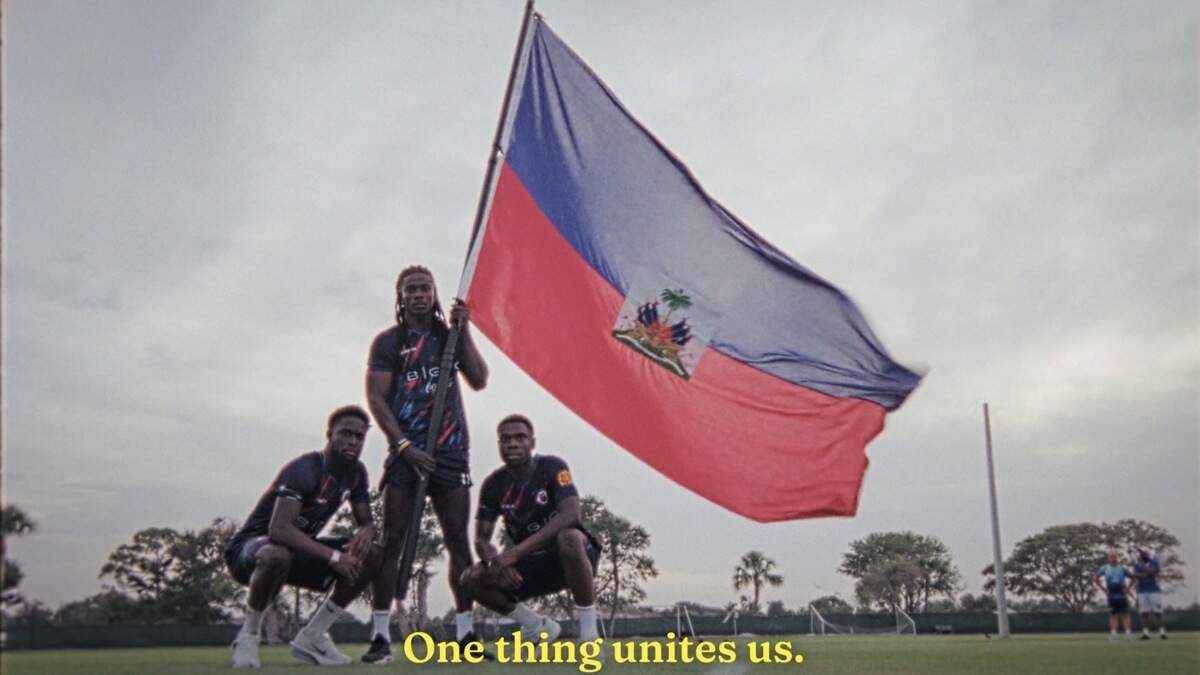
“One thing unites us.”
As a player holds up a Haitian flag and leans forward, the narration continues: “The same flag. The same roots. The same Haiti on our shoulders.”
“They gave us 5% chance. We took it.”
“They placed us last. But we are first.”
Alexis said the film aligns with the federation’s broader efforts in recent years to modernize and professionalize its image while showcasing the positive impact football can have on Haiti and its people.
“We hope the film reminds Haitians everywhere of what is possible when talent, determination, and a shared sense of purpose come together,” he said.
Musicians are also celebrating Haiti’s World Cup return
The project, which is being shared on social media platforms, is one of several creative works that have been inspired by Haiti’s return to the World Cup.
Haitian filmmaker Bruno Mourral, who is behind the dark comedies “Kidnapping Inc.” and “Kafou,” has been documenting the team’s journey for an upcoming documentary.
Musicians have also joined the celebration. Among the releases are “Haiti On The Go,” featuring Jamaica dancehall artist Buju Banton, Jerry Wonda, Top Alderman, Mickael Marabou, Colmix and Miami’s 103.5 The Beat DJ and lyricist Stichiz; “Let’s Go” by guitarist Kendell “Kandoudou” Etienne of the band DISIP; and Paul Beaubrun’s “Ayiti Nan Batay,” recorded with Grammy-nominated Boukman Eksperyans.
Brun, who is celebrating 10 years of his “BAYO” block parties, said while he could have also produced a song for the moment, he felt like his creative energy, and resources, along with Volcy’s, would be better served showcasing the team’s journey and sharing “that with as many people around the world as possible.”
“It’s 52 years since we last qualified,” Brun said, and unlike in ‘74, today’s Grenadiers have “come from all around the world, and despite all odds, they’ve not only come together to be a team, but then they also qualified. That to me was so powerful and so beautiful.“
“In highlighting them, we allow a whole new generation of future athletes, future generations of people of Haitian descent or Haitians in Haiti to know that this is something that’s possible, that Haitian excellence exists,” he said.
This story was originally published June 12, 2026 at 5:27 PM.