UN told new Gang Suppression Force in Haiti is taking shape as Qatar gives $30M
The State of Qatar on Thursday announced a $30 million pledge to the newly established Gang Suppression Force, bolstering efforts to help Haiti regain control from powerful armed groups.
The donation will go into a trust fund the United Nations has established for the recently authorized force, which now has received a total of $203 million, said Stéphane Dujarric, spokesman for United Nations Secretary General António Guterres.
Of the money pledged, including a donation this week from Greece, $174.1 million has been paid into the Trust Fund.
The significant contribution came as the Dominican Republic and other countries called upon the international community to redouble its contributions, both to the Gang Suppression Force and to the Trust Fund supporting its operations. Although the deployment is underway, a significant gap persists between the personnel currently deployed and the authorized ceiling—a gap that constitutes the primary operational challenge at this stage, the Dominican Republic’s representative, Amb. Wellington Bencosme, stressed Thursday during a U.N. Security Council meeting on Haiti.
The council, which authorized the U.S.-backed force in September, received an update on the force’s deployment as the international community’s support transitions from the Kenya-led Multinational Security mission to a broader coalition and more lethal and bigger force.
That new suppression force “is taking shape in a structured and deliberate manner,” the special representative overseeing the Gang Suppression Force, Jack Christofides, told the council.
“Pre-deployment and induction training are being prioritized to ensure that all incoming personnel are prepared to operate effectively in a complex and sensitive environment, and in full compliance with international standards,” he said.
Christofides declined to provide figures on troop deployment, which is expected to reach a strength of 5,500. But he said a deployment plan had been developed, focusing on priority areas and leveraging the specialized capabilities of contributing countries, with personnel now being readied.
In parallel, he said, civilian deployments are advancing and structures are being put in place to support intelligence-led mission planning, coordination and oversight. A finalized concept of operations now provides “a clear framework for how the mission will operate in practice, including integration with Haitian counterparts.”
“We remain acutely aware of the suffering endured by the Haitian people, particularly those living under gang control. There is an urgent need for concrete action to restore security and hope,” he said.
Christofides emphasized that the mission is not starting from scratch.
“But we are starting differently,” he said. “The GSF is being built as a disciplined, accountable and partnership-driven mission, designed to deliver targeted security results while upholding the highest standards of conduct and full respect for Haitian sovereignty.”
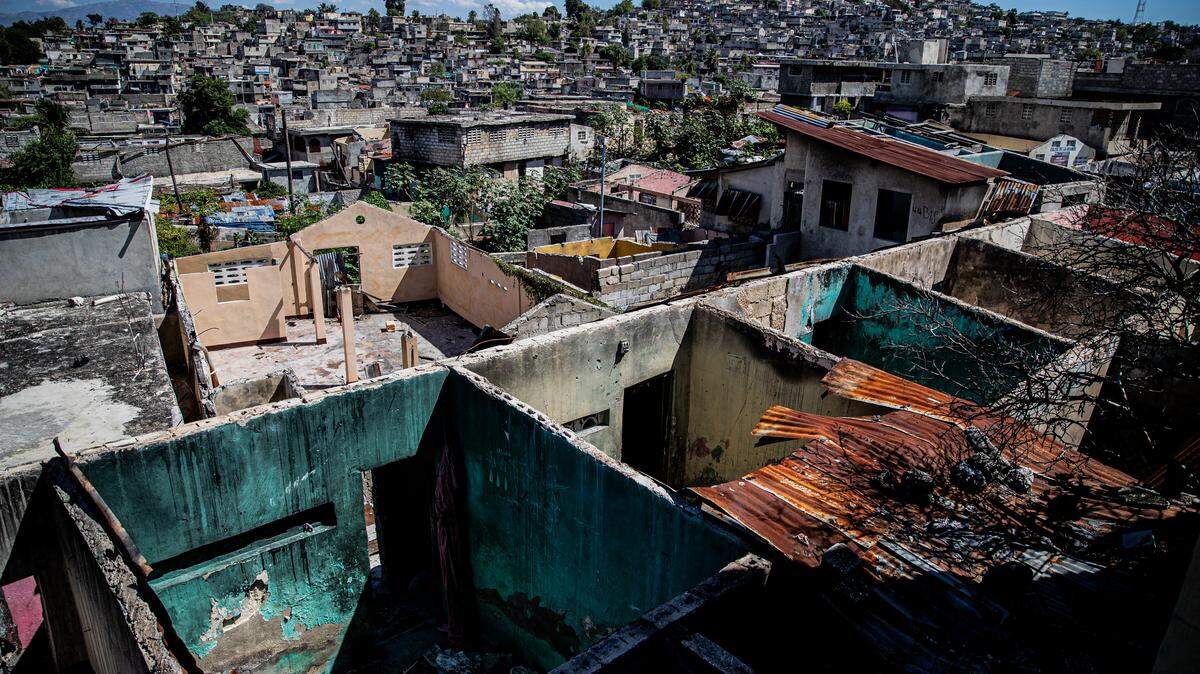
Thursday’s Security Council meeting, which was attended by Haitian Prime Minister Alix Didier Fils-Aimé, unfolded against a backdrop in which security forces have seen some security gains in downtown Port-au-Prince but as armed groups continue to expand and tighten their grip.
Security gains in parts of downtown Port-au-Prince, though difficult to sustain, demonstrate that change can be achieved. The recent holding of Council of Ministers meetings at the National Palace, after more than three years of limited State presence in the area, is not only symbolic. It is also a powerful signal of the State’s gradual return, according to Carlos G. Ruiz Massieu, the head of the U.N. Integrated Office in Port-au-Prince.
While this progress is real, Ruiz Massieu stressed that Haitians continue to live with the daily reality of insecurity and its tragic fallout.
“The recent massacre in Jean-Denis, in the Artibonite department, where dozens were killed on 28 and 29 March, and the attacks in Marigot, in the Southeast department, on 11 April, are tragic reminders that insecurity remains a daily reality for far too many Haitians,” he said. “This violence spreads fear, drives displacement, and continues to expand beyond Port-au-Prince as criminal gangs broaden their reach.”
At present nearly 1.5 million Haitians are internally displaced, mostly because of violence, and an estimated 6.4 million Haitians will require humanitarian assistance this year. “Behind these figures are communities under immense strain, where insecurity and humanitarian needs are increasingly intertwined,” Ruiz Massieu said. “Without tangible improvements on the security front, progress will be difficult to sustain.”
READ MORE: Kenya rejects rape allegations involving members of its forces in Haiti
Haiti recorded more than 9,000 homicides last year, the U.N. said in a report submitted from the secretary-general to the council ahead of Thursday’s meeting. The report noted that recent robust operations in gang strongholds in metropolitan Port‑au‑Prince and the surrounding area had resulted in some 1,343 suspected gang members being killed and 140 firearms seized.
They were among the 2,444 victims of intentional homicide, including 193 women, 20 girls and 34 boys, recorded by the U.N. between December 2025 and February. The reported noted that at least 158 people were killed in anti-gang operations.
“Gangs continued to commit human-rights abuses, notably in areas under their control, including the targeted killings of at least 36 people suspected of cooperating with the police, violence against residents resisting extortion, widespread sexual violence — particularly affecting girls and young women, including rape, sexual exploitation and sexual slavery — and child trafficking for recruitment and exploitation,” Guterres said.
The U.N. office also recorded at least 267 victims of abductions, including 44 women, 9 girls and 14 boys. Killings by self-defense groups continued, with at least 106 alleged gang members killed between December 2025 and February 2026.
“Gangs commit widespread abuses, including killings, maiming, and trafficking. The scale and brutality of sexual and gender-based violence, including rape, is particularly alarming, with women and girls subjected to widespread and often systematic abuse,” Ambassador Christina Markus Lassen of Denmark said. “We strongly condemn all violations against children, including the sharp increase in recruitment by gangs.”
Lassen said given the scale of Haiti’s challenges, urgent progress is still needed. The European nation “remains deeply concerned by the catastrophic humanitarian and human rights situations in Haiti.”
“We call on member states to scale up funding to Haiti’s Humanitarian Response Plan which remains desperately underfunded,” the country added.
Denmark, also joined by Panama, raised concerns about recent reports of four cases of sexual exploitation and abuse involving members of the department Kenyan mission, which the East African nation has rejected.
“We are deeply alarmed by reports of accusations of sexual exploitation and abuse made against personnel in the Multinational Security Support mission. All accusations must be thoroughly and objectively investigated, and accountability ensured,” Lassen said.
Kenya’s ambassador, Ekitela Lokaale, said that although the mission faced significant personnel, logistical and material constraints, it demonstrated unsurpassed professionalism. Kenya conducted itself “with the highest standards of conduct, transparency, and accountability, and remains prepared to cooperate fully with the Office of the High Commissioner for Human Rights and other relevant mechanisms, including consideration of any subsequently emerging, relevant, and credible information,” Lokaale said.
Though the mission is nearing completion and did not achieve its full 2,500 strength, Lokaale said “the progress achieved by a contingent of 999 personnel demonstrates that stability in Haiti is possible. Persuaded of this, Kenya has and remains a strong advocate for stronger international support for Haiti, that is clearly mandated, adequately resourced, and effectively coordinated.”
READ MORE: As gang violence surges, more Haitians are forced to flee their homes
A number of ambassadors noted the recent political progress in Haiti where hundreds of parties and groups signed a National Pact with Fils-Aimé. The governance agreement prioritizes security and the organization of credible elections. The Provisional Electoral Council, which is expected to issue a new electoral calendar and law, recently submitted a $240 million budget. The proposal remains under consideration by the prime minister, who has expressed reservations regarding its overall magnitude.
The pact also calls for strengthening operational capacities of the Haiti National Police and Armed Forces of Haiti, defining cooperation protocols with the Gang Suppression Force and the reactivation of the National Commission for Disarmament, Dismantlement and Reintegration.
Fils-Aimé, addressing the Security Council, assured the room that their observations had been duly taken into account. “The transitional government remains fully committed to leading Haiti out of this crisis,” he said.
His government has three priorities: restoring State authority, protecting the population, and paving the way for a return to constitutional order. “Our conviction is clear: without security, no development is possible,” he said.
But the urgency is absolute and “the deployment of the anti-gang enforcement force must proceed without delay, even as we simultaneously pursue medium-term measures,” he urged.
In the immediate term, the strengthening of the Haiti National Police is underway. Some 1,200 officers are already operational, and an additional 887 are preparing to graduate, with a target of 2,500 to 3,000 officers by the end of 2026. Also, 338 new soldiers joined the ranks of the Armed Forces of Haiti this week.
“To members of armed groups who persist in refusing to lay down their arms, I reiterate—with equal firmness and immediacy—that justice will be served, in full respect of human dignity and applicable laws.,” Fils-Aimé, said.
Christofides noted the high expectations for the Gang Suppression Force, which many view as a potential turning point. But he and others have stressed the measure of success needs to be a return to stability and security that has to allow Haitians to hold elections, which hasn’t taken place since 2016, and to reestablish state authority.
The objective is to degrade the operational capacity of gangs to a level that Haitian institutions can sustainably manage, creating the time and space for the state to reassert its authority.
“This is a focused and time-bound effort to support Haiti in addressing urgent security challenges. It will require sustained international support, disciplined implementation, and realistic expectations,” said Christofides. “The GSF is designed not as an end in itself, but as a means to enable Haitian institutions to regain control and to create the conditions for longer-term stability.”
This story was originally published April 23, 2026 at 1:33 PM.