UN Security Council approves new ‘Gang Suppression Force’ for Haiti
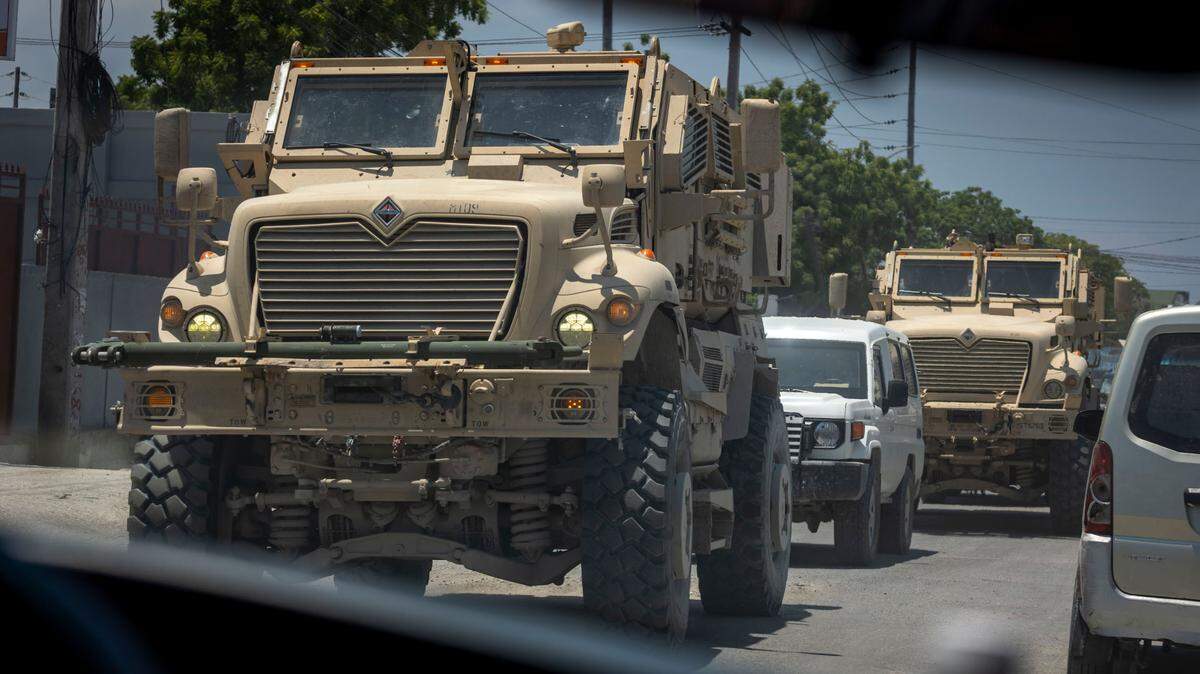
The United Nations Security Council agreed on Tuesday to transition the Kenya-led Multinational Security Support mission in Haiti into a much more lethal and beefed up force, supported by both a newly created U.N. Support Office and the Organization of American States.
The newly authorized Gang Suppression Force was unanimously approved for a period of 12 months, with 12 member countries voting in favor and three abstaining.
The representatives of Russia and China, which hold veto power, and Pakistan said they recognize the dire situation in Haiti and the plight of its 12 million residents. But during their interventions, they criticized the resolution’s “ambiguity on several critical issues” and what they termed as the United States’ failure to provide answers to questions.
Underscoring the concerns, even among those who voted in favor of the measure, country after country expressed hope that with the larger and more robust footprint, they hope other partners will join in Haiti’s fight against armed gangs by deploying personnel and donating to a U.N. Trust Fund to pay their stipends.
“The council’s decision today marks a true turning point. By granting the mission strength and a more offensive, more operational mandate, the Council is giving the international community the means to respond to the gravity of the situation in Haiti,” Haiti’s representative Ericq Pierre said, expressing his government’s gratitude to Washington, Panama and the Caribbean community for their mobilization.
“This force to suppress armed gangs will have the primary objective of neutralizing these terrorist organizations, disarming their militias, dismantling their networks, securing the country’s vital infrastructure and creating the conditions for the effective return of state authority across the entire territory,” he said.
He reminded the room that the fight against Haiti’s armed groups, is not just a national issue but a matter of international security, touching on regional dynamics of arms trafficking, drug trafficking and irregular migration.
Mike Waltz, the United States’ new ambassador to the U.N., said the dramatic expansion of gang violence “has jeopardized the very existence of the Haitian state, with gang activity threatening to turn the country into an exporter of crime, violence and drugs, and to unleash a migration crisis across the region.
“The adoption of this resolution offers Haiti hope,” he said. “It is a hope that has been rapidly slipping away as terrorist gangs expanded their territory, raped, pillaged, murdered and terrorized the Haitian population.“
For months, Washington has been saying the U.S. — which has spent over $1 billion on the Kenyan mission since it was first approved by the Security Council in 2023 — could no longer shoulder the significant burden of Haiti’s security response. But its funding decisions regarding the U.N. had many questioning its commitment to Haiti, as well as its support for the new force, after finally endorsing it in August — six months after it was first proposed by U.N. Secretary-General António Guterres.
But Tuesday’s vote marked a major victory for the Trump administration. The U.S. has come under fire at the U.N. for its clawback of billions of dollars in aid that had been previously authorized by Congress to U.N. agencies — including for the very peacekeeping fund that is supposed to partly fund the newly created U.N. Support Office intended to help provide logistics and operational backing for the gang suppression force, alongside the OAS.
“Today’s vote is a recognition that, due to the lack of true burden sharing, the international community, had failed to deliver a mission that was fit for purpose,” Waltz said. “It lacked the scale, scope and resources needed to take the fight to the gangs and restore a baseline of security in Haiti ... today’s vote sets that right.”
Still, both China and Russia took issue with the U.S., accusing it of failing to live up to funding commitments. They blamed the funding shortfall and the U.S.’s failure to control the flow of illegal arms into Haiti, most of which come from South Florida, for the MSS’s failings.
China’s Permanent Representative Fu Cong said Beijing and Moscow had proposed a temporary rollover of the Kenyan mission, whose 12-month mandate expires on Thursday, to allow for more time for discussions and consensus building. But the U.S. insisted “on putting this highly contentious draft resolution to a vote.”
“This draft resolution risks exacerbating Haiti’s already complex and dire situation. Haiti’s multiple crises are intertwined, and the security situation merely reflects what meets the eye,” Fu said. “Resorting to military force to combat violence with violence at this juncture is not only unlikely to succeed, but could further complicate Haiti’s already intractable situation.”
The Russian Federation, raising similar concerns, said they have “even less trust” toward the initiative given Washington’s buildup of U.S. military assets in the Caribbean off the coast of Venezuela.
“We have no certainty that the authors of today’s text will not come up with some kind of, ‘creative way’ to link their military activity to allegedly combating drug cartels there,” Permanent Representative Vassily Nebenzia said. “We are convinced that the recipe for responsible international assistance to Haiti lies in addressing the root causes of the crisis, including the long history of harmful external interference in the country’s affairs.”
How China and Russia would vote was the biggest uncertainty going into Tuesday’s meeting. Ahead of the vote, the representatives of more than four dozen countries gathered at a media stakeout to show support for both the Gang Suppression Force, GSF, and the U.N. Support Office.
“The unity and collaboration demonstrated by member states, including the Standing Group of Partners for Haiti and the United Nations, underscore our shared objective: Put an end to the violence and suffering so that Haiti may restore security, rebuild strong institutions and lay the foundations for sustainable development,” Panama’s representative to the U.N. Eloy Alfaro de Alba read in English and Spanish.
READ MORE: Haiti healthcare system braces for bad news as money dries up, cholera cases rise
Last week during an address to the U.N. General Assembly, the head of Haiti’s Transitional Presidential Council, Laurent Saint-Cyr, pleaded with the international community for help against the merciless violence, which has taken over entire neighborhoods and already led to more than 3,000 deaths this year.
“Today, the international community must stand alongside Haiti and take large scale measures, not half steps; a strong coordinated and immediate action is needed,” Saint-Cyr said as he highlighted the devastating impact of the violence, including the displacement of over 1.3 million people and the collapse of the healthcare system.
Haiti has not held elections since 2016, and last had an elected president in 2021 when its head of state, Jovenel Moïse, was assassinated in July 2021 inside his bedroom. The Haitian state, Saint-Cyr said, wants elections but restoring security remains its greatest challenge.
“This will create the conditions required for free and fair elections that are vital to security, long term stability and the rights and freedoms of its people,“ United Kingdom Ambassador James Kariuki said after the vote.
Kenyan mission’s failure to stop gangs
The future role of Kenya in the new force remains unclear, and the resolution doesn’t say who has committed to deploying military and police troops, or how much the new GSF will cost.
U.S. officials have argued that a new, scaled-up and more lethal effort is needed in Haiti where despite the valiant efforts of the Kenyans and others, gangs have continued to tighten their grip on Port-au-Prince while quickly expanding north.
One change that not everyone was happy about is that the new suppression mission will be allowed to work independently of the Haitian police, something the MSS’ mandate did not allow. This restriction hampered the MSS’ ability to reduce gangs’ territorial control as gunmen coordinated and simultaneously launched attacks in different corners of the country.
Among the changes that were pushed for ahead of Tuesday’s vote was stronger language to ensure children and women are safe. Child recruitment by armed gangs surged by 70% last year, while rapes are on the rise. Denmark insisted on safeguards for women and children and for Haiti to do more to address the root causes of instability and carry out reforms in its governance system.
“The GSF must take full account child protection as a cross-cutting issue throughout its mandate,“ Amb. Christina Markus Lassen said. “Children must be seen as victims, be able to access safe access strategies and given the opportunity for rehabilitation and reintegration. The GSF must act with the highest standards of conduct and discipline, with a robust oversight mechanism to ensure it operates in transparency and in line with international human rights law.“
What’s in resolution authorizing ‘Gang Suppression Force’
Like the MSS, the new force will still have a force commander in charge. But now, it will be overseen by a group of countries representing the coalition of the willing, troop contributing countries. How often will they meet, how will they settle differences, are among the glaring issues with the proposal, experts on peacekeeping missions have said, noting that the GSF will have soldiers and police who’ve never trained or work together before being asked to fight gangs.
Also, the new force will be reporting up through a special representative, a civilian who will provide oversight and political direction.
According to the resolution, the GSF, will have a ceiling of 5,550 individuals; 5,500 uniformed personnel, comprised of both military and police personnel, and 50 civilians. It will still rely on voluntary contributions to fund its personnel, however, its operations and logistics, including the current U.S.-constructed base in Port-au-Prince, will be overseen by the new U.N. Support Office.
In the resolution, the U.N. is asked to provide technical support to the OAS, which is also tasked with providing assistance to both the GSF and Haiti National Police in the form of provisions of food and water, fuel, transport, tents, defense stores and appropriate communication equipment. The resolution also makes specific reference to the Haitian armed forces, a sign of the increasingly important role they must play in the fight.
The newly named special representative will also be responsible for coordinating with the U.N., and the OAS on the deployment of such a package to ensure it strengthens joint operations between the GSF and the Haitian police, including through the construction of operational facilities and security infrastructure supporting joint planning and oversight of operations by both forces.
. Guterres first proposed in February that the Kenya-led mission be transitioned into a more-scaled up force with a robust mandate in lieu of deploying traditional U.N. blue helmet peacekeepers. He also recommended that members’ dues to the U.N. peacekeeping budget be used to finance a U.N. Support Office to provide logistical and operational support.
“A realistic option is based on a dual-track strategy, with the United Nations assuming new roles to enable the MSS, the national police and Haitian authorities, to substantially reduce gang territorial control through peace enforcement,” Guterres said at the time.
Pakistan Ambassador Asim Iftikhar Ahmad said his nation was hoping for more of a consensus going into Tuesday’s vote given the funding predicaments and operational issues that have dogged the MSS. While they believe the next force should be much larger than the proposed 5,500, Pakistan also worries that the U.S. has “proposed a set of complex mandates to be carried out in a difficult and complicated environment through an equally complicated arrangement.”
He noted that the MSS never reached its 2,500 authorized strength due to funding, which impacted its effectiveness.
“The resolution’s authorization for the use of U.N. peacekeeping funds for logistics and operational support does address this concern to some extent, but cannot be considered a silver bullet,” he said, referencing the body’s ongoing financial crisis. “As we have repeatedly heard, including from the Secretary General for the liquidity crunch in the peacekeeping budgetary allocations.”
This story was originally published September 30, 2025 at 3:06 PM.