‘The hour is grave’: Haiti’s presidential council has a new leader
The political party of former President Jean-Bertrand Aristide, once the most powerful force in Haiti, returned to the country’s leadership Monday after its representative on the transitional ruling council assumed its top job.
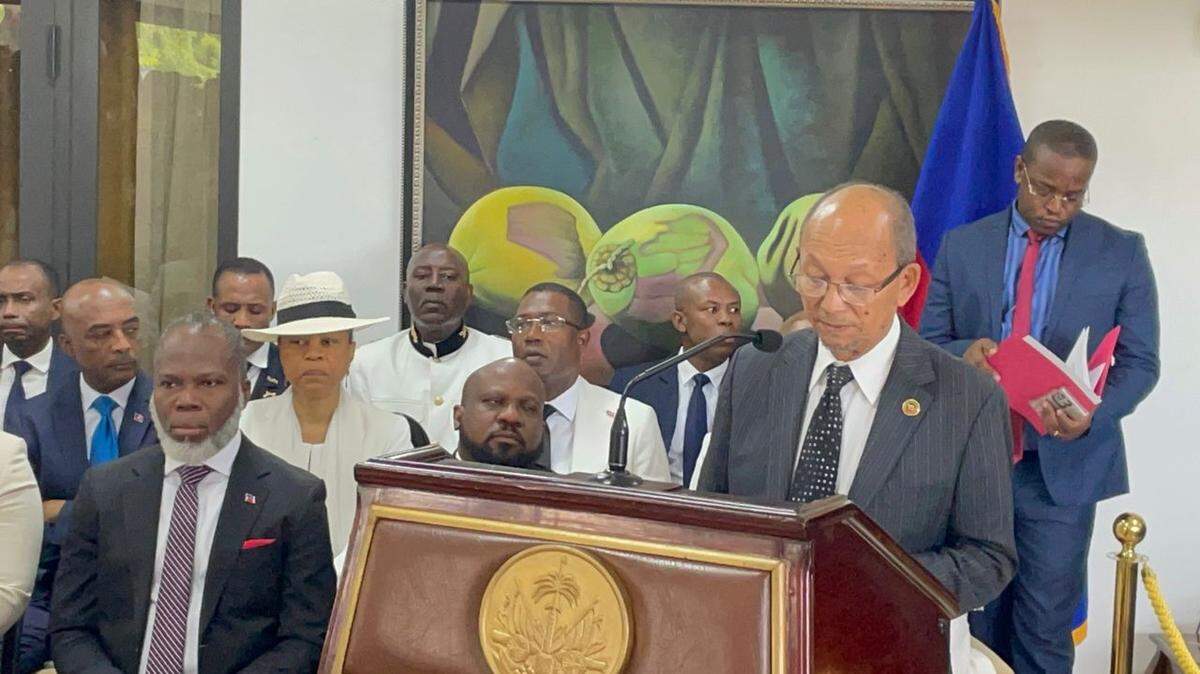
Leslie Voltaire, a former cabinet minister and an urban planner educated in the U.S. and Mexico, was installed as president of the U.S.-backed Transitional Presidential Council in a brief ceremony in Port-au-Prince in the presence of members of the government, the diplomatic corps and all but one council member.
Voltaire’s new role, at least symbolically, puts Aristide’s Fanmi Lavalas political party back in power two decades after the former priest-turned-president was forced into exile amid a bloody coup. It remains to be seen if Voltaire, a former minister of Haitians Living Abroad who has been at odds lately with Prime Minister Garry Conille and his foreign minister, can establish himself as a unifying force capable of guiding Haiti through its humanitarian and security crises.
“The hour is grave,” Voltaire said, citing the “immense responsibility” of leading the nine-member presidential panel that has been embroiled in scandal and controversy almost since inception earlier this year.
In March, Haitian political parties and civil-society organizations agreed to a political transition after the U.S. dropped support for Prime Minister Ariel Henry. But the presidential council, made up of unlikely political bedfellows, has had a rocky start since it was established with the support of members of the international community, including the U.S., Canada and the 15-member Caribbean Community regional bloc, CARICOM.
Voltaire’s tenure will last until March of 2025, after which the presidency is supposed to transfer to another member of the council. Though other representatives of Aristide’s Fanmi Lavalas political party have been involved in Haiti’s government since Aristide was booted from power in 2004, this is the first time the party is actively taking a leadership role.
Monday’s ceremony wasn’t without controversy or noticeable absences. Edgard Leblanc Fils, the former senator and representative of the Collective of January 30th Political Parties, boycotted the ceremony, citing bribery allegations involving three members of the council who have refused to resign and were present Monday.
Hours ahead of the delayed Monday ceremony, the Collective of January 30 issued a statement saying it cannot support the power-sharing deal and was recalling Leblanc. The group cited the fact that among those supporting the transfer of power are three council members accused of corruption in a bank bribery scandal.
In an address to the nation, Leblanc accused his fellow council members of risking the credibility of the transition by supporting a resolution last Friday that removes two of the three accused members from the leadership helm of the presidential transition, but seemingly keeps them on the council for the moment.
“I cannot accept to participate in any process that will further weaken and devalue the country’s justice [system] and at the same time send a bad signal to the population,” Leblanc said. “The path taken by the great majority of the council is not good. It risks throwing us into instability, worsening the situation of the country and extending the transition period. It’s a pity.”
Leblanc did not announce his resignation in his address and it’s unclear if he will heed the request of the bloc that named him to the transition. Increasingly, the parties represented on the council have been losing control of their representatives.
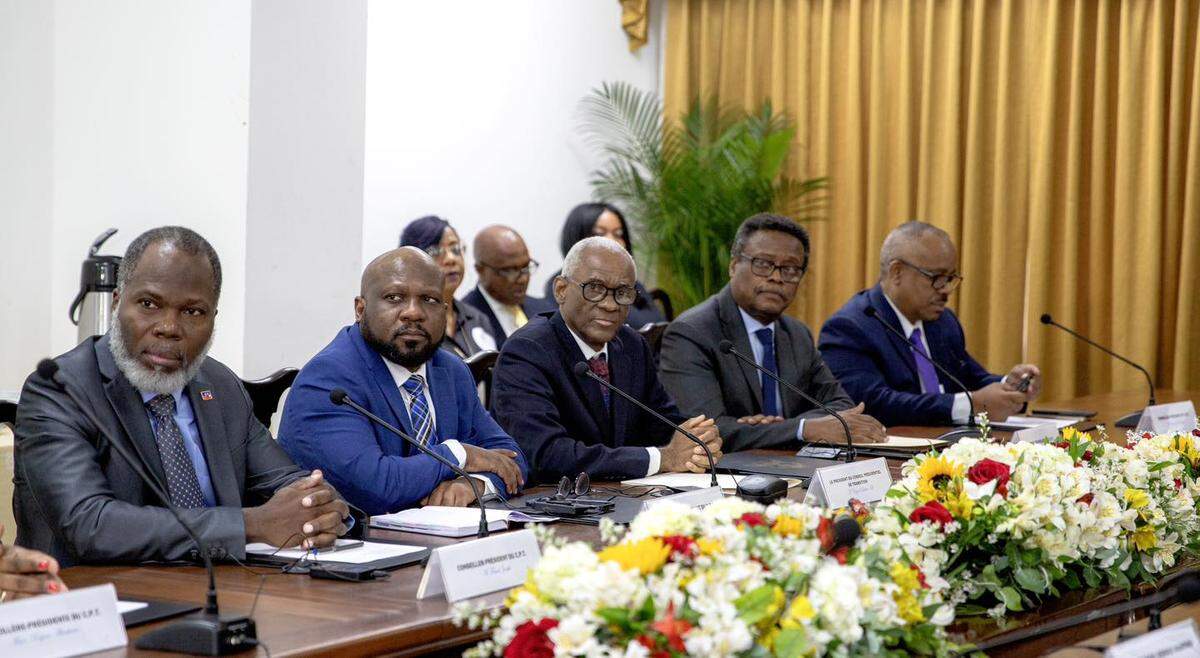
On Monday, the resolution establishing the change in the rotating presidency was published in the country’s official gazette, Le Moniteur, with every one of the presidential advisers’ signature, except for Leblanc. Leblanc had been trying to remain as head of the council.
Smith Augustin, a former ambassador to the Dominican Republic, was next in line to replace Leblanc. However, Augustin is among the three council members accused of corruption. A report issued last week by the country’s Anti-Corruption Unit said its investigation into allegations that three council members tried to shake down the head of a state-owned commercial bank for more than $750,000 found evidence of abuse of office, bribery and corruption by the three men. The agency has asked for criminal charges to be pursued.
The accused council members — Augustin, Louis Gérald Gilles and Emmanuel Vertilaire — were all at Monday’s ceremony. They have maintained their innocence and refused to step down despite requests from political parties and an effort by CARICOM to have them resign and replaced. Diplomatic sources say the way the council was set up doesn’t provide any avenue for the members to be replaced other than through their resignation.
Diplomats also note that the political infighting, power play and corruption allegations are threatening to tear the council apart and come at a delicate moment. The United Nations has said more than 700,000 Haitians have been displaced by gang violence and thousands have died. Meanwhile, 5.4 million Haitians now find themselves struggling with hunger.
Critics, including political parties involved in the transition, say the corruption scandal is tarnishing the credibility of the ruling body, tasked with restoring law and order, and risks endangering the transition, which is supposed to come to an end with the swearing-in of a newly elected president on February 7, 2026.
Voltaire’s rise to the leadership helm was the result of deal between him and other council members. He will be followed in the job by Fritz Alphonse Jean, an economist and former head of Haiti’s Central Bank. Laurent St. Cyr, a businessman who represents the private sector on the council, will take the spot of Gilles.
During the ceremony Monday, Voltaire he painted an optimistic view of the transition and announced that the formation of a nine-member Provisional Electoral Council to organize the elections is nearly complete. He steered clear of the corruption allegations that continuesto raise questions about the transitional government.
The Collective’s objections over the Friday resolution mirror that of the Montana Accord, a group of civil society organizations and parties represented by Jean on the council.
In its note, the Collective of January 30 Political Parties said it “vigorously protests against this desperate attempt to rehabilitate” the accused council members and calls for them to step aside while the allegations are dealt with by the courts.
The bloc said it plans to enter into talks with other signatories of an April 3 accord that officially established the transition council “to determine a stable, responsible governance forum that can guarantee the success of the transition process…and its duration.”
Aristide, who doesn’t go out in public, was not present Monday, nor was Conille. Conille has tried to stay out of the fray but got into a heated argument last week with Gilles, who accused him of being behind the corruption investigation. On Saturday, Conille left Haiti with Foreign Minister Dominique Dupuy on a trip to the United Arab Emirates and Kenya.
Conille’s travels came just days after an armed gang slaughtered more than 70 Haitians in the lower Artibonite region in the town of Pont-Sondé. While the attack has raised questions about the effectiveness of the Kenya-led Multinational Security Support mission, Conille said the purpose of his trip was to discuss with Kenyan President William Ruto the arrival of the next contingent of police officers as part of the deployment. Ruto, who visited Port-au-Prince last month, said he plans to deploy 300 cops this month and another 300 in November.
Ahead of Monday’s ceremony, the International Organization of La Francophonie announced it has appointed Domitien Ndayizeye, the president of Burundi from 2003 to 2005, as special envoy to monitor the situation in Haiti.
This story was originally published October 7, 2024 at 1:27 PM.