Report accuses three members of Haiti’s presidential panel of corruption, abuse of office
Anti-corruption investigators in Haiti are asking for the justice system to pursue criminal charges against three members of the country’s newly-formed ruling presidential body and a former bank director who accused the men of shaking him down for more than $750,000 in bribes to keep his job at a state-owned commercial bank.
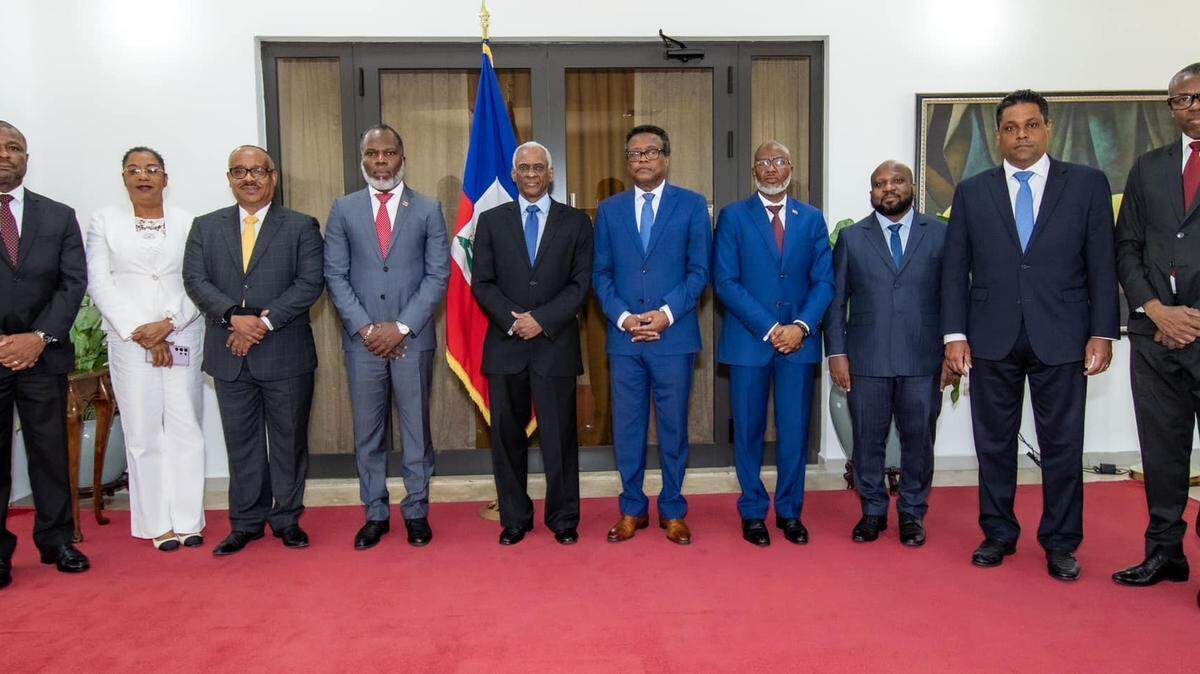
Haiti’s Anti-Corruption Unit is also accusing Transitional Presidential Council Smith Augustin, Louis Gérald Gilles and Emmanuel Vertilaire — and accuser Raoul Pascal Pierre-Louis— of abusing their functions as senior representatives of the Haitian State and engaging in some form of corruption.
The long-awaited report, released to the public on Wednesday, says that the members of the presidential panel and an associate, who was present when a secret meeting was held with Pierre-Louis at a Petionville hotel in May over his future with the bank, had each received pre-approved credit cards outside of the law and the bank’s norms.
The cards, each with a generous limit of $20,000, were given to each of the three council members while a collaborator, Lonick Leandre, received a card with a $12,500 limit, the report said. Though all used under the limit, investigators accused each of being irresponsible in their management of the card.
For example, they note that the holders of the card had either failed to make payments or paid late, and at one point BNC blocked Smith’s card.
The investigative unit implies that the cards were given by Pierre-Louis in lieu of the bribe in order to keep his job, which constitutes bribery and corruption.
“Issuance of these credit cards was directly and personally decided by Mr. Raoul Pascal Pierre Louis as part of the discussions initiated for his renewal at the head of the board of directors of the BNC outside of all regularities and administrative requirements,” the report said. “In this way, Mr. Raoul Pascal Pierre Louis …abuses his function and is guilty of paying…and active corruption.”
By accepting Pierre-Louis’ offer, the investigative unit said, Augustin, Vertilaire and Gilles “have abused their function and are guilty of paying bribes and corruption.”
Both Pierre-Louis and his lawyer, Sonet Saint-Louis, discredited the report and said it failed to look at the larger allegation, which is that the council members demanded 100 million gourdes, or the equivalent of $758,000, from Pierre-Louis to retain his post as director of the National Bank of Credit, BNC. Soon after the accusations leaked, Pierre Louis was fired by Prime Minister Garry Conille, who defended the decision in an Herald interview saying that the banker’s term had expired and the bank was the subject of a takeover by the Central Bank.
“The message being sent here from the government is very discouraging because everyone who denounces corruption in the public administration now knows they will be fired and they will be delivered to the corruptors and after that they will not denounce anyone,” Saint-Louis said.
Pierre-Louis, he said, is the victim and yet he’s being treated as the perpetrator of a crime.
“All of the rules of the National Bank of Credit were respected; the council members made the request and signed their applications for their credit cards,” Saint-Louis said about the credit card accusations. “Raoul Pierre-Louis did not participate in traffic in influence or corruption.”
It will all is now up to a prosecutor to decide whether the report should be forwarded to an investigative judge for further investigation. But politically, some are stepping up calls for the accused to step down.
Their continued presence on the council, which is supposed to helping return stability to Haiti through the organization of presidential and legislative elections next year, endangers the credibility of the process, said attorney Samuel Madistin. A former presidential candidate and well-known criminal lawyer, Madistin believes the accused council members should not be allowed to be replaced by the sectors that sent them.
“Morally, they cannot stay on the council,” he said. “If they are charged with organizing the elections, they will sell the elections too. The political forces cannot trust them to be at the helm of the [Transitional Presidential Council] while the government is organizing elections. The credibility of the elections will be at stake if these guys do not resign.”
So far, all three have resisted calls to resign while vehemently denying accusations of wrongdoing.
The scandal, which has laid bare the weaknesses of the U.S. backed political transition and the widespread corruption in the country, first surfaced in late July and has overshadowed the political transition. Two of the accused, Augustin and Gilles, are among four members of the council who are supposed to lead the panel through a rotating presidency.
Augustin is supposed to take the helm on Monday from current President Edgard Leblanc Fils, who is trying to remain, while Gilles’ rotation is supposed to coincide with the country’s forthcoming elections next fall.
READ MORE: Haiti’s armed gangs are also trafficking drugs. Why is the DEA closing its office there?
In a letter to Conille that was subsequently leaked, Pierre-Louis accused Augustin, Gilles and Vertilaire of asking him for 100 million gourdes, approximately $758,000, to retain his post. Soon after, the Anti-Corruption Unit announced it had opened an investigation and the 15-member Caribbean Community engaged with Haiti’s political parties in hopes of fending off a deeper political crisis.
By most accounts, the report is weak. It points out that there are some elements of wrongdoing that warrant further investigation by a judge, however, it stops short of saying outright if the bribery scheme actually occurred. Instead, it details circumstantial evidence that hints at wrongdoing, such as a text exchange from Gilles admonishing Pierre-Louis from filing a complaint.
The report’s most damning findings perhaps isn’t even the four pre-approved credit cards that investigators said Pierre-Louis issued to the council members — but rather the supposed monthly salaries of each of the nine council members.
According to the amount shared with investigators by Augustin during his appearance, it’s more than $40,000 a month once the salary and other privileges are added. Several sources have told the Miami Herald that the actual amount is far more than what was listed because members of the council are also receiving money from an intelligence budget assigned to the presidential palace, that has also been a target of accusations.
The Transitional Presidential Council “is a scandal,” Madistin said. “In a country that has all of these problems, all of this misery; you have a bunch of police officers on strike because they are not getting paid for their risks, teachers who can’t get paid, people in the health sector who are on strike because they can’t get paid, the amount of money and privileges they are giving the members is a scandal.”
The salary isn’t the only hit to the council’s image. Haitians are increasingly losing patience with the presidential panel, which has been at logger heads with Conille’s cabinet as they try to exert control over the country’s foreign policy and other areas.
Pierre-Louis and his lawyer have taken issue with the report, describing it as “false” and “fanciful” while pointing out mistakes and what they describe as unproven claims. Saint-Louis also said that the law on bribery isn’t being correctly interpreted since the burden of proof isn’t on his client, but on those accused.
Pierre-Louis had been invited to confront the council members but through Saint-Louis refused. The lawyer said the banker was forced to leave Haiti for his safety and despite asking to be accommodated so he could speak with investigators, he was not.
Pierre-Louis is open, Saint-Louis said on Wednesday, to cooperate with an investigative judge as long as measures are taken to secure his safety.
This story was originally published October 2, 2024 at 9:39 PM.